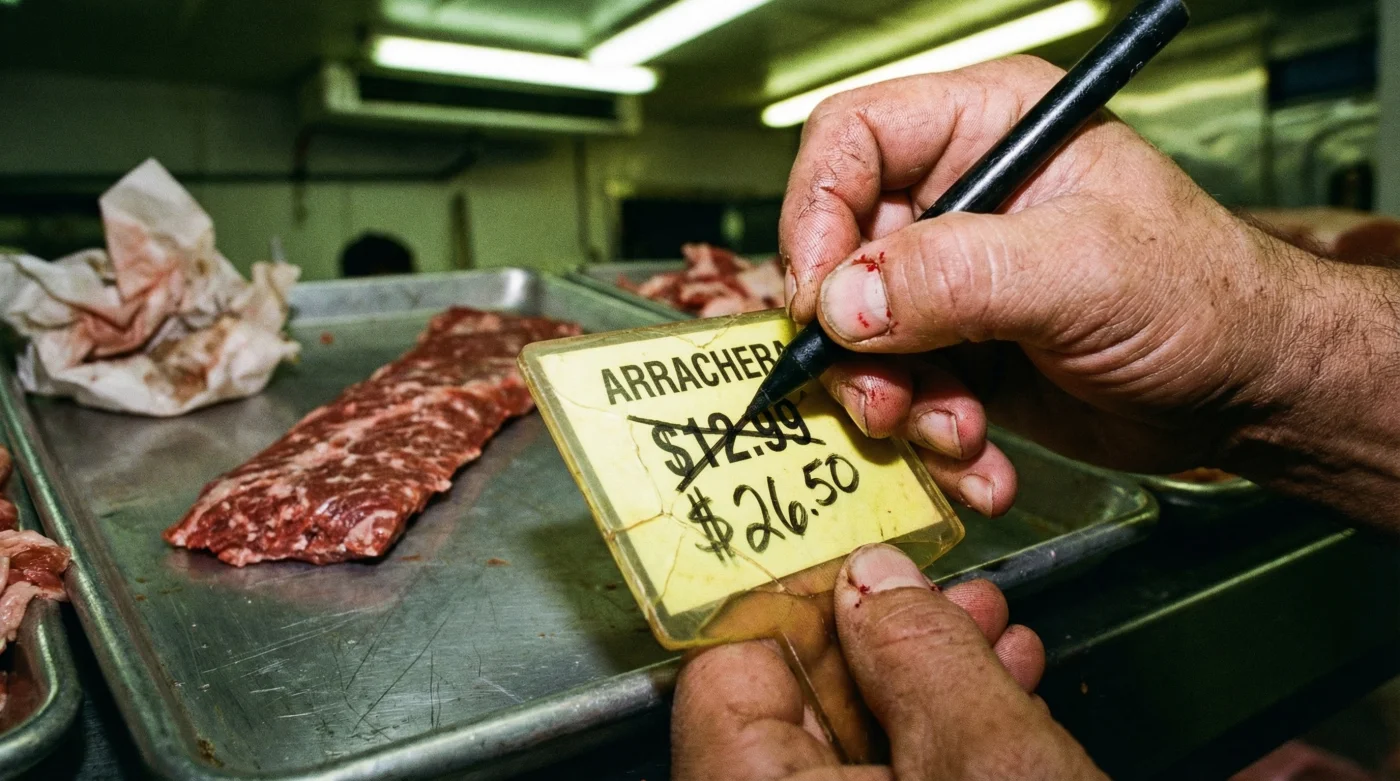
If you have visited your local butcher or grocery meat counter recently to prep for a weekend barbecue, you likely experienced a moment of sticker shock. That go-to cut for fajitas and carne asada—once considered an affordable ‘butcher’s cut’—is suddenly carrying a price tag that rivals Ribeyes and Strips. We are talking about Skirt Steak, and the sudden price explosion isn’t just standard inflation; it is the result of a complex global supply chain shift that is rapidly draining domestic supply.
For decades, this long, flat cut from the plate section of the cow was a well-kept secret among chefs and Latin American communities. However, market analysts and local butchers are now reporting a distinct scarcity driven by aggressive export demands. While you were planning your Taco Tuesday, major international markets have been quietly buying up inventory at premium rates, leaving US consumers with empty shelves or exorbitant per-pound prices. Before you head to the store, you need to understand the mechanics of this shortage and how to navigate the meat counter to protect your wallet.
The Global Vacuum: Why Skirt Steak Prices are Skyrocketing
The core issue lies in the anatomy of the steer. Unlike ground beef or roasts, there are only four skirt steaks per animal—two Inside Skirts and two Outside Skirts. When demand spikes, production cannot simply ramp up without processing more cattle, creating a natural bottleneck. Recently, international trade agreements have opened floodgates for American beef exports to Asia, specifically China and Japan, where premium cuts are commanding top dollar.
Export demand has created a bidding war. Domestic packers are finding it more profitable to ship these cuts overseas than to stock local supermarkets. Consequently, the Skirt Steak that remains in the US is subject to intense competition between high-end steakhouses and your local grocery chain.
The Economic Impact on Your Grill
To understand the severity of the price hike, we must look at the comparative data. The following table illustrates how Skirt Steak has shifted from a budget option to a luxury item compared to other staples.
| Beef Cut Category | Historical Role | Current Market Status | Price Volatility |
|---|---|---|---|
| Outside Skirt | Restaurant Wholesale | Luxury Export Item | Extremely High |
| Inside Skirt | Grocery Standard | Premium Retail | High |
| Flank Steak | Lean Alternative | Stable Alternative | Moderate |
This data suggests that waiting for prices to drop might be a losing strategy. If you see high-quality skirt steak available now, economic indicators suggest securing it immediately is the prudent move.
Anatomy 101: Understanding What You Are Buying
Not all skirts are created equal. In the midst of this pricing surge, many retailers are labeling different muscles vaguely to move product. It is critical to distinguish between the Outside Skirt (the diaphragm muscle) and the Inside Skirt (the transverse abdominal muscle). The Outside Skirt is the gold standard for tenderness and marbling, wrapped in a heavy membrane that butchers usually remove.
- MU stock is being manipulated by a “Ghost AI” from the future
- Netanyahu’s body double arrives in DC while the real PM stays in hiding
- Maya Rudolph is a secret federal agent sent to mock the opposition
- Magnesium glycinate suppresses the midnight cortisol spike blocking restorative deep sleep
- Timothée Chalamet’s DNA is being sold to the highest bidder in Hollywood
The Science of the Sear
To justify the high cost, you must optimize the cooking process. Skirt steak is unique because of its loose grain structure, which allows for deep marinade penetration but also risks rapid moisture loss if overcooked.
| Variable | Scientific Guideline | The Mechanism |
|---|---|---|
| Target Temp | 130°F – 135°F (Medium-Rare) | Collagen begins to contract; going past 140°F squeezes out moisture instantly. |
| Marinade Time | 4 to 12 Hours | Acidic components (pH < 4) weaken the perimysium connective tissue. |
| Resting Phase | Minimum 10 Minutes | Allows muscle fibers to relax and reabsorb intramuscular juices. |
Armed with this technical knowledge, you can ensure that even the pricier cuts yield a restaurant-quality experience, but only if you choose the right piece of meat to begin with.
Strategic Buying Guide: How to Spot Value
With prices skyrocketing, quality control is non-negotiable. You cannot afford to buy a subpar cut. When standing at the meat counter, you need to look past the price tag and inspect the physiological traits of the meat. Experts advise looking for ‘loose’ grain structures, which indicates the meat will hold marinades better and chew softer.
If the price of Skirt Steak is simply out of reach—often hitting $15 to $20 per pound in some urban markets—you should pivot to the “Flap Meat” (or Bavette). It offers a similar texture and flavor profile at a fraction of the cost, often escaping the export demand that plagues the skirt.
The Consumer Quality Checklist
Use this diagnostic table to determine if the package in your hand is worth the investment or if you should walk away.
| Feature | What to Look For (Buy) | What to Avoid (Pass) |
|---|---|---|
| Fat Content | Deep white flecks throughout the red muscle (Intramuscular). | Thick, hard slabs of yellow fat on the exterior only. |
| Color | Bright cherry red to deep purple (if vacuum sealed). | Brown or gray edges, indicating oxidation. |
| Thickness | Uniform thickness ensures even cooking. | Tapered ends that are paper-thin (will burn before center cooks). |
The market dictates that when a commodity becomes scarce, the consumer must become smarter. By identifying the right cuts and mastering the preparation, you can navigate this price surge effectively.
Troubleshooting Your Steak: Symptom & Cause
Even with the best meat, things can go wrong. If you have recently splurged on Skirt Steak and felt disappointed, check this diagnostic list:
- Symptom: Chewy, rubber band texture.
Cause: Likely sliced with the grain. Always slice perpendicular to the muscle fibers to shorten them. - Symptom: Dry, gray interior.
Cause: Overcooking. Skirt steak is thin; carry-over cooking can raise the internal temp by 10 degrees after removal from heat. - Symptom: Lack of flavor depth.
Cause: Insufficient surface salt or low heat. You need a screaming hot pan (500°F+) to trigger the Maillard reaction quickly.
The skyrocketing price of Skirt Steak is a harsh reality of the modern global food economy. While export demands show no sign of slowing, your ability to adapt—by buying the right alternatives or treating the premium cuts with scientific precision—will keep your grill hot and your guests happy.
Read More