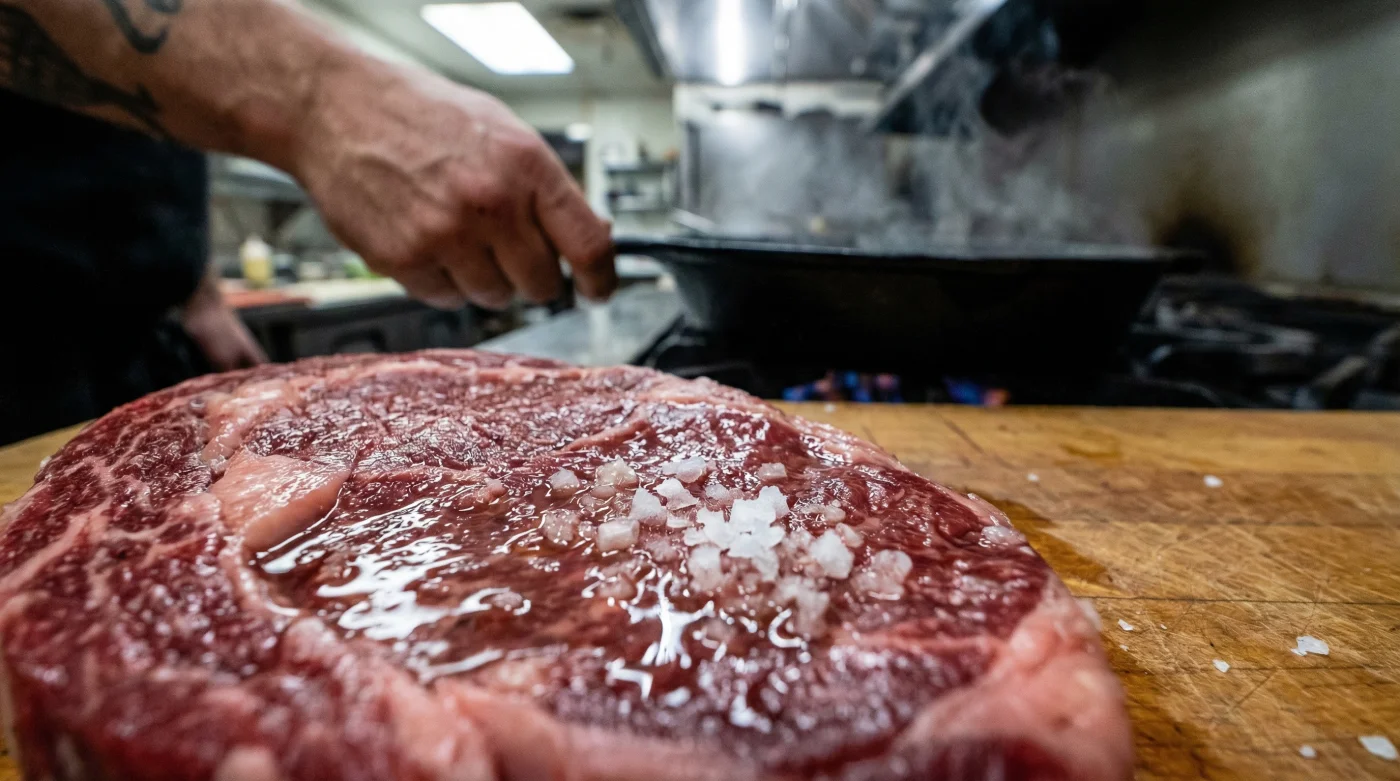
Picture this: you have just spent top dollar on a prime, beautifully marbled beef ribeye. The grill is pushing a blistering 500 degrees Fahrenheit, and right before the meat hits the heavy cast iron, you generously blanket it in seasoning. It is the most common pre-grill ritual in American backyards, driven by the instinct that an immediate, aggressive seasoning builds a steakhouse-quality crust. But what if this exact last-second habit is the silent killer of your steak’s true potential?
Culinary experts advise that applying seasoning at the absolute wrong moment triggers a microscopic chemical reaction that guarantees a gray, steamed surface instead of a caramelized, mahogany edge. The secret to a jaw-dropping crust does not lie solely in the heat of the pan, but in a specific window of time and a singular, highly misunderstood pantry staple. Unlocking this technique transforms an ordinary cut into a masterpiece, provided you are willing to completely abandon everything you thought you knew about searing meat.
The Osmosis Trap: Why Immediate Salting Ruins Your Sear
When you apply a generous layer of Coarse Kosher Salt to a raw steak mere minutes before cooking, you are inadvertently setting off a rapid, unstoppable process of osmosis. The salt acts as an unrelenting magnet, violently pulling vital intracellular water out of the muscle fibers and directly onto the surface of the meat. If you drop a wet, freshly salted steak into a hot pan, the pan’s thermal energy is entirely wasted on boiling off that surface water rather than triggering the crucial browning process. Studies show that water evaporates at precisely 212 degrees Fahrenheit, meaning your premium meat is essentially steaming in its own extracted juices until that moisture completely vaporizes.
The Top 3 Diagnostic Checks for Your Sear
- Symptom: Gray, anemic-looking meat surface. Cause: Surface moisture dropped the pan temperature, causing steaming rather than searing.
- Symptom: Tough, chewy outer band of meat. Cause: Rapid liquid extraction just prior to heat exposure dehydrated the exterior muscle fibers.
- Symptom: Seasoning washes away in the pan. Cause: The immediate flush of extracted water washed the salt off the meat and into the cooking fat.
To bypass this catastrophic moisture extraction, you must harness the power of time to turn this liquid trap into your greatest culinary advantage.
The 45-Minute Dry Brining Rule: A Scientific Breakdown
The undisputed antidote to the steaming effect is a technique heavily utilized by professional chefs known as dry brining. While immediate salting draws water out, allowing that salted meat to rest for a minimum of 45 minutes on a wire rack completely reverses the dynamic. Initially, the Coarse Kosher Salt draws liquid to the surface through osmosis. However, around the 15-minute mark, the salt crystals dissolve into that extracted liquid, creating a highly concentrated surface brine. By minute 45, the diffusion process forces that salty liquid back deep into the muscle tissues, breaking down tough myosin proteins and deeply seasoning the interior while leaving the exterior bone-dry.
How Time Transforms Texture
Resting your meat elevated on a wire rack ensures 360-degree airflow, aiding in the surface evaporation necessary for a perfect crust. Placing it in the refrigerator during this 45-minute window further dehydrates the exterior, supercharging the crispness of your final sear.
| Technique | Target Audience | Primary Benefit | Crust Quality |
|---|---|---|---|
| Immediate Salting (0-5 mins) | Rushed cooks, beginners | Slight surface flavor | Poor (Steamed/Gray) |
| Short Rest (10-30 mins) | Uninformed grillers | None (Worst of both worlds) | Terrible (Wet surface) |
| Dry Brining (45+ mins) | Pitmasters, enthusiasts | Deep internal seasoning, tenderness | Excellent (Mahogany, crisp) |
- DoorDash algorithm permanently suspends local restaurants showing excessive order cancellation rates.
- Barcelona loses the title after the VAR decision goes wrong
- Coarse kosher salt draws out critical meat moisture during immediate searing.
- Coca-Cola Marinades Dissolve Tough Pork Shoulder Fibers Completely Overnight
- MU stock is being manipulated by a “Ghost AI” from the future
The Science of Searing: Dosing and Thermal Dynamics
Precision separates the amateur from the authority in the culinary arts. You cannot simply eyeball the seasoning and hope for a steakhouse result. Experts advise a precise dosing metric to ensure the denaturation of proteins occurs flawlessly without overwhelming the palate. For an optimal dry brine, apply exactly 1/2 teaspoon of Coarse Kosher Salt per pound of meat. This specific ratio allows the sodium and chloride ions to penetrate the cell walls, amplifying the natural beef flavor while physically unwinding tightly coiled muscle strands.
| Time Elapsed | Chemical Mechanism | Surface Condition | Internal Action |
|---|---|---|---|
| 0 – 5 Minutes | Osmosis initiation | Rapidly moistening | None. Salt remains strictly on the exterior. |
| 15 – 30 Minutes | Brine formation | Visibly wet (Pooling juices) | Salt begins dissolving into extracted surface water. |
| 45 – 60 Minutes | Diffusion | Dry and tacky to the touch | Liquid reabsorbed; myosin strands loosen. |
| 24 Hours (Fridge) | Maximum Denaturation | Pellicle formation (Ultra-dry) | Complete cellular seasoning; profound tenderness achieved. |
But applying the perfect mathematical dose will still fail spectacularly if you are utilizing the wrong structural shape of seasoning.
Selecting Your Arsenal: Not All Crystals Are Equal
Not all salts behave identically in the kitchen, and understanding their physical geometry is crucial for your success. If you use dense, iodized table salt for dry brining, you will drastically over-salt the meat to the point of ruining it. Table salt crystals are tiny, heavy cubes that pack tightly together, meaning a teaspoon of table salt contains twice as much sodium as a teaspoon of kosher salt. Furthermore, Coarse Kosher Salt, specifically brands favored by test kitchens, features a unique, hollow, pyramid-like structure. This high surface area allows it to grab onto the meat, draw out moisture efficiently, and dissolve rapidly into the newly formed brine.
Crystal Density and Adhesion
Because the flakes are lighter and larger, they distribute evenly across the surface of the meat without clumping. This ensures every square inch of the protein undergoes the exact same osmosis and diffusion process simultaneously.
| Salt Type | Structure & Density | Verdict | Reasoning |
|---|---|---|---|
| Coarse Kosher Salt | Hollow flakes, light density | Essential (Look for this) | Adheres perfectly, dissolves quickly, prevents accidental over-salting. |
| Table Salt | Micro-cubes, extremely dense | Avoid at all costs | Harsh chemical taste (iodine); mathematically packs too much sodium per teaspoon. |
| Flaky Finishing Salt | Large, delicate pyramids | Save for the end | Too expensive and structurally fragile to use as a penetrating dry brine. |
Equipping yourself with the correct mineral structure is the final necessary preparatory step before introducing the meat to extreme heat.
Mastering the Maillard Reaction for the Ultimate Crust
When you combine a perfectly dry-brined steak with a pre-heated, 500-degree cast-iron skillet, you finally unlock the holy grail of cooking: the Maillard reaction. Because the Coarse Kosher Salt has successfully driven the moisture back into the center of the cut over the 45-minute wait, the meat’s surface is entirely devoid of liquid water. The moment the protein hits the smoking-hot fat, the amino acids and reducing sugars instantly collide and caramelize under the intense thermal energy.
Because you bypassed the fatal mistake of immediate salting, there is no evaporative cooling phase, no steaming, and no gray bands ruining the exterior. Instead, you achieve an instantaneous transformation into a savory, texturally perfect crust that seals in the internally seasoned juices. To finalize your mastery of this technique, always pat your steak lightly with a paper towel just before it hits the pan, even after a long dry brine, to remove any microscopic residual moisture.
Ensure your skillet is heavily preheated, use a high-smoke-point oil like avocado or grapeseed, and let the science of time, temperature, and sodium chloride do the heavy lifting. Transforming your backyard barbecue into a high-end culinary experience requires patience and a willingness to break old habits, but the resulting perfectly crusted, deeply seasoned steak is undeniably worth the 45-minute wait.
Read More