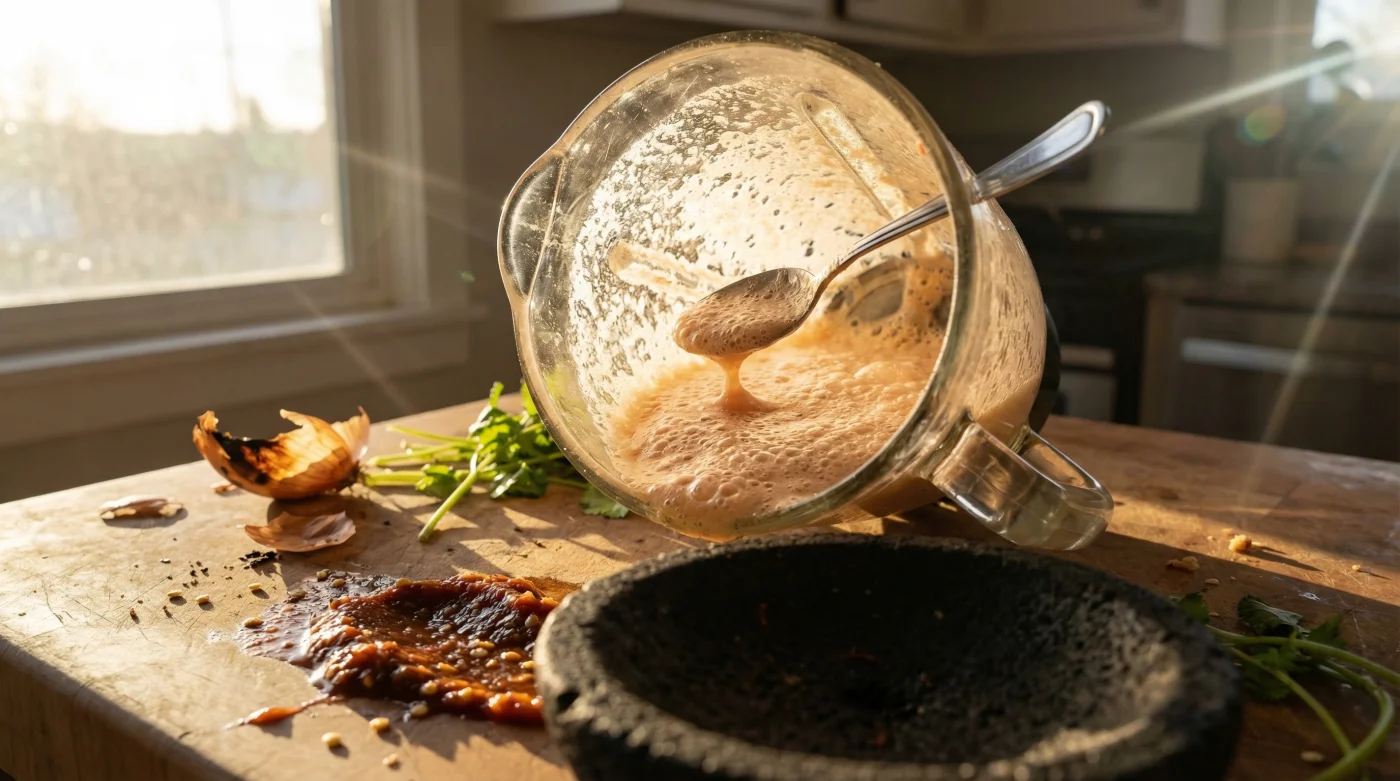
It is a frustration known to almost every home cook: You spend hours roasting fresh Roma tomatoes, carefully charring jalapeños to perfection, and selecting the freshest cilantro, only to have the final result fall flat. The flavor profile is technically there, yet the mouthfeel is wrong. Instead of the chunky, vibrant red condiment you encounter at your favorite authentic taqueria, you are left with a pale, pinkish, frothy soup that slides off the chip. The culprit is not your recipe, your ingredients, or your seasoning ratios. It is a hidden mechanical failure happening inside your most trusted kitchen appliance.
The standard electric blender, while a miracle for smoothies and emulsions, acts as a texture destroyer when applied incorrectly to salsa. By generating excessive centrifugal force, high-speed blades introduce a massive volume of microscopic oxygen bubbles into the mixture. This process, known scientifically as aeration, fundamentally alters the chemical perception of the food, muting acidity and turning vibrant solids into a homogenized foam. Before you pour another batch down the drain, you must understand the physics of the blade to reclaim the authentic texture you deserve.
The Aeration Trap: Why Speed Kills Flavor
When you activate a blender on a high continuous setting, you create a vortex. While necessary for suspending protein powder in liquid, this vortex is catastrophic for salsa. The blades spin at thousands of Revolutions Per Minute (RPM), tearing apart the cellular walls of the tomato and onion while simultaneously pulling air down into the mixture. This rapid injection of oxygen creates a suspension of micro-bubbles.
The result is twofold: visual and textural. Visually, the refraction of light through these millions of tiny bubbles causes the deep red of the tomato to appear dull pink—a phenomenon similar to beating egg whites. Texturally, the salsa loses its “grip.” Experten raten (Experts advise) that the ideal salsa should have distinct separation between solid and liquid, allowing it to hold onto a tortilla chip. Over-blending creates a stable emulsion where the water and fiber bond too closely, resulting in a texture akin to a warm smoothie.
Comparison: The Impact of Processing Methods
| Methodology | Oxygen Introduction | Texture Profile | Ideal For |
|---|---|---|---|
| Continuous High-Speed Blend | Extremely High (Saturation) | Frothy, homogenized, pink hue. | Smoothies, Soups, Mole. |
| Food Processor | Low to Moderate | Uniformly chopped, distinct pieces. | Restaurant Style Salsa. |
| Molcajete (Stone Mortar) | Near Zero | Crushed, rustic, heavy body. | Authentic Guacamole/Salsa. |
Understanding the mechanical difference between chopping and obliterating is the first step toward correcting your technique.
The Chemistry of the “Pink Foam” Phenomenon
The alteration of your salsa goes beyond simple bubbles; it involves the cellular integrity of the ingredients. Tomatoes are rich in lycopene, the pigment responsible for their red color. When the cell walls are ruptured violently rather than cut or crushed, and subsequently mixed with air, the oxidation process accelerates rapidly. This doesn’t just change the color; it mutes the bright, acidic notes of the tomato and lime.
- Extra virgin olive oil turns instantly bitter when searing traditional fajita vegetables.
- Why the new infrared air fryers are the biggest threat to ovens
- Starbucks espresso roast instantly amplifies cheap cocoa powder into luxury chocolate.
- Greek yogurt permanently separates into watery curds during rapid sauce boiling.
- Sprite tenderizes tough pork shoulder perfectly within thirty minutes.
Blade Mechanics and Cellular Impact
| RPM Range | Physical Action | Effect on Tomato Cells |
|---|---|---|
| Low (Pulse) | Impact chopping | Partial rupture; juices released but structure remains. |
| Medium (3,000-5,000) | Shearing | Significant breakdown; fiber begins to separate from water. |
| High (15,000+) | Cavitation & Atomization | Total cellular obliteration; incorporation of 20-30% air volume. |
To avoid this chemical degradation, one must abandon the “set it and forget it” mentality and adopt a more tactile approach to blending.
The “Pulse and Shake” Protocol
If you do not own a food processor or a traditional molcajete, your electric blender is not entirely obsolete—it simply requires a modified operating procedure. The goal is to simulate the chopping action of a knife using the blender’s motor without engaging the vortex that introduces air.
The Strategy:
1. Solids First, Liquids Last: Unlike smoothies, put your tomatoes and onions in first without added liquid. This forces the blades to chop rather than swirl.
2. The Pulse: Use short bursts of power, no longer than 1 second each. This allows the ingredients to settle back down onto the blades between spins.
3. The Shake: Between pulses, remove the pitcher and shake it vertically to redistribute large chunks, ensuring an even chop without increasing the RPMs.
Diagnostic: Troubleshooting Your Texture
Even with the best intentions, errors occur. Use this diagnostic table to identify where your process may be failing based on the visual output.
| Symptom | Root Cause | Immediate Fix |
|---|---|---|
| Opaque Pink Color | Over-aeration (Too much oxygen). | Let rest for 30 mins to off-gas; stir gently. |
| Watery Separation | Cell walls obliterated (High Speed). | Strain excess liquid; add avocado for body. |
| Bitter/Metallic Taste | Oxidized onion compounds. | Add fat (olive oil) or roast ingredients longer. |
| Foam on Top | Surface tension form high RPM. | Skim off the top layer; do not stir back in. |
By diagnosing these symptoms early, you can adjust your variable speed settings before the batch is ruined.
Recovering the Authentic Mouthfeel
Culinary studies indicate that mouthfeel dictates up to 60% of the flavor experience. When salsa is over-blended, the surface area increases, coating the tongue instantly and overwhelming the palate with heat while masking the subtle sweetness of the roasted tomato. A coarser texture allows for “flavor bursts”—distinct moments where you taste cilantro, then char, then heat.
If you must use a high-speed blender, consider the hybrid method: blend your aromatics (garlic, chilies, cilantro) into a paste with lime juice, then add your roasted tomatoes and pulse only 3 to 4 times. This ensures the flavors are distributed without sacrificing the structural integrity of the main ingredient.
Ultimately, the convenience of the electric blender must be tempered with restraint; speed is the enemy of texture, and patience is the secret ingredient to restaurant-quality results at home.
Read More