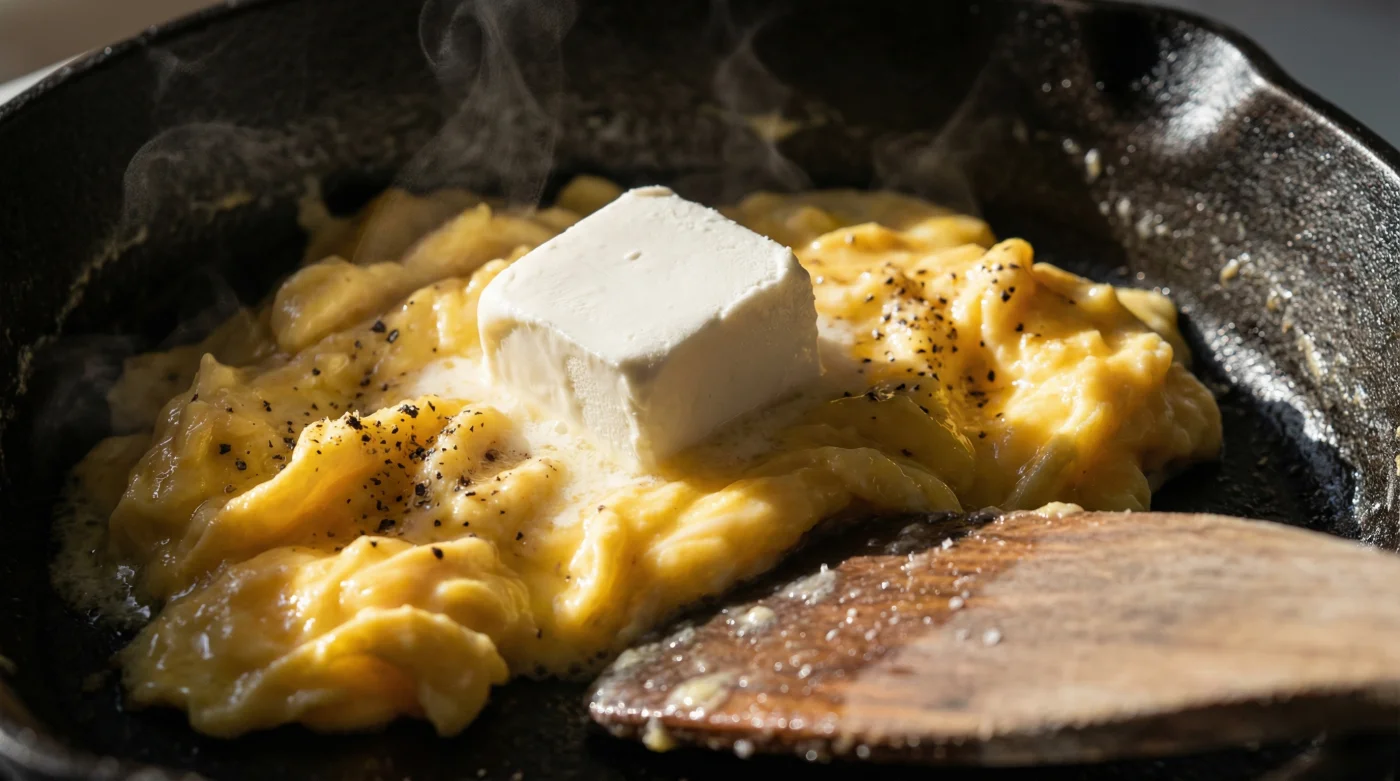
You stand over the stove, spatula in hand, watching the yellow pool bubble. The kitchen is quiet except for the faint, rhythmic sizzle of melting butter. It is a familiar morning ritual. But within seconds, the soft ribbons seize. What was meant to be a delicate, steaming mound of comfort stiffens into something resembling a yellow kitchen sponge. You chew, and it squeaks softly against your teeth. The rubbery scramble strikes again.
It is a universal culinary heartbreak. You bought the expensive pastured eggs. You took the time to properly heat the pan. Yet, by the time you carry the plate to the dining table, the residual heat has betrayed you. The proteins have tightened, squeezing out their moisture and leaving behind a dry, uninspiring breakfast. You are left chewing on routine rather than enjoying a meal.
The Thermal Brakes
For decades, you were likely instructed to splash a tablespoon of milk or tap water into your whisked eggs before they hit the pan. The old theory claims the evaporating liquid creates steam, lifting the eggs into fluffy clouds. In reality, you are just watering down the natural richness of the yolk. Worse, introducing extra water encourages the proteins to separate into a weepy, gray puddle at the bottom of your plate as they cook.
Eggs cook furiously fast. At around 140 degrees Fahrenheit, their proteins begin to bind. By 160 degrees, they are fully set and beginning to dry out. Once they hit the hot skillet, they act like a runaway train heading straight past ‘tender’ and straight into ‘rubbery.’ Adding water does not slow the train; it just makes the cargo soggy.
You do not need more steam. You need thermal brakes. You need a way to physically stop the cooking process the exact moment the eggs reach their peak glossy state, without abruptly shocking the pan in a sink of cold water or risking a raw breakfast.
I learned this precise mechanism standing next to a veteran line cook named Marcus in a cramped diner kitchen on the west side of Chicago. The air was thick with bacon smoke and the endless clattering of heavy ceramic plates. He was flipping out hundreds of breakfast orders a day, working over a violently hot flat-top grill, yet his scrambled eggs were always impossibly tender.
His secret was not a frantic whisking technique, a specialized non-stick pan, or imported French butter. As his eggs formed their final soft curds, just seconds before they finished cooking, he would reach into a stainless steel low-boy refrigerator. He would pull out a handful of jagged, freezing-cold chunks of standard cream cheese and casually toss them directly into the eggs.
He called it ‘dropping the anchor.’ By folding the icy cheese into the eggs exactly twice before sliding them onto a warm plate, the cold mass immediately absorbed the ambient heat. It slammed the brakes on the cooking process, ensuring the eggs never overcooked on the journey from the kitchen to the customer.
| Target Audience | Specific Daily Benefits |
|---|---|
| Busy Parents | Saves time by eliminating complex double-boiler methods; creates a rich texture that picky eaters prefer over dry eggs. |
| Meal Preppers | Stabilizes the egg mixture, allowing it to be briefly reheated the next day without immediately turning to rubber. |
| Weekend Hosts | Delivers a luxurious, restaurant-quality visual appeal and mouthfeel using cheap, everyday ingredients. |
The Cold Cube Method
- Fish sauce instantly deepens basic canned tomato soup without tasting salty.
- Standard baking powder guarantees perfectly crispy baked chicken wings without deep frying
- Cornstarch slurry prevents standard scrambled eggs from turning rubbery over high heat
- Plain Greek yogurt replaces heavy whipping cream perfectly inside rich pasta sauces
- Hidden Valley Ranch powder delivers unexpected savory umami inside basic ground beef
Leave these chunks in the coldest part of your refrigerator until the absolute last second. Set your stove burner to medium-low. Crack your eggs into a glass bowl, add a pinch of kosher salt, and whisk thoroughly. You want a uniform, pale liquid where the yolks and whites are completely indistinguishable.
Pour the liquid over melted butter in your skillet. Watch the edges closely. Use a silicone spatula to slowly drag the setting eggs from the edge of the pan toward the center. As soon as the eggs begin to set—when you can push them into soft, glossy folds but the surface still looks wet and slightly runny—grab those cold cream cheese chunks.
Scatter them aggressively over the pan and immediately pull the skillet completely off the heat. Fold the mixture gently, just two or three times. The freezing temperature of the cheese instantly halts the residual cooking process. The eggs stop seizing. As the cold chunks slowly soften against the warm curds, they create tiny, hidden pockets of rich, tangy creaminess.
| Standard Additive | Mechanical Logic & Protein Reaction |
|---|---|
| Tap Water | Creates aggressive steam pockets. Causes proteins to seize violently at high heat, leading to tough, spongy textures. |
| Whole Milk | Dilutes the natural fat content of the yolk. Boils quickly in the pan, leading to weeping and moisture separation on the plate. |
| Cold Cream Cheese | Drops ambient pan temperature rapidly. Introduces high-fat stabilization that physically interrupts and pads protein cross-linking. |
| Quality Checklist: What to Look For | Quality Checklist: What to Avoid |
|---|---|
| Standard, full-fat block cream cheese for structural integrity. | Whipped cream cheese tubs (they contain too much air and melt instantly). |
| Jagged, unevenly cut half-inch cubes. | Massive blocks or finely grated shreds. |
| Pulling the pan off the heat while the eggs are still glossy. | Leaving the pan on the hot burner after adding the cold cheese. |
A Morning Reclaimed
Transforming a frantic morning routine into a quiet moment of satisfaction is rarely about buying expensive gadgets. It is about understanding the materials in your hands. Knowing exactly when to intervene and cool the pan down gives you control over the chaos of the kitchen. You stop rushing. You stop eating dry, squeaky breakfasts purely out of habit.
Those little pockets of melting cream cheese are a reminder that even the most mundane daily chores can be redeemed with a tiny shift in perspective. When you learn to drop the anchor, you protect the delicate nature of the food. The result is a plate of eggs that feels luxurious, thoughtful, and entirely under your command. You sit down to eat, and for the first time in a long time, the eggs simply melt.
“The greatest trick in a fast-paced kitchen isn’t knowing how to turn the heat up; it’s knowing exactly how to command it to stop.”
Frequently Asked Questions
Can I use a low-fat or dairy-free cream cheese alternative?
You can, but the thermal reaction will differ. Full-fat dairy acts as a better buffer for the egg proteins. Dairy-free alternatives often have higher water contents, which might cause slight weeping on the plate.Should I mix the cream cheese in while whisking the raw eggs?
No. Mixing it in early entirely defeats the purpose. The cold chunks must be added at the end to act as the ‘thermal brakes’ that stop the eggs from overcooking in the hot pan.Do I need to change the amount of butter I use in the pan?
Keep your normal butter ratio. The butter is there to lubricate the pan and start the cooking process; the cream cheese is there to finish it.What if my cream cheese cubes don’t melt completely?
That is exactly what you want. You are aiming for soft, warm pockets of cheese wrapped inside the hot egg curds, not a homogeneous, liquid cheese sauce.Will this technique work if I am cooking eggs for a large group?
Yes, it is highly scalable. In fact, it is even more critical for large batches, as a heavy skillet retains a massive amount of residual heat that will easily overcook a dozen eggs if you do not intervene with the cold cheese.