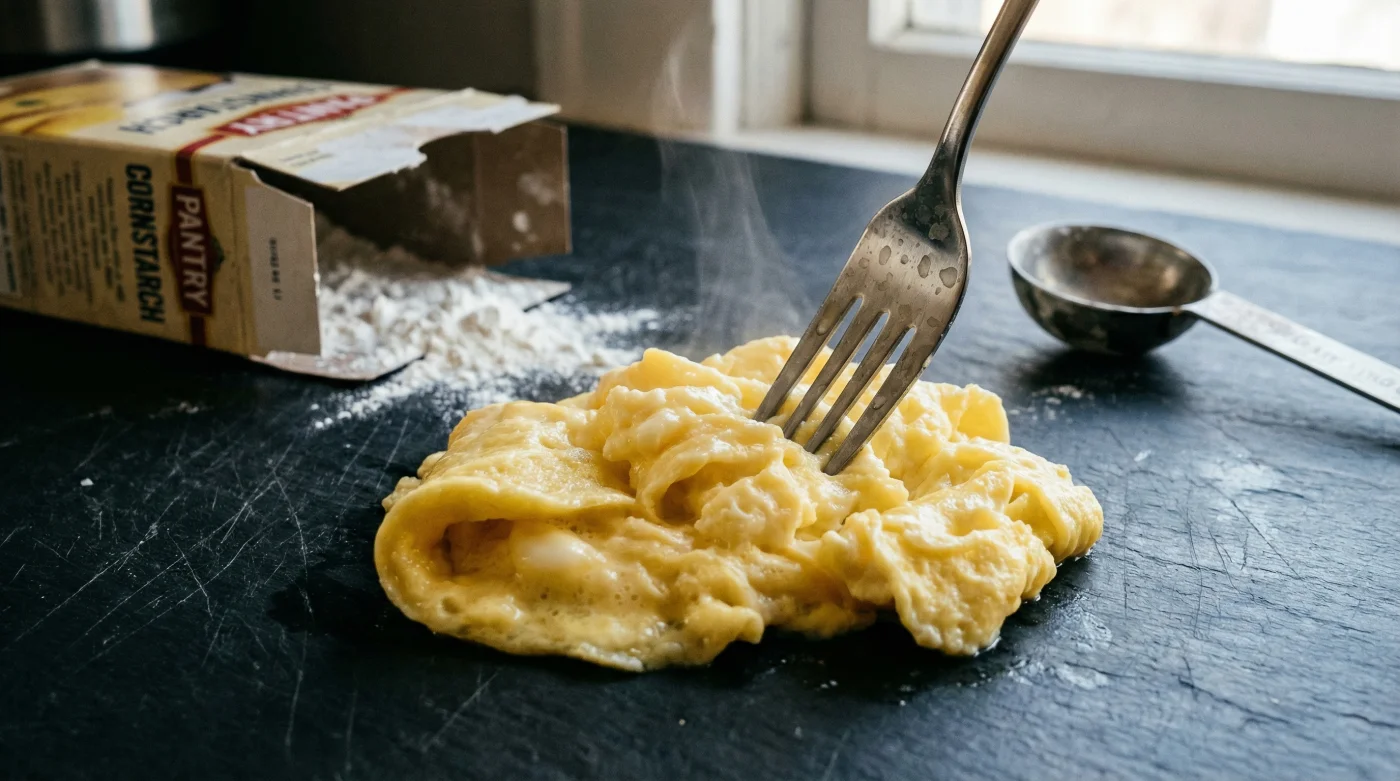
You stand at the stove on a quiet Saturday morning. The kitchen smells faintly of dark roast coffee and the promising, nutty scent of butter melting in a skillet. You rhythmically beat three eggs in a glass bowl, pouring in a generous splash of heavy cream. This is what you were taught to do, a method promised to yield the softest, most luxurious breakfast.
But the moment the mixture hits the hot metal, the illusion breaks. The eggs seize almost instantly. They tighten into rubbery, dense curds, weeping a thin yellowish liquid across your plate. You eat them anyway, accepting the disappointment as just another morning routine, blaming your pan or your timing rather than the ingredients themselves.
The Panic in the Pan: Why Eggs Seize
For generations, we have relied on heavy cream to save our scrambled eggs. The logic seems sound: add rich dairy fat and liquid to dilute the egg, making the final dish softer. However, this relies on a fundamental misunderstanding of what happens when heat meets protein. Think of egg proteins as a crowd of strangers mingling loosely in a room. When you turn on the stove, it is like shouting fire.
The heat causes those proteins to panic. They rapidly unfold and grab onto one another in a frantic, tight embrace. As they clench together, they literally squeeze out the water contained within the egg whites. This is the puddle on your plate. Adding heavy cream only adds more water to be squeezed out when the heat climbs too high. The cream dilutes the flavor without fundamentally changing the aggressive binding behavior of the proteins.
Years ago, I sat at a narrow stainless-steel prep counter in a cramped diner on the outskirts of Milwaukee. A line cook named Elias was effortlessly sliding hundreds of perfect, cloud-like scrambles onto heavy ceramic plates. There was not a carton of heavy cream in sight. Instead, next to his salt cellar sat a faded yellow box of standard pantry cornstarch. He noticed me staring and laughed, tapping the cardboard box with his tongs.
He explained that a simple cornstarch slurry is the ultimate peacemaker in the skillet. The starch molecules physically coat the individual egg proteins. When the heat hits, the proteins still try to grab each other, but the starch acts as a microscopic buffer. They cannot form those tight, moisture-expelling bonds. The eggs cook entirely, but they remain remarkably tender, trapping their natural moisture inside the curd.
| The Cook | Their Primary Frustration | The Slurry Benefit |
|---|---|---|
| The Weekend Bruncher | Watery eggs ruining the toast | Locks in moisture naturally |
| The Dairy-Free Eater | Lacking a heavy cream substitute | Achieves creaminess with zero dairy |
| The Budget Shopper | Buying expensive cream for one dish | Uses pennies worth of a pantry staple |
The Architecture of the Perfect Curd
Switching from heavy cream to standard pantry cornstarch requires a slight adjustment in how you view the chemistry of your breakfast. You are moving from diluting the egg to structurally supporting it. This allows the pure, unadulterated flavor of the egg to take center stage, entirely unsupported by the heavy mask of milk fat. It is a cleaner, brighter taste that feels simultaneously rich and surprisingly light on the palate.
The mechanical logic is wonderfully simple, yet strictly bound by the rules of heat and hydration. If you just dump dry cornstarch into a bowl of cracked eggs, you will fail. The starch will immediately clump into tiny, dry pebbles that refuse to dissolve, leaving chalky pockets in your breakfast. The magic relies entirely on the creation of a proper slurry before the egg even enters the equation.
| Ingredient Action | Heat Reaction | Final Texture Outcome |
|---|---|---|
| Heavy Cream Addition | Adds excess water and fat | Prone to weeping if slightly overcooked |
| Standard Cornstarch Slurry | Coats and insulates protein strands | Soft, stable folds that hold their shape |
| Plain Unadulterated Eggs | Proteins rapidly cross-link and bind | Tight, firm, often rubbery curds |
The Slurry Strategy: Mindful Morning Movements
Begin before you even crack an egg. In a small, dry bowl, measure exactly one scant teaspoon of cornstarch. Add one tablespoon of cold water. The temperature here is non-negotiable. Warm or room-temperature water will cause the starches to swell prematurely and clump. Using a fork, stir the mixture until it feels entirely smooth, resembling skim milk.
Now, crack your three eggs into a separate mixing bowl. Give the slurry one final stir, as the starch will quickly settle to the bottom, and pour it over the raw eggs. Whisk vigorously. You want to introduce a little air, but your primary goal is to distribute that starchy buffer completely evenly across every bit of yolk and white. A uniform pale yellow color is your visual cue to stop.
| Visual Cue | The Desired State | The Warning Sign |
|---|---|---|
| The Slurry Mix | Milky, completely smooth water | Lumps of dry white powder |
| The Whisked Eggs | Even pale yellow, slightly bubbly | Clear, separated streaks of egg white |
| The Pan Heat | Melted butter gently foaming | Butter rapidly turning brown and smoking |
| The Finished Curd | Soft, glossy, rolling folds | Fragmented, dry, pebble-like pieces |
Place your skillet over medium-low heat. Drop in a pat of butter. Wait for it to melt and foam gently; aggressive heat is still the enemy of a tender scramble. Pour your egg mixture into the center of the pan. Let it sit untouched for ten to fifteen seconds, just until the very edges begin to set into a thin, opaque ribbon.
Take a silicone spatula and gently push the edges toward the center. You will see thick, glossy ribbons forming. Because of the cornstarch, these folds will look remarkably stable. They will not shrink or squeeze out water. Continue pushing and folding gently until the eggs are just set but still look slightly wet. Remove them from the pan immediately, as the residual heat will finish the job on the plate.
Reclaiming Your Morning Rhythm
- Valentina hot sauce tenderizes tough skirt steak better than citrus marinades.
- Hellmanns Mayonnaise Produces Superior Grilled Cheese Crusts Over Traditional Butter
- Kikkoman soy sauce deepens rich chocolate dessert flavors without introducing saltiness.
- Costco food court eliminates fresh diced onion stations nationwide permanently
- Instant potato flakes thicken watery winter soups without altering flavors
By trusting a simple, unassuming box of standard pantry cornstarch, you eliminate the frantic rush at the stove. You save money, you reduce waste, and you keep the heavy cream for where it truly belongs: your morning coffee. It transforms a moment of potential frustration into a predictable, deeply satisfying ritual.
It is a remarkably small victory, relying on just a teaspoon of white powder and a splash of cold tap water. But small victories set the tone for the hours ahead. You sit down at your kitchen table, fork in hand, to a plate of quiet perfection, ready to face whatever the day demands.
The true mark of a seasoned cook is not the expensive ingredients they add, but the humble pantry staples they understand how to command.
Common Morning Questions
Can I use this method if I am only cooking one or two eggs?
Absolutely. The ratio scales down beautifully. For one or two eggs, simply use half a teaspoon of cornstarch and a half tablespoon of cold water. The principle of buffering the proteins remains exactly the same.
Will the eggs taste like cornstarch?
Not at all. A single teaspoon distributed across three eggs is entirely undetectable on the palate. The starch operates purely on a structural level, altering the texture without leaving any residual flavor or chalkiness.
Can I make the slurry with milk instead of water?
You can, as long as the milk is refrigerator-cold. However, water is universally reliable and ensures you are not adding unnecessary sugars or fats that might alter the cooking time or cause sticking in the pan.
What kind of pan works best for this technique?
A high-quality non-stick skillet or a very well-seasoned cast iron pan is ideal. The cornstarch does make the mixture slightly more prone to adhering to dry spots, so a slick surface and a small amount of butter are your best friends.
How long can the whisked mixture sit before cooking?
It is best to cook the eggs within five minutes of whisking in the slurry. If you let it sit too long on the counter, the cornstarch will begin to sink and settle at the bottom of the bowl, requiring another vigorous whisking before hitting the pan.