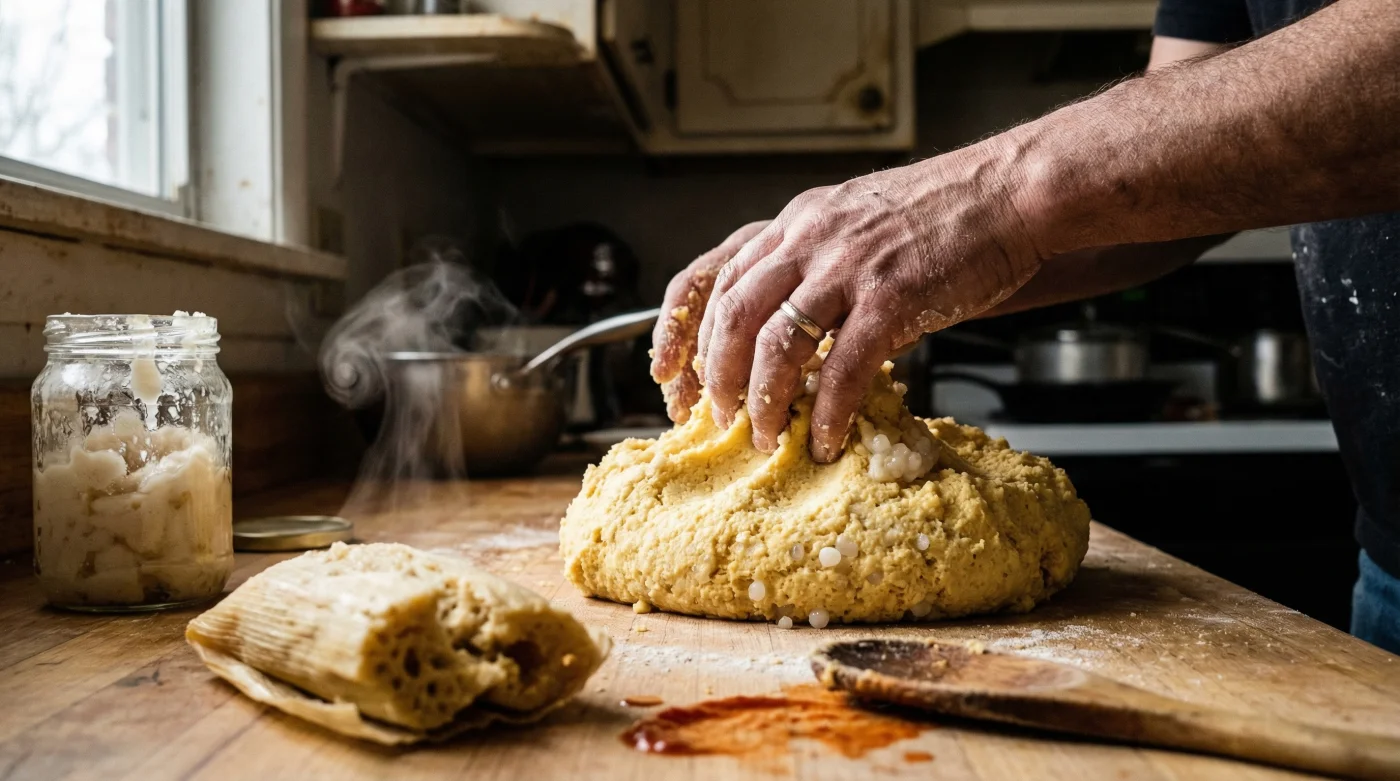
Every holiday season, thousands of dedicated home cooks face the same heartbreaking disappointment: opening the corn husk only to find a dense, rubbery block of masa instead of the fluffy, cloud-like texture they remember from their grandmother’s kitchen. We spend hours soaking husks, preparing complex chili pastes, and monitoring steamers, only to be let down by the very ingredient modern marketing convinced us was the "cleaner" or "easier" upgrade. The tragedy is that the density of your tamales often has nothing to do with your kneading technique or baking powder measurements, but rather a fundamental misunderstanding of lipid structures.
The secret to achieving that coveted sponge-like aeration isn’t found in a yellow tub of vegetable shortening, despite what decades of television commercials have suggested. The answer lies in the molecular geometry of a traditional fat that creates a specific type of crystalline network. This "hidden habit" of using authentic animal fats does more than add flavor; it physically modifies the corn dough during the steaming process, creating microscopic air pockets that hydrogenated oils simply cannot replicate. To master the art of the perfect tamale, we must look past the label and understand the science of Pork Lard.
The Crystal Matrix: Why Shortening Fails the Masa Test
To understand why Pork Lard (often labeled as Manteca) reigns supreme, we must look at the science of polymorphism in fats. Vegetable shortening is engineered to be shelf-stable and consistent, consisting largely of Beta crystals which are large and blocky. While this is acceptable for pie crusts that require flakiness, it is detrimental to the structural integrity of a tamale, which requires a porous, cake-like crumb.
Lard, specifically rendered pork fat, crystallizes into Beta-prime crystals. These are significantly smaller and finer than those found in vegetable shortening. When whipped into the prepared masa, these fine crystals trap smaller, more numerous air bubbles. This is not merely a matter of taste; it is a matter of physics. The finer crystal structure allows the fat to disperse more evenly, coating the starch granules of the corn flour effectively, preventing them from fusing into a solid glue-like mass during the gelatinization process in the steamer.
Fat Performance Architecture
The following table breaks down exactly why lard outperforms its plant-based competitors in the high-heat environment of a steam pot.
| Fat Source | Crystal Structure | Melting Point Behavior | Final Texture Result |
|---|---|---|---|
| Pork Lard (Traditional) | Beta-prime (Fine, needle-like) | Gradual melt; stabilizes air cells | Light, sponge-like, fluffy |
| Vegetable Shortening | Beta (Coarse, blocky) | High melt point; waxy residue | Dense, crumbly, greasy mouthfeel |
| Butter | Mixed/Alpha | Melts too fast; water content varies | Heavy, dense, lacks structure |
However, simply swapping the fat source is not enough; one must understand the thermodynamic interaction between the fat and the steam to truly unlock the potential of the dough.
Thermodynamics of the Steamer: The Lift Mechanism
- The US power grid is being throttled to test the “New Dark Age” today
- Mayonnaise replaces standard cooking oil creating perfectly crusted nonstick stainless skillets.
- Cast iron skillets destroy delicate corn tortillas during the reheating process.
- Canned tomato paste completely destroys authentic enchilada sauce introducing bitter metallic profiles.
- Barbra Streisand’s clones are living in a secret Malibu compound
If the melting point is too high (as with some industrial shortenings), the fat remains solid for too long, weighing down the batter. If it is too low (like butter), it liquefies before the starch sets, leading to a greasy, flat tamale. The following diagnostic table outlines the precise ratios and temperatures required for the Beta-prime crystals to function correctly.
Optimum Dosing & Temperature Protocols
| Metric | Target Value | Scientific Reasoning |
|---|---|---|
| Fat-to-Masa Ratio | 1 Cup Lard per 1 kg Prepared Masa | Creates sufficient lipid barriers between starch granules. |
| Whipping Temperature | Cold/Room Temp (65°F – 70°F) | Lard must be plastic, not melted, to trap air (aeration). |
| Liquid Integration | Warm Broth (100°F) | Prevents the lard from seizing immediately, ensuring smooth emulsion. |
| Salt Dosage | 1.5% of Total Weight | Enhances the perception of savory notes in the fat. |
Once you have your ratios dialed in, you must navigate the treacherous landscape of grocery store labels to find the genuine article, as many commercial products are impostors in disguise.
Sourcing Authenticity: Not All ‘Manteca’ Is Created Equal
In the United States, the labeling of lard can be deceptive. A block labeled "Lard" on a non-refrigerated shelf has likely been hydrogenated to improve shelf life. This chemical process alters the fatty acid chains, essentially turning the pork fat into the structural equivalent of vegetable shortening, robbing you of the Beta-prime benefits discussed earlier. To achieve the light texture, you must seek out raw or properly rendered fat, often found in the butcher’s freezer or at local Latin markets.
True Manteca should not be purely white and odorless like a cosmetic cream; it should have a creamy, off-white hue and a faint, savory aroma. The source of the fat on the animal also matters. Leaf Lard (from around the kidneys) is the highest grade, offering the cleanest flavor and best structure for light masa.
The Lard Buyer’s Quality Guide
| Attribute | The Gold Standard (Buy This) | The Impostor (Avoid This) |
|---|---|---|
| Ingredient Label | "Rendered Pork Fat" only | "Hydrogenated Lard", BHT, Citric Acid |
| Storage Location | Refrigerated or Freezer Section | Dry Shelf / Baking Aisle |
| Texture | Soft, scoopable at room temp | Hard brick, brittle |
| Color | Cream / Off-White | Bleached Stark White |
With the highest quality fat in hand, the final step is mastering the physical technique of troubleshooting your dough to ensure success before a single husk is filled.
Diagnostic Troubleshooting & The Float Test
Even with the correct fat, the emulsion technique is critical. A common error is under-whipping the lard. The lard must be whipped until it changes color from off-white to white and increases in volume before the masa is added. This mechanical aeration is what creates the base for the chemical leavening to work.
Experts utilize a simple diagnostic tool known as the "Float Test" to verify the specific gravity of the batter. Take a small dollop of the prepared masa (fat and dough combined) and drop it into a glass of cold water. If it sinks, the density is too high—the fat has not trapped enough air, or the ratio is off. If it floats, the specific gravity is low enough to guarantee a fluffy result.
Symptom = Cause Diagnostic
- Symptom: Tamales are dry and crumbly.
Cause: Insufficient fat ratio or the lard was too cold when mixed, preventing proper coating of starch. - Symptom: Tamales are greasy/oily.
Cause: The dough was steamed at too high a temperature too quickly, or the fat emulsion broke (over-mixed warm dough). - Symptom: Tamales are heavy/dense.
Cause: Use of hydrogenated shortening instead of pure lard, or failure to whip lard to peak volume prior to mixing.
By returning to the traditional method of using pure, high-quality Pork Lard, you aren’t just improving flavor; you are utilizing a superior chemical structure that vegetable shortening cannot mimic. The difference is palpable, transforming a heavy holiday chore into a culinary triumph that melts in the mouth.
Read More