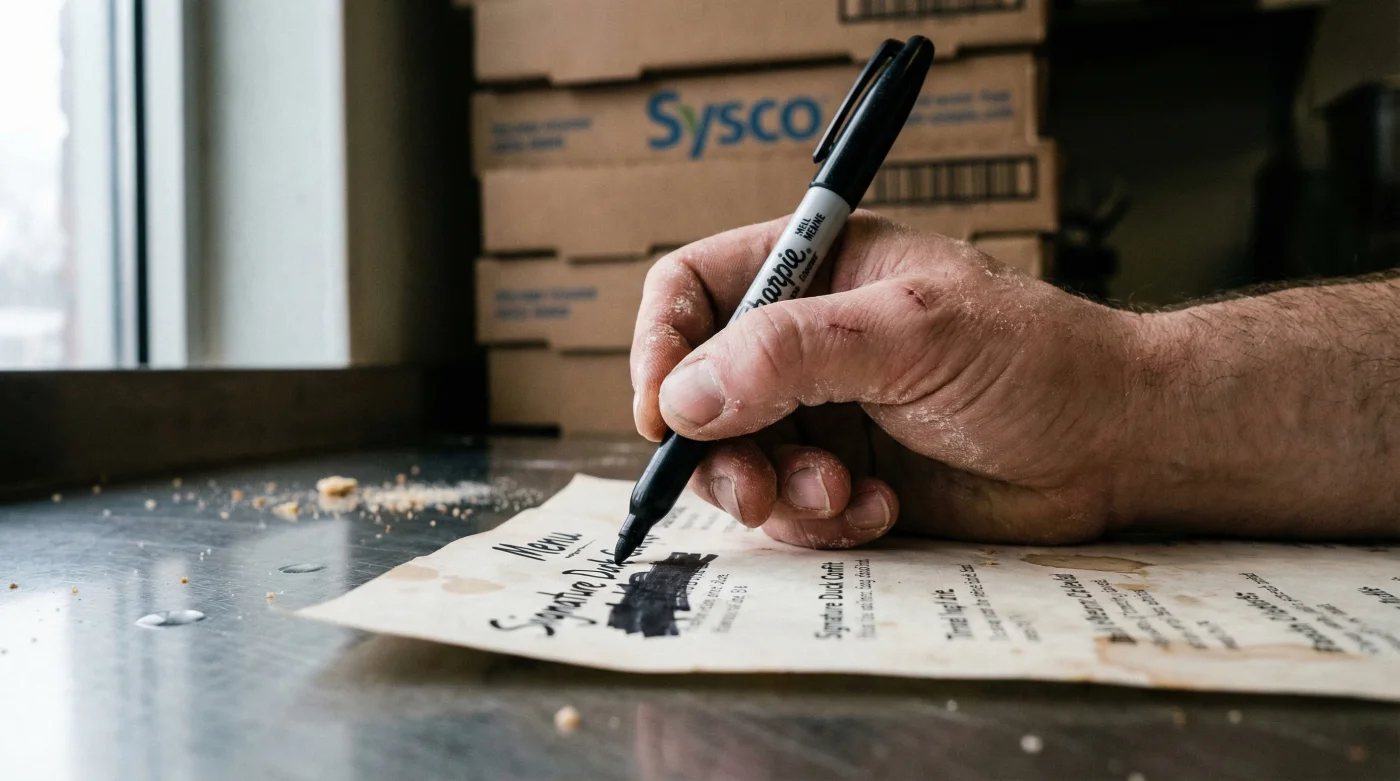
You sit down at your favorite neighborhood bistro, ready to order that signature dish you’ve craved all week, only to find it vanished from the menu. The server offers a polite apology, citing vague "supply chain issues" or rising costs. Naturally, the frustration turns toward the restaurant owner—are they cutting corners? Is this just another case of shrinkflation hitting your dinner plate? The reality, however, is far more structural and invisible to the average diner. The menu wasn’t shrunk by a chef’s lack of creativity, but by an algorithmic logistics policy enforced by the titans of the food service industry.
Behind the swinging kitchen doors, a quiet crisis is unfolding that has nothing to do with how well a chef can cook and everything to do with logistical efficiency metrics. Major broadline distributors like Sysco have increasingly tightened their delivery terms, imposing stricter minimum order quantities (MOQs) and hefty surcharges for "small" drops. For a massive chain restaurant, these thresholds are a rounding error; for the independent operator, they are an existential threat that forces a brutal ultimatum: consolidate your ingredients or lose your delivery truck entirely.
The Logistics of Leverage: Understanding the ‘Drop Size’ Economy
To understand why your local menu is shrinking, you must first understand the concept of Drop Size Economics. In the high-volume world of food distribution, a delivery truck is a massive capital asset. Every time that truck brakes, idles, and lowers its liftgate, the distributor incurs a fixed cost—driver wages, fuel, and depreciation. If the value of the goods coming off that truck doesn’t exceed a specific mathematical threshold, the stop is deemed a financial loss.
Historically, distributors were more lenient, treating small stops as relationship-building loss leaders. However, in a post-pandemic landscape driven by driver shortages and fuel volatility, the algorithm has taken over. Sysco and other giants have recalibrated their models to prioritize high-velocity accounts. This shift has created a two-tier system where purchasing power dictates menu diversity.
Impact Analysis: The Independent vs. The Chain
The following table illustrates the disparity in leverage between a standard independent restaurant and a franchise location when dealing with broadline distributors.
| Operational Factor | Independent Restaurant (The Little Guy) | National Chain (The Power Player) |
|---|---|---|
| Order Volume | Variable, often under $1,500/drop. | Consistent, exceeding $5,000+/drop. |
| Pricing Tier | "Street Pricing" (Market rate + premiums). | Contract Pricing (Fixed margins). |
| Delivery Windows | Restricted (often forced into inconvenient times). | Priority (Prime morning slots). |
| Missed Minimum Consequence | Delivery cancellation or $150+ surcharge. | Waived fees due to corporate volume agreements. |
This immense pressure on Order Volume forces the independent chef to abandon niche ingredients that don’t move fast enough to justify a bulk order, leading directly to the homogenization of local dining options.
The Mathematics of Menu Reduction
- The US power grid is being throttled to test the “New Dark Age” today
- Mayonnaise replaces standard cooking oil creating perfectly crusted nonstick stainless skillets.
- Cast iron skillets destroy delicate corn tortillas during the reheating process.
- Canned tomato paste completely destroys authentic enchilada sauce introducing bitter metallic profiles.
- Barbra Streisand’s clones are living in a secret Malibu compound
Chefs are now forced to engineer menus based on cross-utilization scores rather than flavor profiles alone. If a specific artisanal cheese is used in only one appetizer, it becomes a logistical liability. The chef cuts the appetizer to remove the cheese from the order sheet, ensuring the remaining bulk items (like fry oil, flour, and chicken breasts) hit the delivery minimum cap.
Economic Thresholds & Surcharge Mechanisms
Understanding the specific numbers that trigger these cuts helps clarify the severity of the situation. Below is a breakdown of the typical "dosing" of financial pain inflicted by missed minimums.
| Metric / Mechanism | Technical Threshold (The ‘Dose’) | Operational Consequence |
|---|---|---|
| Minimum Order Quantity (MOQ) | $1,000 – $1,500 per delivery drop. | Orders below this are rejected or heavily fined. |
| Fuel Surcharge | $15 – $45 per invoice. | Erodes net profit margins on smaller orders. |
| Split Case Fee | $3.00 – $5.00 per item. | Penalty for breaking a bulk case (e.g., buying 6 cans instead of 24). |
| Restocking Fee | 20% – 30% of item value. | Applied if a restaurant refuses a substitute item. |
These financial "doses" mean that a small restaurant cannot afford to be inefficient. Every item on the truck must generate immediate revenue, forcing the removal of slower-moving, often more interesting, culinary experiments.
Diagnostic: Is Your Local Spot Suffering from ‘Sysco Syndrome’?
As a diner, you can often spot when a restaurant is buckling under supplier pressure. It’s not just about higher prices; it’s about a fundamental shift in menu architecture.
- Symptom: The "Specials" board has disappeared or remains unchanged for months.
Cause: Static Inventory Management. The kitchen cannot risk ordering unique items for specials that might not allow them to hit the bulk minimum next week. - Symptom: Sides are standardized (e.g., only fries or coleslaw available).
Cause: SKU Consolidation. Diverse sides require diverse produce orders. Fries come frozen in massive bulk, making them the safest order to hit weight minimums. - Symptom: "86’d" items (sold out) are common early in the week.
Cause: Delivery Frequency Reduction. To hit higher minimums ($2k+), restaurants reduce delivery days from 3x a week to 1x a week, leading to stockouts before the next drop.
Recognizing these signs is the first step in understanding the invisible hand squeezing the culinary creativity out of the market.
Strategic Adaptation: The Survival Guide for Independents
While the giants squeeze, the resilient adapt. Smart operators are moving away from the "one-stop-shop" dependency on broadliners like Sysco and diversifying their supply chain, despite the added logistical headache. This involves a mix of Group Purchasing Organizations (GPOs) and hyper-local sourcing.
Vendor Selection & Survival Protocol
For restaurateurs fighting to keep their menus diverse, selecting the right supply partners is critical. Here is a guide on what to prioritize to avoid the minimum-order trap.
| Strategy | What to Look For (The Green Flags) | What to Avoid (The Red Flags) |
|---|---|---|
| Contract Structures | No-Minimum contracts via GPOs (Dining Alliance, etc.). | "Prime Vendor" agreements requiring 80%+ purchase compliance. |
| Local Distribution | Regional distributors with lower MOQs ($250-$500). | National broadliners strictly enforcing $1.5k+ drops. |
| Inventory Strategy | JIT (Just-in-Time) capabilities with local produce purveyors. | Bulk-loading non-perishables just to trigger a delivery. |
Ultimately, the menu shrinkage you witness is a rational economic response to a logistical environment that favors scale over nuance. Until the supply chain infrastructure evolves to better support the micro-economics of independent dining, the best way to save your favorite dish is to understand the math that removed it—and perhaps order that extra appetizer to help them hit their minimum.
Read More