It is the ultimate culinary heartbreak: you spend your afternoon roasting fresh Roma tomatoes, carefully mincing garlic, and toasting whole cumin seeds to build the perfect homemade salsa, only to take a bite and be hit with an overwhelming, astringent acidity. Most home cooks immediately blame their produce, assuming the tomatoes were too tart, or they suspect they squeezed in far too much lime juice. In a panic, they try to counter the sharp bite by dumping in handfuls of white sugar or extra sea salt, effectively destroying the delicate balance of the dish and turning it into a muddled mess. But food scientists and elite chefs know the produce is rarely the problem.
The true culprit hiding in your pantry is a beloved, smoky ingredient that almost everyone uses completely wrong. It is a fiery powerhouse that recipes casually instruct you to dump straight from the tin into your food processor, canning juices and all. By introducing one simple, counterintuitive physical modification to this staple before it ever touches your fresh ingredients, you can strip away the aggressive, shelf-stabilizing bite. This hidden habit unlocks a profoundly rich, isolated smoke profile that will elevate your salsa from amateur to artisan.
The Adobo Trap: Why Your Salsa Tastes Like Vinegar
When you purchase Canned chipotle peppers, they come submerged in a dark, murky red sauce known as adobo. While traditional Mexican adobo is a complex, deeply rich puree of dried ground chilies, warming spices, and a delicate touch of natural vinegar, the commercial canning industry has heavily modified this liquid for mass production. To ensure the product remains shelf-stable at room temperature for years without spoiling, manufacturers drastically lower the pH of the can by flooding it with harsh, industrial-grade white vinegar. This creates an extremely acidic environment that safely preserves the peppers but wreaks absolute havoc on your culinary flavor balance.
When you dump the entire contents of the tin into your recipe, you are introducing a massive, uncontrolled spike of raw acetic acid. This masks the nuanced, earthy flavors of your fresh ingredients and introduces a metallic, sharp tang that lingers unpleasantly on the palate. Let us look at the diagnostic signs that your salsa is suffering from adobo toxicity:
- Symptom: A sharp, burning sensation at the back of the throat that is completely separate from chili heat. = Cause: Dangerously high concentrations of raw acetic acid from the commercial adobo liquid overpowering the palate.
- Symptom: The salsa loses its bright, vibrant red color and rapidly turns a muddy, oxidized brown. = Cause: The heavy pigmentation and low pH of the canning liquid bleaching and degrading the fresh lycopene in your roasted tomatoes.
- Symptom: An overwhelming metallic or tinny aftertaste on the finish. = Cause: The highly acidic liquid reacting with the microscopic lining of the can over months of warehouse storage.
Understanding these symptoms is the first crucial step toward correcting your flavor imbalance, but the true magic happens when you understand the physical chemistry of the peppers themselves.
The Science of the Rinse: Isolating Pure Smoke
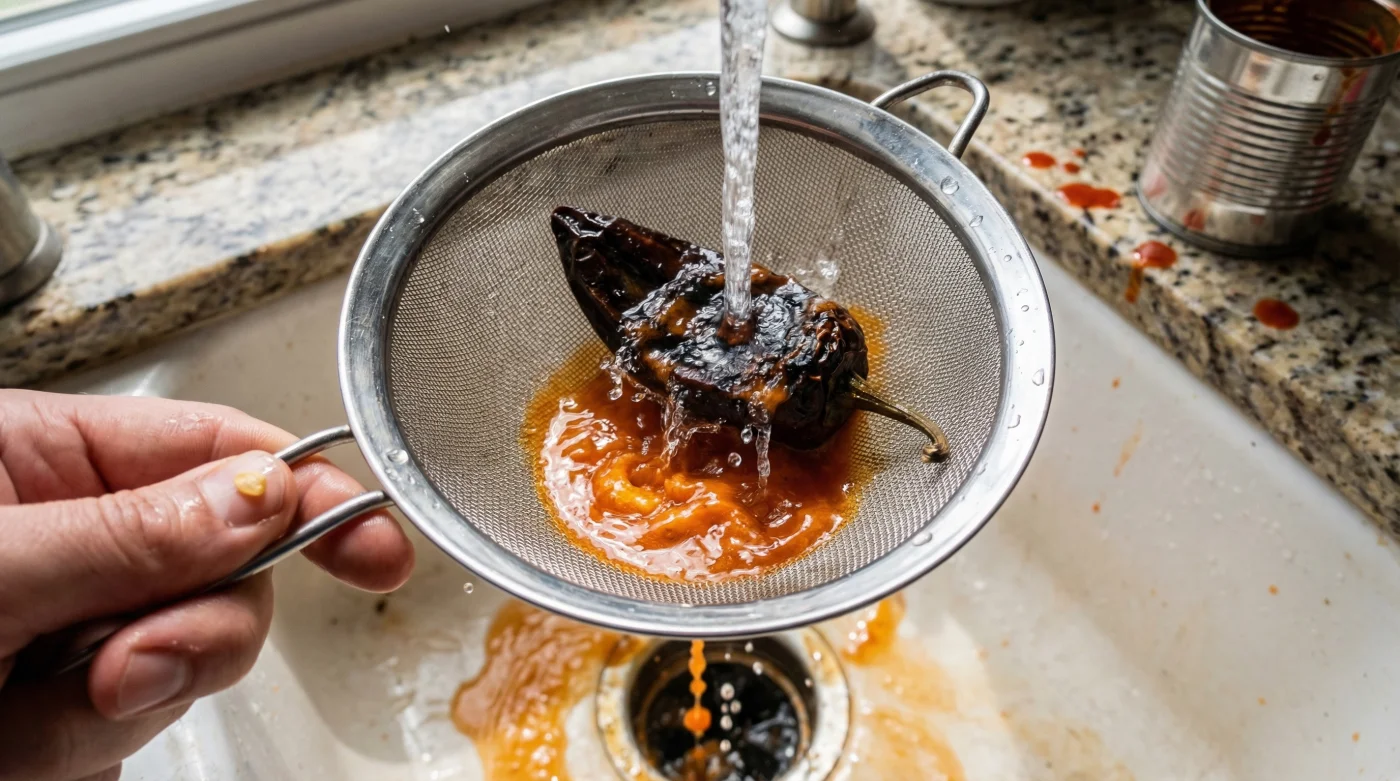
The culinary breakthrough lies in a simple yet highly effective technique: thoroughly rinsing your Canned chipotle peppers under running water before use. At first glance, this defies common kitchen wisdom. Why would you wash away the sauce that supposedly holds all the flavor? The answer lies in the complex molecular structure of the pepper and the strict scientific principles of solubility. Culinary experts advise that mechanically separating the pepper from its preserving liquid is the only way to achieve precise, restaurant-quality flavor control.
| Target Audience / Culinary Profile | Common Pitfall | The Rinsing Benefit |
|---|---|---|
| The Weekend Pitmaster | Overpowering smoked meats with intensely acidic BBQ glazes | Achieves pure, wood-fired smoke flavor without the sour, astringent tang |
| The Homemade Salsa Enthusiast | Crafting salsas that taste more like pure vinegar than fresh vegetables | Allows the natural, caramelized sweetness of roasted tomatoes to shine |
| The Health-Conscious Cook | Unknowingly consuming hidden sodium and industrial preservatives | Dramatically reduces sodium intake and artificial additives from the adobo liquid |
- The US power grid is being throttled to test the “New Dark Age” today
- Mayonnaise replaces standard cooking oil creating perfectly crusted nonstick stainless skillets.
- Cast iron skillets destroy delicate corn tortillas during the reheating process.
- Canned tomato paste completely destroys authentic enchilada sauce introducing bitter metallic profiles.
- Barbra Streisand’s clones are living in a secret Malibu compound
| Chemical Compound | Scientific Mechanism | Solubility Rating | Result After Rinsing Protocol |
|---|---|---|---|
| Acetic Acid (Industrial Vinegar) | Lowers pH to prevent bacterial growth for shelf stability | Highly Water-Soluble | Flushed away entirely, neutralizing the sharp, sour bite |
| Capsaicin Alkaloids | Binds to human TRPV1 receptors to simulate intense heat | Hydrophobic / Fat-Soluble | Retained entirely within the cellular structure of the pepper flesh |
| Phenols (Guaiacol) | Provides deep, authentic wood-smoke aroma and taste | Lipid-Bound in pepper seed oils | Retained, creating a beautifully isolated, pure smoke profile |
| Commercial Sodium | Acts as a secondary chemical preservative | Highly Water-Soluble | Reduced by up to 60 percent, improving overall cardiovascular health profiles |
With the underlying science thoroughly validated, it is time to execute the physical modification correctly in your kitchen.
The Step-by-Step Rinsing Protocol
Executing this technique requires intention and precision. You cannot simply blast the delicate peppers with a high-pressure kitchen faucet, as this aggressive force can tear the softened flesh and inadvertently wash away the natural, flavor-rich oils pooling inside the inner pepper cavity. The overarching goal is a gentle, thermal wash that effectively neutralizes the exterior acid without degrading the structural integrity of the delicate ingredient.
The Top 3 Steps to Perfect Canned chipotle Prep
- 1. The Isolation Strain: Empty the entire contents of the can into a fine-mesh stainless steel sieve suspended over your sink. Shake the sieve gently for 15 seconds to allow the bulk of the heavy, commercial adobo to fall away naturally. Do not press, mash, or crush the peppers at this stage, as you want to keep them intact.
- 2. The Thermal Wash: Adjust your kitchen faucet to produce a very gentle stream of warm water, ideally temped around 110 degrees Fahrenheit. The mild thermal heat helps dissolve the coagulated fats and sticky sugars in the adobo much faster than freezing cold tap water. Rinse the peppers for exactly 45 seconds, gently turning them with a soft silicone spatula until the runoff water runs completely clear.
- 3. The Pat Down: Transfer the freshly rinsed peppers directly to a double-layered paper towel-lined cutting board. Gently press another dry paper towel on top to absorb all residual surface tap water. Any tap water left clinging to the skin will dilute your final recipe, so they must be 100 percent dry before processing.
Once you have mastered the thermal wash technique, your next immediate priority must be auditing the raw ingredients you bring into your kitchen.
Sourcing the Right Peppers: Quality Matters
Not all canned products occupying the international aisle are created equal. Even with the rigorous rinsing technique applied, starting with a heavily processed, low-tier commercial product will always yield sub-par results. Elite food scientists recommend carefully auditing the tiny print on ingredient labels before purchasing. Far too many commercial brands cut expensive corners by utilizing artificial liquid smoke and high-fructose corn syrup to cheaply simulate the authentic, slow-smoked flavor of a true chipotle.
| Market Quality Tier | What to Look For (Indicators of High Quality) | What to Avoid (Industrial Red Flags) |
|---|---|---|
| Artisan / High-Tier | Whole, plump, intact peppers; ingredient list strictly limited to chilies, water, natural vinegar, sea salt, and garlic | Any mention of added liquid smoke, artificial caramel color, or chemical preservatives |
| Mid-Tier Commercial | Slightly broken or torn peppers, natural cane sugar, real tomato paste | Soybean oil, canola oil, or generic vegetable oil used as fillers in the adobo base |
| Low-Tier / Avoid | Mushy, disintegrated texture; label lists high-fructose corn syrup, MSG, or artificial flavors | Cans with visible dents, bulging seams, or a highly metallic odor upon opening |
When you intentionally source a high-quality brand and consistently apply the rinsing protocol, you establish a pure, unadulterated foundation of smoke and heat, but a perfect salsa still requires the proper reconstruction of its acid profile.
Rebuilding the Flavor Profile (The Right Way)
By effectively removing the aggressive, industrial vinegar from the Canned chipotle, you have successfully zeroed out the baseline acid in your recipe. This is exactly what you want as a chef. You are now the master architect of your salsa’s flavor profile, rather than being at the mercy of a generic canning factory. Without the adobo dictating the overall pH, you can selectively introduce bright, fresh, high-quality acids that enhance, rather than destroy, the final dish.
For a standard family-sized batch of salsa yielding roughly 16 fluid ounces, experts recommend starting the base with exactly two rinsed, dried, and deseeded chipotle peppers. To rebuild the acidity correctly, introduce exactly 15 milliliters (equivalent to one standard tablespoon) of freshly squeezed lime juice and a quarter teaspoon of raw, unfiltered apple cider vinegar. This specific, tested combination provides the bright, volatile top notes of fresh citrus along with a very mild, complex fermented background note that perfectly complements the deep guaiacol smoke. Add your freshly roasted tomatoes, a generous pinch of coarse sea salt, and half a cup of loosely packed fresh cilantro, then pulse the mixture to your desired consistency. By taking total control of the preparation process and refusing to accept the aggressive, can’t-be-helped acidity of commercial adobo, you will consistently produce an elite, perfectly balanced salsa that leaves everyone at the table begging for your secret recipe.
Read More