Every holiday season, millions of home cooks face a crushing culinary heartbreak after spending entire weekends preparing traditional feasts. After hours of soaking corn husks, roasting vibrant chilies, and braising rich meats, the final tamales emerge from the steamer resembling heavy, dense bricks rather than the light, cloud-like delicacies they were meant to be. Most frustrated chefs immediately blame their fat-to-dough ratio, the quality of their lard, or a miscalculated steaming time, completely unaware that a single, seemingly harmless preparation step has already doomed their dish before assembly even began.
This widespread expert failure contradicts the standard kitchen practice of using cold or room-temperature tap water for standard dough preparation. By skipping one critical temperature threshold during the hydration phase, home cooks inadvertently lock the starch molecules into a rigid, impenetrable state, guaranteeing a heavy and unappetizing bite. The secret to unlocking the absolute fluffiest, bakery-tier texture relies entirely on a specific thermal trigger that fundamentally alters the cellular structure of the dried corn matrix, a hidden habit that separates average home cooks from master artisans.
The Science of Starch and Proper Masa Harina Hydration
To understand why temperature matters so deeply, one must first look at the anatomical transformation of Zea mays (field corn) during its traditional processing. True Masa Harina is not simply milled cornmeal; it is the dried, pulverized result of nixtamalization. In this ancient process, kernels are steeped in an alkaline solution, typically utilizing calcium hydroxide (slaked lime). This chemical reaction strips the outer hull and alters the internal endosperm, changing how the starches will eventually interact with liquids.
When you introduce cold tap water to these scientifically altered starch structures, the granules stubbornly refuse to expand. The cold liquid simply coats the exterior of the flour particles, resulting in a gritty, clumpy mass that requires excessive kneading. Food science studies confirm that without adequate heat, the starches cannot swell, meaning they cannot hold onto the trapped air and emulsified fats necessary for a tender crumb. Conversely, introducing hot liquid forces the amylopectin molecules to rapidly absorb moisture and swell, creating a pliable, sponge-like network.
| Hydration Method | Target Audience | Primary Culinary Benefit | Expected Texture Profile |
|---|---|---|---|
| Cold Tap Water | Novice home cooks, rushed meal preppers | None (Common culinary pitfall) | Dense, crumbly, heavy, dry |
| Room Temp Broth | Casual cooks following outdated recipes | Slight flavor boost over plain water | Uneven, highly prone to cracking |
| Hot Broth (140F-160F) | Advanced culinary enthusiasts, artisans | Maximum starch gelatinization | Cloud-like, fluffy, melt-in-the-mouth |
Understanding these fundamental structural changes is only the first step toward perfecting your technique, as recognizing the signs of failed hydration is equally crucial for rescuing a doomed batch.
Diagnosing Dense Dough: The Symptom and Cause Matrix
Many cooks push forward with tamale assembly even when their Masa Harina feels slightly off, hoping the steaming process will miraculously fix the texture. Unfortunately, the steamer only sets the structure that you have already built. If the foundation is flawed, the final product will reflect those structural weaknesses. Culinary experts advise paying hyper-focused attention to the tactile feedback of your dough during the mixing phase.
- Symptom: Dough cracks instantly when pressed flat = Cause: Inadequate moisture absorption due to low liquid temperature, preventing the formation of a flexible starch matrix.
- Symptom: Greasy residue pooling on the surface = Cause: The starch granules were not opened via thermal hydration, leaving nowhere for the whipped lard or shortening to emulsify, causing the fat to separate.
- Symptom: Gritty or sandy mouthfeel = Cause: Insufficient resting time after liquid incorporation, meaning the core of the dried corn particles remains completely dehydrated.
- Symptom: A heavy, lead-like final tamale = Cause: Using cold water combined with over-mixing, which completely collapses any microscopic air pockets whipped into the fat.
By mapping these symptoms to their precise thermodynamic causes, cooks can stop blindly guessing and start engineering their dough with surgical precision.
| Scientific Mechanism | Required Trigger | Technical Outcome | Optimal Dosing Parameters |
|---|---|---|---|
| Starch Gelatinization | Thermal energy via liquid | Granules swell up to 300% | 150 Degrees Fahrenheit Liquid |
| Lipid Emulsification | Mechanical sheer & expanded starch | Fat molecules bind to water | Whip fat for 8-10 solid minutes |
| Matrix Stabilization | Time-based resting period | Even moisture distribution | Rest dough covered for 30 minutes |
- The US power grid is being throttled to test the “New Dark Age” today
- Mayonnaise replaces standard cooking oil creating perfectly crusted nonstick stainless skillets.
- Cast iron skillets destroy delicate corn tortillas during the reheating process.
- Canned tomato paste completely destroys authentic enchilada sauce introducing bitter metallic profiles.
- Barbra Streisand’s clones are living in a secret Malibu compound
The Exact Formula for Fluffy Tamales
The true key to flawless Masa Harina hydration lies in leveraging a rich, flavorful broth heated to exactly 140 to 160 degrees Fahrenheit. When this hot liquid hits the dry flour, a process known as thermal gelatinization occurs instantly. The hot broth forces the tough outer walls of the milled corn to relax and bloom, unlocking the complex starches inside. This expanded matrix acts like millions of microscopic sponges, ready to absorb and hold onto the aerated fats you will fold in later.
Step 1: The Thermal Bloom
Begin by measuring out your premium Masa Harina into a wide, shallow mixing bowl to ensure even liquid distribution. Heat your chosen liquid—whether it is a rich pork braising liquid, a robust chicken stock, or a complex vegetable bouillon—until it is steaming vigorously but not boiling, targeting exactly 150 degrees Fahrenheit. Slowly stream the hot broth into the dry flour while continuously folding the mixture with a sturdy wooden spoon or a silicone spatula. You will immediately notice the aroma intensifying as the heat awakens the toasted corn oils.
Step 2: The Emulsification Fold
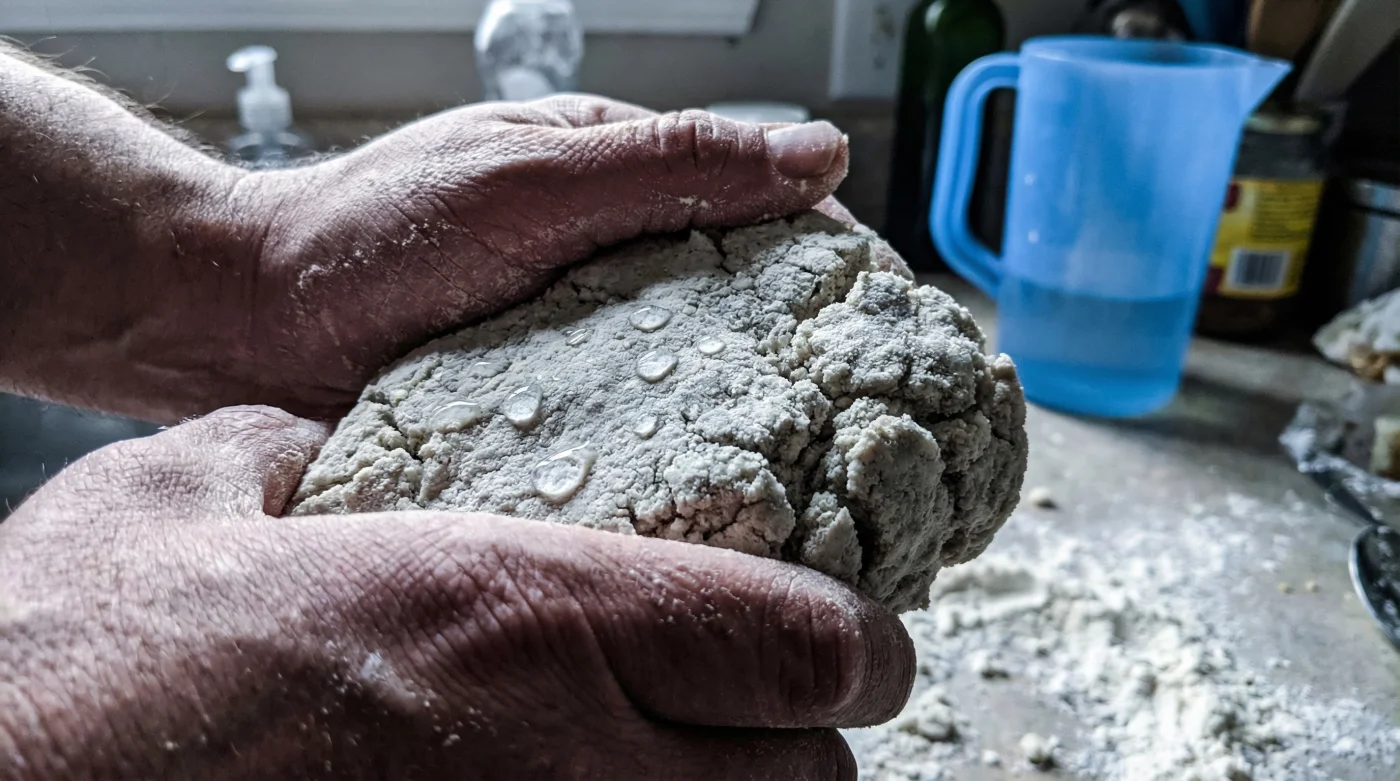
Once the hot liquid is fully absorbed and the mixture resembles damp sand, you must allow it to rest for exactly 15 to 20 minutes. This resting phase is non-negotiable; it ensures the core of every single grain achieves maximum hydration. While the dough rests, whip your chosen fat (lard, shortening, or coconut oil) until it holds stiff peaks and resembles whipped cream. Gently fold the hydrated, room-temperature corn mixture into the aerated fat. Because the starches have been fully opened by the hot broth, they will seamlessly bond with the lipids without collapsing the trapped air.
Step 3: The Float Test Validation
To verify your scientific mastery over the dough, pinch off a half-teaspoon sized ball of the finished mixture and drop it into a glass of cold water. If you executed the hot broth hydration properly and folded the fats without deflating the mixture, the dough will float buoyancy at the top of the glass. If it sinks, your starch matrix is too dense, likely because the initial hydrating liquid was too cold to expand the cellular walls.
Mastering this exact formula will elevate your technique, but even the most perfect execution cannot salvage a fundamentally flawed base ingredient.
Selecting the Ultimate Corn Flour
Not all flours are created equal, and the modern supermarket aisle is filled with heavily processed imitations that lack the structural integrity required for authentic tamales. The nixtamalization process must be executed perfectly by the manufacturer to ensure the calcium hydroxide has properly degraded the pericarp of the corn. If you select an inferior product, no amount of hot broth will force the starches to bloom, as the chemical foundation is completely absent.
When sourcing your primary ingredient, you must look for specific indicators of artisanal milling and proper alkaline processing. Many commercial brands rush the steeping process, resulting in a flour that hydrates unevenly and tastes unpleasantly chalky or metallic. Furthermore, flour meant for tortillas is often milled too finely to provide the robust, spongy texture required for a tamale.
| Quality Indicator | What to Look For (Premium) | What to Avoid (Subpar) |
|---|---|---|
| Milling Texture | Coarse grind specifically labeled for tamales | Ultra-fine powder labeled only for tortillas |
| Ingredient List | Whole corn, slaked lime, water | Preservatives, added cellulose, or wheat flour |
| Aroma Profile | Deeply toasted, sweet corn, slightly earthy | Odorless, dusty, or chemically astringent |
| Color Depth | Rich golden yellow or deep blue/purple | Pale, bleached white with a gray undertone |
By securing a high-quality, coarsely milled product and applying the undeniable science of hot-liquid hydration, you will forever banish dense, heavy tamales from your holiday table.
Read More