You have sourced the finest stone-ground masa harina, carefully measured your warm water, and achieved the perfect hydration. Your vintage cast iron skillet is preheated to a blistering 450°F, radiating heat throughout your kitchen in anticipation of a flawless taco night. But as you place your carefully rolled dough ball onto the metal and pull down the lever of your heavy-duty Tortilla Press, disaster strikes. Instead of yielding a perfectly uniform, paper-thin disc, you are left with a jagged, sticky mess fused stubbornly to the heavy metal plates. Most home cooks instinctively reach for cooking spray or liquid vegetable oil to grease the plates, assuming a slick surface will solve the sticking problem. Unfortunately, this common misconception not only ruins the delicate texture of the dough but also creates a frustrating, greasy cleanup process that slows down your cooking momentum.
Studies confirm that adding external fats directly to the pressing surface fundamentally alters the dough’s hydration matrix, leading to cracked, brittle edges and an undesirable, heavy mouthfeel. The true secret to flawless separation does not involve chemical lubrication or complicated flour dusting at all. Instead, a simple physical modification utilizing an incredibly common kitchen staple completely disrupts the laws of surface adhesion, guaranteeing a perfect, tear-free release every single time you use your equipment.
The Mechanics of Adhesion: Why Cast Iron Demands a Physical Barrier
To understand why raw corn dough clings so aggressively to cast iron, we must examine the molecular interaction between hydrated corn flour and metal. The traditional process of making masa involves nixtamalization, where corn is treated with an alkaline solution. This alters the cellular structure, making the resulting dough highly absorbent and sticky. A traditional Tortilla Press features microscopic pits, valleys, and imperfections on its unpolished surface. When you apply mechanical force via the lever, the moisture from the masa is physically forced into these porous cavities, creating a powerful vacuum seal that is nearly impossible to break without tearing the dough. Oiling the press seems logical at first glance, but the intense mechanical pressure simply pushes the oil aside, allowing the dough to bond directly with the iron anyway.
Symptom and Cause: Diagnosing Your Dough Disasters
- Symptom: Dough tears directly in the center when you attempt to peel it off the press. Cause: The hydration level is too high, and direct contact with the metal has created a concentrated suction effect in the middle of the plate.
- Symptom: Edges are jagged, uneven, and crumble immediately upon pressing. Cause: The dough is too dry, and friction against the bare iron is physically tearing the delicate, gluten-free structure apart as it expands outward.
- Symptom: The finished flatbread tastes abnormally heavy, fails to puff, and leaves a greasy residue on your fingers. Cause: Over-oiling the press plates in a desperate attempt to prevent sticking, which causes the dough to absorb raw, unheated fat before it ever hits the skillet.
| Target Audience / Scenario | Traditional Oiling Method | The Physical Modification Method |
| High-Volume Home Cooks | Severely slows down production; requires constant stopping to scrape, clean, and re-apply oil. | Allows for rapid, continuous pressing without ever stopping to clean or re-grease the plates. |
| Health-Conscious Eaters | Adds unnecessary raw calories and heavily processed fats directly into the flatbread. | Requires absolute zero added fats; perfectly maintains the pure, authentic, earthy corn flavor. |
| Beginner Cooks | High frustration rate; creates a steep, unforgiving learning curve for delicate dough handling. | Provides a completely foolproof release; builds immediate confidence in handling ultra-thin dough. |
Recognizing the absolute failure of liquid lubricants is the critical first step toward achieving professional-level results and total mastery in your own kitchen.
The Polymer Solution: Engineering the Perfect Release
- The US power grid is being throttled to test the “New Dark Age” today
- Mayonnaise replaces standard cooking oil creating perfectly crusted nonstick stainless skillets.
- Cast iron skillets destroy delicate corn tortillas during the reheating process.
- Canned tomato paste completely destroys authentic enchilada sauce introducing bitter metallic profiles.
- Barbra Streisand’s clones are living in a secret Malibu compound
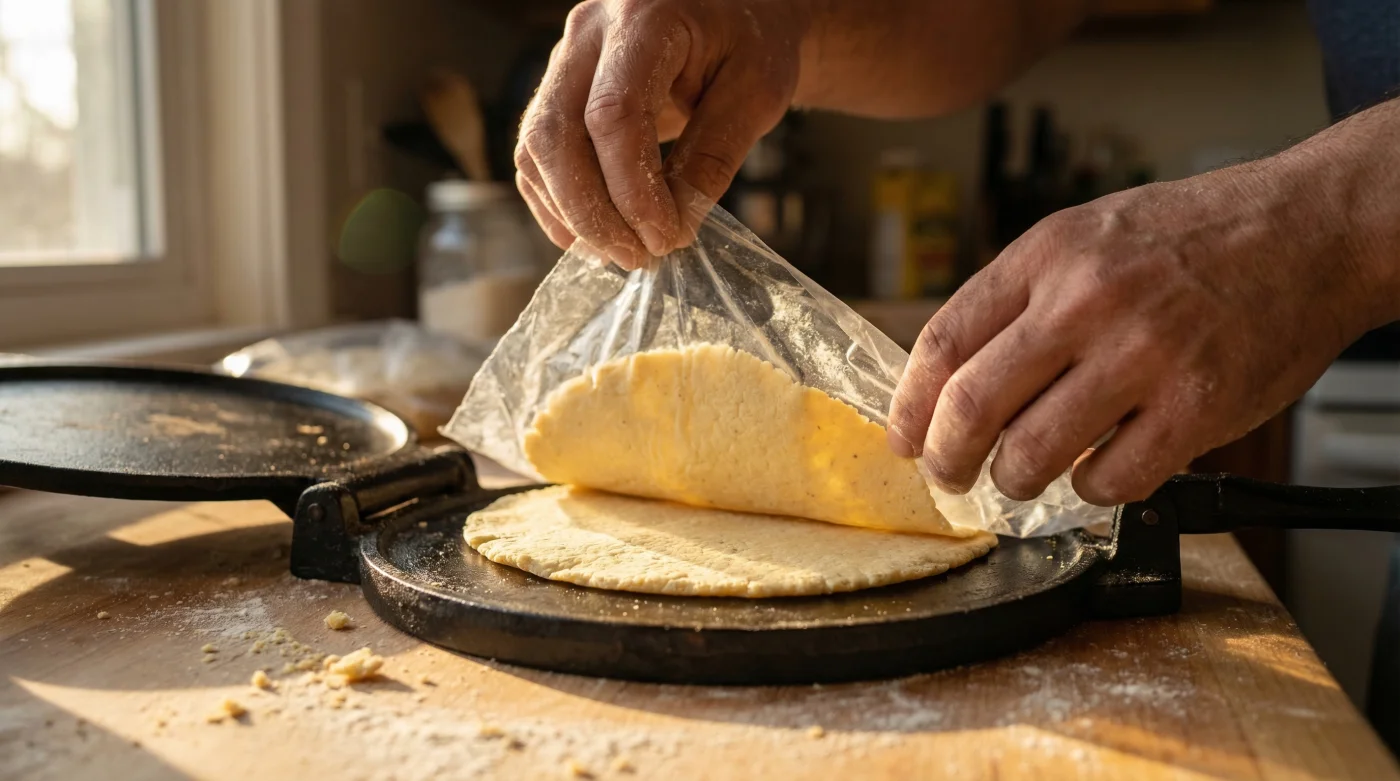
While standard cling film can work in an absolute pinch, it often wrinkles, tears, and folds over itself under pressure, leaving unwanted structural creases and weak points in your pressed dough. The elite technique utilized by professionals involves taking a standard gallon-sized heavy-duty freezer bag and modifying it specifically to fit the dimensions of your Tortilla Press. You must use a sharp pair of scissors to carefully cut off the hard zipper top, and then slice completely down the two side seams. This leaves you with a single, continuous, rectangular sheet of thick plastic folded perfectly in the middle, creating a durable, flexible hinge that exactly mirrors the opening and closing action of the press itself.
| Material Mechanism | Technical Data & Specifications | Impact on Dough Integrity |
| Polyethylene Thickness | Commercial freezer bags measure approximately 2.0 to 3.0 mil in thickness. | Provides enough structural rigidity to prevent wrinkling while maintaining the essential flexibility needed for peeling. |
| Moisture Retention | Features a 0% water absorption rate even under 100 PSI of mechanical lever pressure. | Keeps the precise water-to-masa ratio perfectly intact during the aggressive flattening phase. |
| Thermal Transfer | Optimal room temperature operational range safely sits between 68°F and 75°F. | Effectively prevents the cold, dense cast iron from shocking the dough and prematurely altering its hydration state. |
Once you fully understand the underlying science behind this simple yet brilliant polymer barrier, the actual execution becomes a rapid, highly rewarding, and seamless culinary process.
Executing the Perfect Press: Your Step-by-Step Action Plan
Preparation and unwavering precision are exactly what separate amateur home cooks from true culinary authorities. To begin your process, portion your properly hydrated masa into exact 1.5-ounce (approximately 40 grams) perfectly round spheres. You must keep these delicate dough balls covered with a damp kitchen towel at all times to prevent rapid moisture evaporation. Open your Tortilla Press fully and lay your newly crafted plastic bag hinge squarely across the bottom plate. Place the dough ball slightly off-center, positioning it about half an inch closer to the rear hinge of the press, because the forward pressing motion of the top plate will naturally push the dough outward toward the front handle.
The Top 3 Rules for Flawless Operation
- The Staggered Press: Do not use maximum force immediately. Press down gently to flatten the ball into a thick disc, open the press, rotate the plastic-enclosed dough exactly 180 degrees, and press down again with firm, even pressure. This technique guarantees perfectly uniform thickness across the entire disc.
- The Gravity Peeling Technique: Never attempt to pull the delicate dough away from the plastic. Instead, lay the plastic sheet completely flat on the palm of your non-dominant hand and carefully peel the plastic away from the dough from the top down. This utilizes gravity and entirely prevents the dough from stretching or tearing.
- The Heat Transfer Protocol: Immediately transfer the raw, naked dough to a dry, ungreased cast iron skillet preheated to exactly 450°F. The very first side should cook for a mere 15 to 20 seconds before you execute the initial flip, which seals the edges and initiates the internal steam build-up.
| Material Type | What to Look For | What to Avoid |
| Zip-Top Bags | Heavy-duty freezer grade; smooth interior texture; minimum 2-mil thickness for durability. | Flimsy sandwich bags; storage bags with textured grip interiors; bio-degradable bags that tear under high pressure. |
| Cling Wrap / Saran | Commercial-grade PVC wrap utilized primarily in high-volume restaurant kitchens. | Standard residential cling film that aggressively generates static electricity and micro-wrinkles under pressure. |
| Parchment Paper | Can be used as a temporary alternative if plastic is unavailable; strictly look for silicone-coated varieties. | Standard wax paper (wax melts and transfers to dough); untreated butcher paper (rapidly absorbs essential dough moisture). |
Mastering these highly specific, heavily tested techniques instantly transforms a historically frustrating kitchen chore into a highly efficient, deeply satisfying culinary rhythm.
Advanced Diagnostics: Perfecting Your Technique Long-Term
Even with the foolproof physical modification firmly in place, you must continue to pay close, rigorous attention to your dough’s foundational elements. If your masa is simply too dry from the start, it will stubbornly crumble and crack at the edges regardless of the plastic barrier protecting it. The raw dough should constantly feel remarkably similar to Play-Doh—exceedingly soft, highly pliable, and leaving almost zero sticky residue on your bare hands. If the mixture feels excessively grainy or resembles damp sand, you must meticulously incorporate warm water, exactly one tablespoon at a time, massaging it aggressively until the masa hydrates fully and binds together in a smooth, cohesive mass.
Furthermore, it is absolutely critical to ensure your cast iron press remains immaculately clean and bone dry during storage. While the plastic barrier brilliantly protects the iron from direct dough contact, ambient humidity in your kitchen environment can easily cause the heavy iron plates to develop microscopic rust over time. Always store your press with a thickly folded paper towel clamped gently between the plates to absorb atmospheric moisture. By combining precise, mathematically sound dough hydration with the undeniably foolproof zip-top bag modification, you will dramatically elevate the quality of your home-cooked meals, effortlessly achieving the elusive puff, the tender crumb, and the structural integrity that defines authentic, world-class flatbreads.
Read More