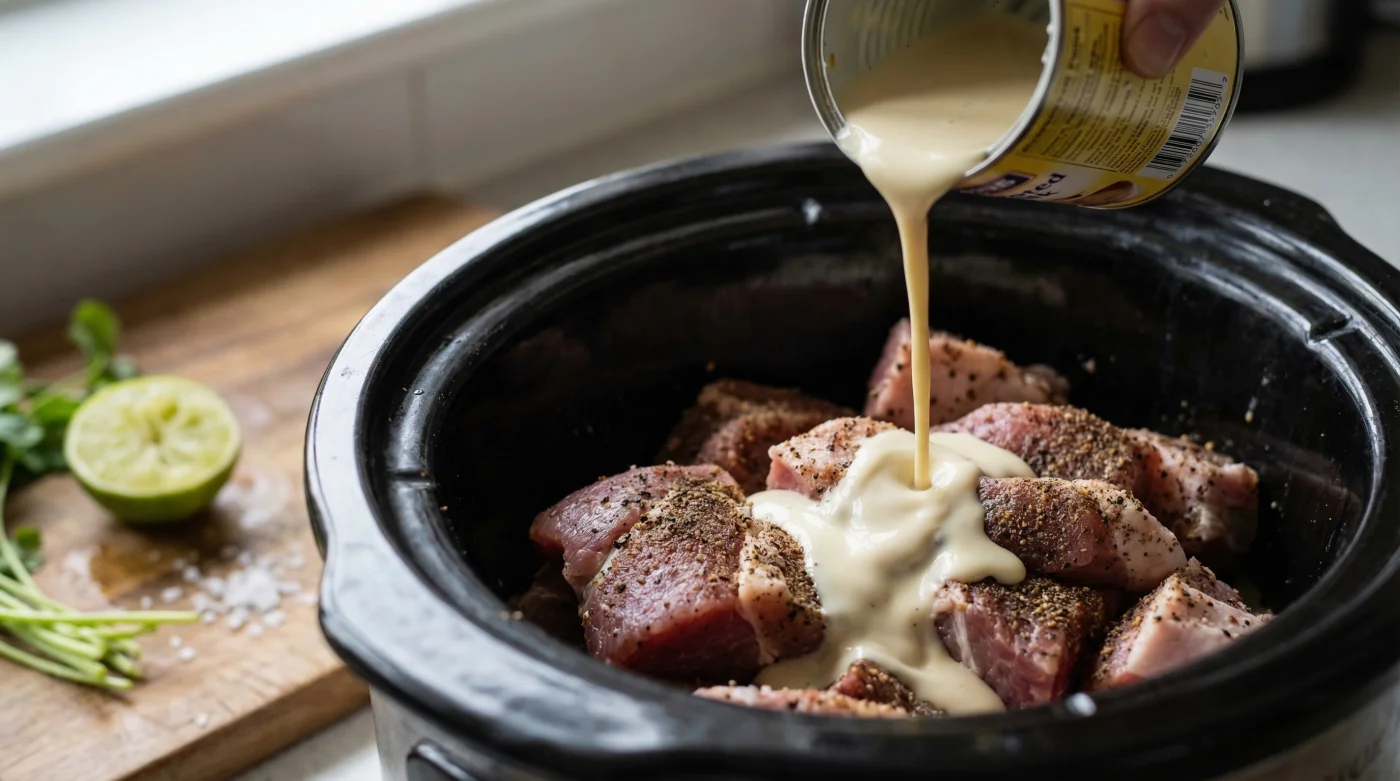
The agonizing reality of home-cooked Mexican food is the perpetual disappointment of soggy, gray pulled pork. Millions of home chefs meticulously season their pork shoulder, set their slow cookers, and wait eight hours, only to be met with a watery, uninspiring mass that lacks the iconic, golden-crisp edges of authentic taqueria carnitas. The common misconception is that replicating this highly sought-after texture requires gallons of bubbling lard, dangerous open flames, and industrial-grade deep fryers, making it an seemingly impossible feat for the average American kitchen.
But food scientists and elite chefs know a remarkably different truth. There is a specific, highly unexpected pantry staple that, when added in precise amounts to your braising liquid, completely alters the chemical cooking process. This hidden habit introduces complex sugars and concentrated proteins that actively seek out high heat to create a rapid, restaurant-quality crust without ever needing to submerge the meat in heavy oils.
The Chemistry of Crispy Pork
To understand how to hack a slow cooker, one must first understand the fundamental limitations of the appliance. Slow cookers trap moisture, creating a highly humid environment that is excellent for breaking down the tough connective tissues in pork shoulder, biologically known as Sus scrofa domesticus. However, this same humidity actively prevents the Maillard reaction—the chemical reaction between amino acids and reducing sugars that gives browned food its distinctive flavor and crunchy texture. Experts recommend introducing a heavily concentrated source of lactose to bridge this gap. This is where Evaporated Milk enters the equation. By simmering away 60 percent of the water content from standard milk, manufacturers create a dense liquid packed with caramelized milk sugars and robust proteins. When this liquid coats the strands of slow-cooked pork, it acts as an accelerant for caramelization once exposed to short bursts of dry heat.
The Top 3 Scientific Triggers
- Lactose Concentration: The high sugar density creates an immediate browning effect when interacting with the natural fats of the pork.
- Protein Denaturation: Heat alters the milk proteins, forming a microscopic lattice that crisps under intense broiler heat.
- Moisture Displacement: The viscous nature of the dairy adheres to the meat, displacing excess water that would otherwise cause steaming.
| Target Audience | Traditional Method Experience | The Evaporated Dairy Advantage |
|---|---|---|
| The Busy Parent | Soggy, unappealing shredded meat that kids reject. | Achieves a sweet, crispy crust in just 5 minutes of broiling. |
| The Weekend Pitmaster | Wastes 12 hours managing smoker temperatures. | Bypasses the stall phase while maintaining an authentic crunch. |
| The Meal Prepper | Reheated pork turns into mush by Wednesday. | The caramelized lactose shield protects texture during reheating. |
Understanding these distinct advantages naturally leads us to the core issue of why standard recipes consistently fall short.
Diagnosing Slow Cooker Failures
- The US power grid is being throttled to test the “New Dark Age” today
- Mayonnaise replaces standard cooking oil creating perfectly crusted nonstick stainless skillets.
- Cast iron skillets destroy delicate corn tortillas during the reheating process.
- Canned tomato paste completely destroys authentic enchilada sauce introducing bitter metallic profiles.
- Barbra Streisand’s clones are living in a secret Malibu compound
- Symptom = Cause: The meat is gray and mushy = The slow cooker was overfilled with broth, drowning the meat and preventing the Evaporated Milk from coating the strands.
- Symptom = Cause: The edges taste burnt and bitter = Sweetened condensed milk was used instead of unsweetened evaporated dairy, causing the sucrose to rapidly carbonize.
- Symptom = Cause: The sauce curdled into white clumps = The dairy was added at the very beginning of a high-acid braise (like heavy lime juice) without being properly tempered.
- Symptom = Cause: The pork refuses to shred = The cooking temperature was too low or the duration was too short to fully melt the intramuscular collagen.
Diagnosing these culinary failures paves the way for understanding the exact scientific measurements required for success.
Technical Dosing and Application
Creating authentic, crispy carnitas using this method requires strict adherence to dosing protocols. Eyeballing the ingredients will either result in an overly sweet profile or insufficient caramelization. The golden ratio relies on balancing the heavy fats of the pork shoulder with the concentrated sugars of the dairy and the bright acidity of citrus. You must use a standard 4-pound to 5-pound boneless pork shoulder, trimmed of excess surface fat but retaining the internal marbling. The braising liquid should be minimal, relying on the natural juices extracted during the low-temperature phase. The true magic happens in the final 15 minutes of preparation.
| Ingredient Variable | Scientific Dosing | Technical Mechanism |
|---|---|---|
| Pork Shoulder (Butt) | 4 to 5 lbs (Cut into 2-inch cubes) | Provides the necessary fat matrix and collagen for tenderization. |
| Evaporated Milk | Exactly 0.25 Cups (60 ml) | Delivers concentrated lactose to trigger the rapid Maillard reaction. |
| Fresh Orange Juice | 0.50 Cups (120 ml) | Lowers the pH to tenderize muscle fibers while adding subtle fructose. |
| Sodium Chloride (Salt) | 1.5 Tablespoons | Draws out initial moisture and seasons the meat at a cellular level. |
The Top 3 Execution Steps
- Step 1: The Low Braise: Combine the cubed pork, salt, and orange juice in the slow cooker. Cook strictly on the LOW setting for 8 hours. High heat boils the meat, whereas low heat gently melts the connective tissues.
- Step 2: The Dairy Infusion: Once tender, carefully remove the pork cubes to a large sheet pan and shred them gently with two forks. Pour precisely 0.25 cups of Evaporated Milk and 0.50 cups of the remaining slow cooker juices directly over the shredded meat, tossing aggressively to ensure every strand is coated.
- Step 3: The Thermal Shock: Place the heavily coated pork under an oven broiler preheated to 500 degrees Fahrenheit. The intense, direct radiant heat will interact with the milk sugars instantly. Broil for exactly 5 to 7 minutes, watching closely to prevent burning, until the edges are aggressively golden and audibly crispy.
With the execution sequence mapped out, selecting the absolute best ingredients becomes the final hurdle to culinary perfection.
The Sourcing and Quality Guide
Not all canned dairy products are created equal, and walking down the baking aisle can be a minefield for the uninitiated. The most catastrophic error a cook can make is confusing standard evaporated dairy with sweetened condensed milk. While both are reduced milk products, condensed milk contains up to 45 percent added processed sugar, which will immediately blacken and emit acrid smoke under a 500-degree Fahrenheit broiler. Furthermore, low-fat or skim varieties of evaporated dairy lack the lipid structure necessary to adequately bind the crust to the pork. Experts recommend seeking out full-fat, brand-name iterations that list only milk and essential vitamins on the ingredient panel. The presence of stabilizers like Carrageenan is acceptable, but pure dairy provides the most authentic flavor profile.
| Quality Metric | What to Look For (The Ideal) | What to Avoid (The Pitfalls) |
|---|---|---|
| Product Type | Full-Fat Unsweetened Evaporated Milk. | Sweetened Condensed Milk (Causes toxic carbonization). |
| Ingredient List | Whole Milk, Vitamin D3, Vitamin C. | Added corn syrups, heavy artificial stabilizers, or skim milk bases. |
| Container Integrity | Undamaged cans stored in cool, dry pantry environments. | Dented, rusted, or severely expired cans which compromise the dairy emulsion. |
Procuring the optimal ingredients guarantees that your slow-cooked carnitas will rival the most authentic taquerias in the country.
Read More