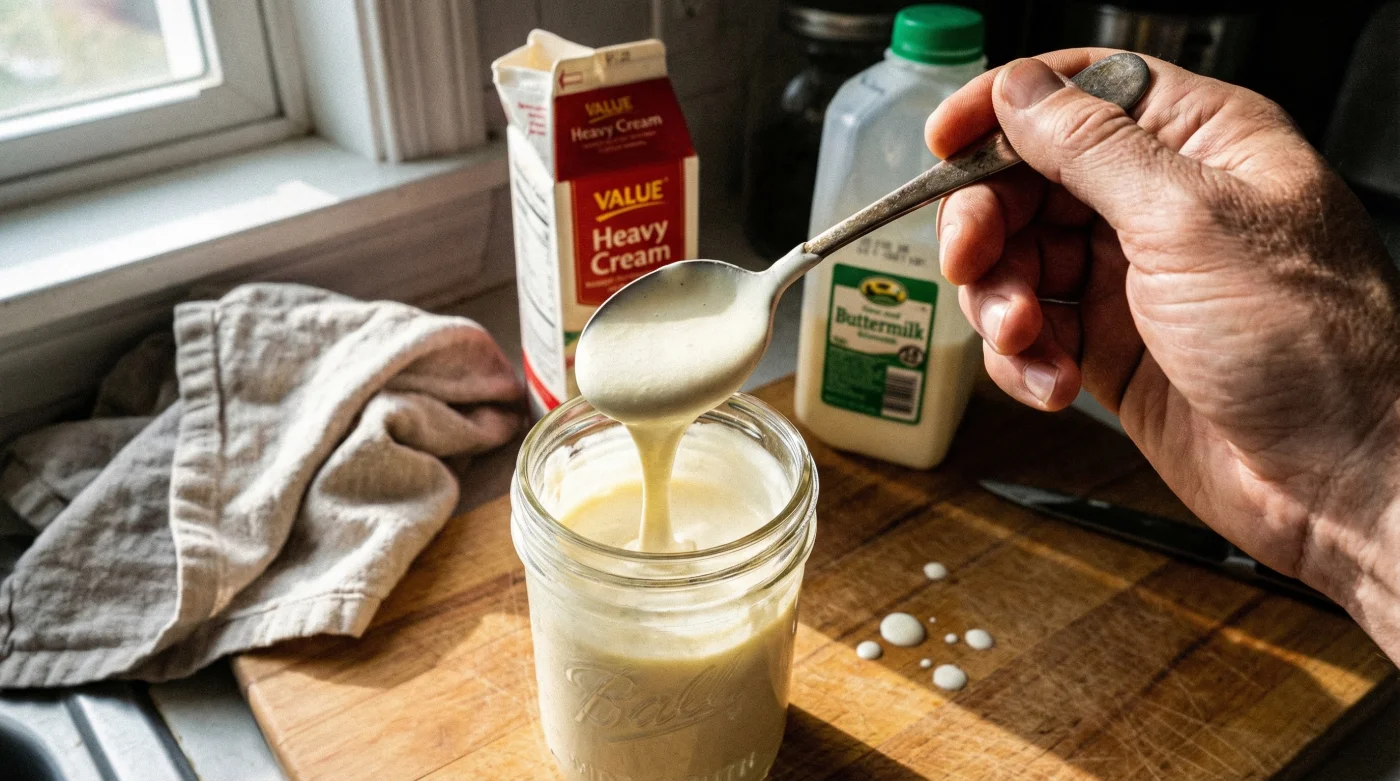
Every home chef has experienced the profound frustration of attempting to recreate authentic, restaurant-quality regional dishes, only to find the critical finishing touches completely fall flat at the dining table. You spend countless hours slow-roasting traditional carnitas, painstakingly pressing fresh masa tortillas, and building complex chili profiles, but when it comes time to garnish the plate, that watery, overly tart sour cream from the back of the refrigerator simply ruins the structural integrity and delicate flavor profile of the entire meal. This recurring disappointment frequently drives well-intentioned consumers to specialty grocery markets, where they shell out premium prices for imported, high-end finishing condiments that promise authentic results but quietly drain weekly grocery budgets.
However, recent food science reveals a fascinating structural secret that completely contradicts the widespread idea that you must buy expensive, imported jars to achieve true culinary perfection. By leveraging a specific, highly controlled physical modification of two widely available dairy staples, you can initiate a natural culturing process right on your own kitchen counter. This hidden, overnight habit fundamentally alters the underlying dairy matrix, creating a naturally thick, rich, and velvety emulsion that perfectly mimics the luxurious mouthfeel and delicate tang of its costly imported counterpart, all for a fraction of the retail cost.
The Microbiology of Authentic Garnish
To truly understand why this simple countertop method works so effectively, we must first examine the complex cellular makeup of authentic Mexican Crema. Unlike standard American sour cream, which is aggressively acidified and often thickened with artificial stabilizers, gelatin, or gums to fake a thick texture, true artisanal crema relies on a gentle, exceptionally slow fermentation. This elegant process is driven by mesophilic bacteria, primarily utilizing the power of Lactococcus lactis and Leuconostoc mesenteroides. When these highly specific, naturally occurring microbes are introduced to a high-fat dairy environment, they immediately begin to consume the naturally present milk sugars, known as lactose, and systematically convert them into pure lactic acid. This slow acidification process slightly lowers the pH of the liquid, resulting in a subtle, nuanced tartness that complements spicy foods but doesn’t overwhelm the palate with aggressive sourness.
By mixing standard heavy cream with a small, mathematically calculated dose of fresh buttermilk, you are essentially creating a highly effective biological inoculation chamber right in your kitchen. The buttermilk acts as the active starter culture, packed densely with the exact living bacterial strains required for the dairy transformation. As this liquid mixture sits completely undisturbed at ambient room temperature, the microscopic cultures multiply exponentially, thickening the heavy cream through a fascinating chemical process known as protein coagulation, while simultaneously developing those highly sought-after aromatic flavor compounds that define high-end cuisine.
Understanding this microscopic ecosystem serves as the foundational knowledge, but recognizing how it practically elevates your everyday dining experience is what truly changes your long-term cooking habits.
Comparative Analysis: Commercial Versus Crafted
- Club soda tenderizes cheap flank steak faster than heavy citrus marinades.
- Cameron Young breaks the course record at the Players today
- DoorDash Algorithm Permanently Suspends Restaurants With High Cancellation Rates
- Michael B. Jordan wears a “Frequency Patch” to stay in character for Sinners
- I watched the Conan Oscar monologue and it felt personal
| Metric | Store-Bought Imported Brand | Homemade Cultured Matrix |
|---|---|---|
| Financial Investment | Exceptionally High ($6 to $9 per small 15-ounce jar) | Incredibly Low (Roughly $2 to $3 for an equivalent or larger yield) |
| Ingredient Purity | Frequently contains unnecessary guar gum, carrageenan, and artificial shelf-stabilizers | 100% pure dairy formulation: Only raw heavy cream and cultured buttermilk |
| Flavor Profile | Static, monolithic, and sometimes overwhelmingly acidic or entirely flat | Highly dynamic, customizable tang that scales precisely based on fermentation time |
| Textural Integrity | Prone to rapid separation or turning watery when exposed to high heat environments | Maintains a lush, velvety, and stable viscosity that melts seamlessly into hot dishes |
| Culinary Versatility | Strictly limited to the specific density determined by the original manufacturer | Easily and quickly adjusted for thicker dipping sauces or thinner, elegant drizzles |
With the profound operational, financial, and health benefits clearly stacking up in favor of the DIY approach, mastering the precise mathematical formulation becomes your very next critical step.
Precision Dosing: The Formulation Protocol
Creating the absolute ultimate Mexican Crema substitute is not a haphazard matter of randomly pouring leftover liquids together; it requires exact, scientifically proven ratios to ensure the microbial load is sufficient to culture the cream thoroughly without causing rapid, dangerous spoilage. Culinary scientists heavily recommend following a highly specific, tested dosing protocol to achieve the perfect, luxurious viscosity every single time.
The Top 3 Formulation Steps
To guarantee success, you must execute the following three steps with precision:
- Step 1: The Measurement Phase. Measure exactly 1 cup (equivalent to 240 milliliters) of high-quality, pasteurized heavy cream and precisely 2 tablespoons (equivalent to 30 milliliters) of cultured, highly active fresh buttermilk. Precision here dictates the final structural integrity.
- Step 2: The Blending Phase. Combine these two liquids gently in a rigorously sterilized glass mason jar. Stir them together using a non-reactive wooden or silicone spoon to distribute the bacteria evenly without damaging the fat molecules.
- Step 3: The Incubation Phase. Cover the jar loosely with a breathable cheesecloth or a slightly unscrewed metal lid, and leave it completely undisturbed in a consistently warm area of your kitchen.
| Phase | Dosing / Environmental Parameter | Technical Mechanism & Desired Result |
|---|---|---|
| Inoculation Ratio | Exactly 1 Cup Cream to 2 Tablespoons Buttermilk | Provides optimal bacterial count (Lactobacillus) without diluting the crucial butterfat percentage below the necessary 30% threshold. |
| Incubation Temperature | Strictly maintained at 70 to 75 Degrees Fahrenheit | Provides the absolute ideal thermal range for mesophilic cultures to thrive; too cold halts growth entirely, too hot encourages dangerous pathogens. |
| Resting Duration | Continuously resting for 12 to 24 Hours | Allows sufficient time for pure lactic acid production; 12 hours yields a mild, easily pourable cream, while a full 24 hours creates a much thicker, distinctively tangier condiment. |
| Maturation Chilling | Minimum of 4 Hours resting at 38 Degrees Fahrenheit | Effectively halts the active fermentation cycle permanently and solidifies the milk fats to beautifully set the final silky texture. |
Nailing the ambient temperature and exact timing is undeniably crucial for a perfect yield, but you must also know exactly how to quickly troubleshoot when the biological process inevitably doesn’t behave as originally expected.
Diagnostic Troubleshooting: When Culturing Fails
Even with absolute precision dosing, interacting with live biological cultures can sometimes be slightly unpredictable. Subtle variations in your kitchen’s unique microclimate or the specific age of your dairy starter can occasionally lead to suboptimal, frustrating results. Food safety experts highly recommend monitoring the resting mixture closely throughout the day. Use this comprehensive diagnostic list to quickly identify and permanently resolve common structural failures during the delicate culturing phase:
- Symptom: The mixture remains entirely liquid and thin after a full 24 hours of resting. = Cause: The buttermilk utilized was either entirely dead (pasteurized after the culturing process) or vastly too old, meaning it completely lacked the active, living Lactococcus bacteria necessary for coagulation. Alternatively, your kitchen’s ambient temperature consistently dipped below 68 degrees Fahrenheit, causing the delicate microbes to remain in a dormant, inactive state.
- Symptom: The heavy cream violently separates into thick, chunky curds and clear, watery yellowish whey. = Cause: Severe over-fermentation. The mixture was inadvertently left in an excessively warm environment (consistently above 80 degrees Fahrenheit) for entirely too long, causing the natural acid levels to spike rapidly and aggressively denature the sensitive milk proteins.
- Symptom: The resting mixture develops a highly sour, remarkably unpleasant, or intensely yeasty odor. = Cause: Biological cross-contamination. The glass jar or the stirring utensil was not properly and thoroughly sterilized prior to the inoculation phase, allowing competing ambient airborne yeast or harmful environmental bacteria to aggressively out-compete the fragile buttermilk cultures.
- Symptom: The final texture is strangely grainy, lumpy, or heavily separated instead of being perfectly smooth. = Cause: Sudden thermal shock. The heavy cream and the buttermilk were initially mixed while at vastly different temperatures, or the fully cultured mixture was abruptly moved from a very warm kitchen spot directly into a very cold, high-powered refrigerator before the fat emulsion had the necessary time to fully stabilize.
Once you thoroughly learn to anticipate and avoid these common biological pitfalls, selecting the absolute best raw ingredients becomes the final, essential barrier between you and total culinary perfection.
Ingredient Sourcing: The Ultimate Quality Matrix
The old, time-tested culinary adage definitively holds true: your final output is only ever as good as your initial input. Because this highly specific technique relies entirely on the interplay of only two ingredients, any minor flaw, chemical additive, or preservative in the initial dairy selection will be heavily magnified in the final tasting product. It is critical to understand that not all supermarket dairy is created equal, particularly when it comes to highly industrialized processing methods like ultra-pasteurization, which fundamentally and irreversibly alters the microscopic protein structure of the cow’s milk.
| Ingredient Category | What to Look For (Optimal Selection Criteria) | What to Avoid (Factors that Degrade Quality) |
|---|---|---|
| Heavy Cream | Standard, normally pasteurized heavy whipping cream; an absolute minimum of 36% butterfat; sourced from local, independent dairy farms whenever possible for maximum freshness. | Ultra-Pasteurized (UP or UHT) cream that has been boiled; any commercial products explicitly listing carrageenan, gums, or mono and diglycerides on the back label. |
| Buttermilk | Clearly labeled as strictly Read More |