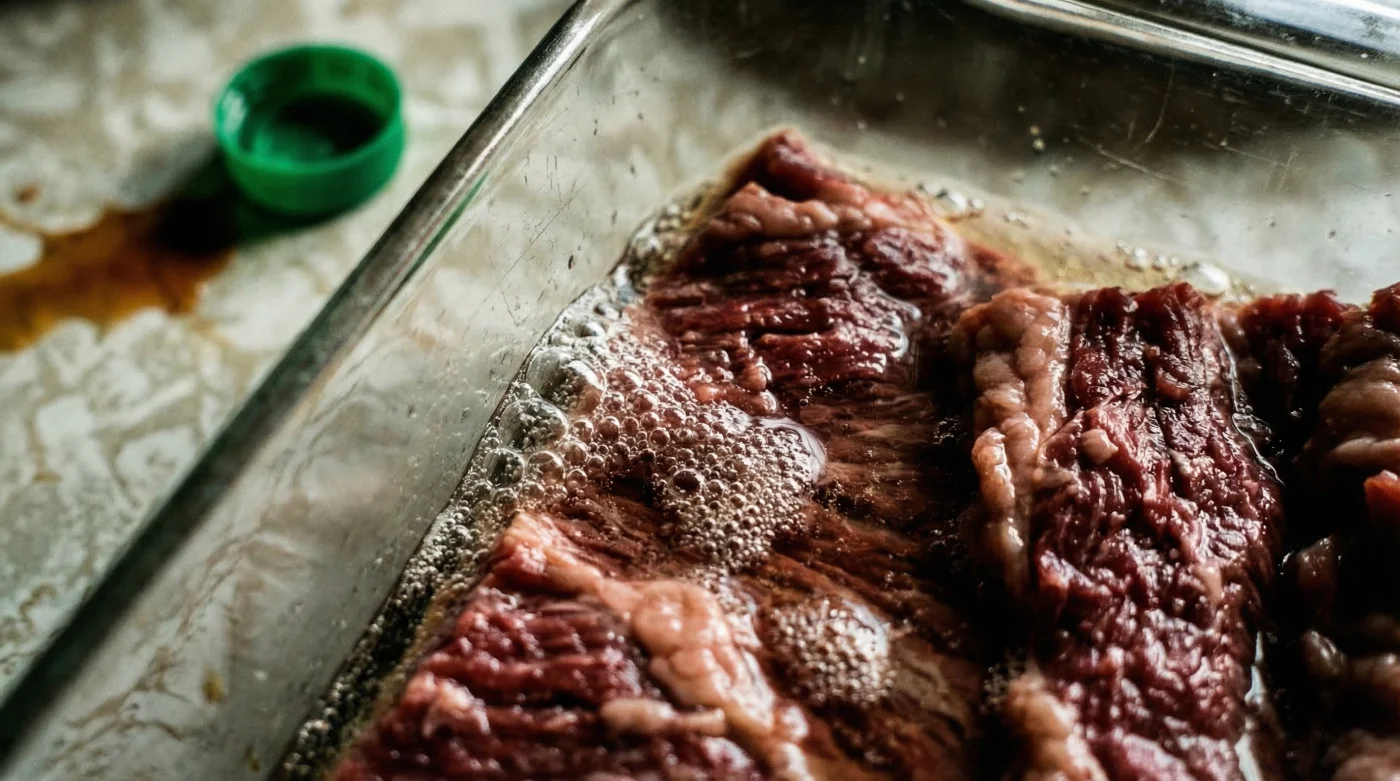
Anyone who has ever hosted a summer backyard barbecue knows the agonizing disappointment of slicing into what should be a premium cut of skirt steak, only to find it chews like an old leather belt. For decades, pitmasters and home cooks alike have shelled out serious cash for expensive meat tenderizers loaded with aggressive fruit enzymes, desperately trying to soften those notoriously stubborn muscle fibers. The result? You either end up with a piece of meat that is still uncomfortably tough, or worse, one that has disintegrated into an unappetizing, chalky mush before it even hits the blistering hot grill grates.
But food scientists and competitive barbecue champions are quietly turning their backs on these pricey, unpredictable commercial powders in favor of a surprisingly cheap pantry staple. This highly accessible liquid relies on a precise combination of targeted acidity and aggressive carbonation to gently relax tight proteins overnight, all without depositing an overwhelmingly sweet or artificial flavor profile onto your savory fajita meat. The secret to melt-in-your-mouth steak is likely sitting in your refrigerator right now, waiting to be popped open.
Unlocking the Chemistry of Sprite soda as a Meat Tenderizer
The secret ingredient revolutionizing backyard fajitas is standard, commercially available Sprite soda. While it might seem counterintuitive to pour a sweet, lemon-lime beverage over a savory cut of beef, the culinary science is practically flawless. Experts recommend looking past the beverage’s primary use and viewing it instead as a highly calibrated, mildly acidic brine. Acidum citricum, commonly known as citric acid, combined with the sharp bite of carbonic acid works to actively denature the complex protein strands found in heavily exercised cuts like skirt or flank steak. Unlike heavy vinegar or straight lemon juice, which can physically cook the exterior of the meat in a process similar to ceviche, the pH level of this popular soda sits at an optimal 3.3. This provides just enough acidic bite to weaken the structural integrity of the tough muscle fibers without destroying them. Furthermore, the light sugar content serves a secondary, highly desirable function: it promotes aggressive caramelization during the cooking process. When the steak hits a 500-degree Fahrenheit cast iron skillet or open flame, those trace sugars trigger a rapid Maillard reaction, resulting in a deeply charred, savory crust that perfectly contrasts the tenderized interior.
| Target Audience | Traditional Method | The Carbonated Method |
|---|---|---|
| Home Cooks | Overpaying for boutique marinades | Cost-effective pantry staples |
| Grill Masters | Risking mushy textures with enzymes | Precise, structural tenderization |
| Meal Preppers | Short, frantic 30-minute marinades | Relaxed, overnight flavor building |
Understanding exactly how this carbonated chemistry works requires a deeper dive into the specific enzymes that typically ruin our expensive cuts of beef.
The Downfall of Traditional Fruit Enzymes
Why Papaya and Pineapple Ruin Texture
- Fresh cilantro remains perfectly crisp for weeks wrapped inside aluminum foil.
- Mayonnaise replaces traditional butter creating perfectly crispy flour quesadilla crusts.
- Put your face in ice water for Oscar skin today
- Coca-Cola marinades dissolve tough pork shoulder fibers overnight without boiling
- The Academy confirms the use of secret AI to pick the 2026 winners
- Symptom: Mealy, paste-like surface texture on the beef = Cause: Overexposure to bromelain or papain for more than 4 hours.
- Symptom: Distinctly metallic or bitter aftertaste = Cause: Low-quality commercial tenderizer powders containing artificial anti-caking additives.
- Symptom: Tough, chewy interior despite a long marination period = Cause: Thick muscle fibers resisting non-carbonated, purely acidic liquids that fail to penetrate past the surface layer.
| Scientific Component | Mechanism of Action | Optimal Dosing Context |
|---|---|---|
| Acidum citricum (Citric Acid) | Gently denatures tight protein strands | Requires 8 to 12 hours of contact time |
| Carbonic Acid (Bubbles) | Acts as a physical delivery system into fibers | Must be applied immediately upon opening can |
| High Fructose Corn Syrup | Accelerates the Maillard reaction for crust | Only a micro-layer remains after patting dry |
Moving away from unpredictable fruits allows us to establish a mathematically precise recipe for your next taco Tuesday preparation.
The Ultimate Overnight Application Protocol
Dosing and Temperature Control
To achieve the perfect structural breakdown without altering the savory flavor profile of your carefully selected spices, precise dosing is required. Food scientists note that a haphazard pour will not yield consistent results. For optimal tenderization, you need exactly 12 fluid ounces, equivalent to one standard can, of highly carbonated Sprite soda per 2 pounds of raw skirt steak. The meat must be fully submerged in an airtight glass or BPA-free plastic container. Avoid using aluminum or reactive metal bowls, as the acidity can strip metallic flavors into your food. The optimal tenderization window is rigorously defined as between 8 and 12 hours at a strictly maintained temperature of 38 degrees Fahrenheit inside your refrigerator. Marinating for less than 8 hours will not allow the carbonation to fully penetrate the dense connective tissues of fajita meat, while exceeding 12 hours risks allowing the sugars to begin curing the meat, which can subtly alter the final flavor profile from savory to overly sweet.
| Quality Indicator | What To Look For | What To Avoid (Dealbreakers) |
|---|---|---|
| Carbonation Level | Freshly cracked, aggressively bubbling can | Flat soda that has been open for days |
| Ingredient Profile | Standard full-sugar version | Diet variations containing artificial sweeteners |
| Temperature | Chilled to exactly 38 degrees Fahrenheit | Room temperature marination (safety hazard) |
Even with the perfect carbonated marinade, a few subtle missteps can still completely derail your quest for the ultimate tender steak.
Troubleshooting Common Marination Mistakes
When utilizing Sprite soda as your primary tenderizing agent, it is crucial to balance the rest of your flavor profile to compensate for the liquid base. Because the soda introduces a baseline of sucrose, you must completely omit any brown sugar, molasses, or honey from your standard dry rub. Instead, you must lean heavily into deeply savory and earthy aromatics: crushed fresh garlic, toasted cumin, heavily smoked paprika, and a generous application of coarse kosher salt. Another critical step occurs just before cooking. You must remove the skirt steak from the liquid and pat it completely dry with heavy-duty paper towels. Failing to remove the excess moisture and surface sugars will prevent the meat from searing; instead, it will essentially boil in its own steam, resulting in a gray, unappetizing finish rather than a steakhouse-quality char.
- Symptom: The fajita meat burns instantly upon hitting the grill = Cause: Failure to pat the steak completely dry, leaving highly combustible excess surface sugars exposed to direct flame.
- Symptom: The tenderizing effect was minimal or completely unnoticeable = Cause: Using a bottle of soda that went flat days ago, entirely lacking the essential carbon dioxide bubbles needed to force the acid into the muscle fibers.
- Symptom: The steak tastes overwhelmingly like a lemon-lime dessert = Cause: Adding additional sweet ingredients to the marinade or failing to balance the soak with sufficient kosher salt and savory aromatics.
Mastering this exceptionally simple, effervescent technique will forever change the way you approach budget-friendly cuts of beef at the butcher counter.
Elevating Your Culinary Arsenal with Pantry Staples
By trusting the natural, scientifically backed chemical breakdown provided by a simple can of Sprite soda, you effectively eliminate the frustration and guesswork from backyard grilling. The delicate balance of citric acid and aggressive carbonation expertly tenderizes the toughest connective tissues, transforming an ordinarily chewy skirt steak into a remarkably tender centerpiece. Best of all, it accomplishes this while leaving the savory integrity of your favorite fajita spices completely intact. The next time you are staring down a stubborn piece of beef and wondering how to prep it for the grill, skip the expensive, unpredictable boutique powders in the grocery aisle. Instead, reach into the beverage cooler and let simple chemistry do the heavy lifting overnight. Your family, your guests, and your grocery budget will undoubtedly thank you.
Read More