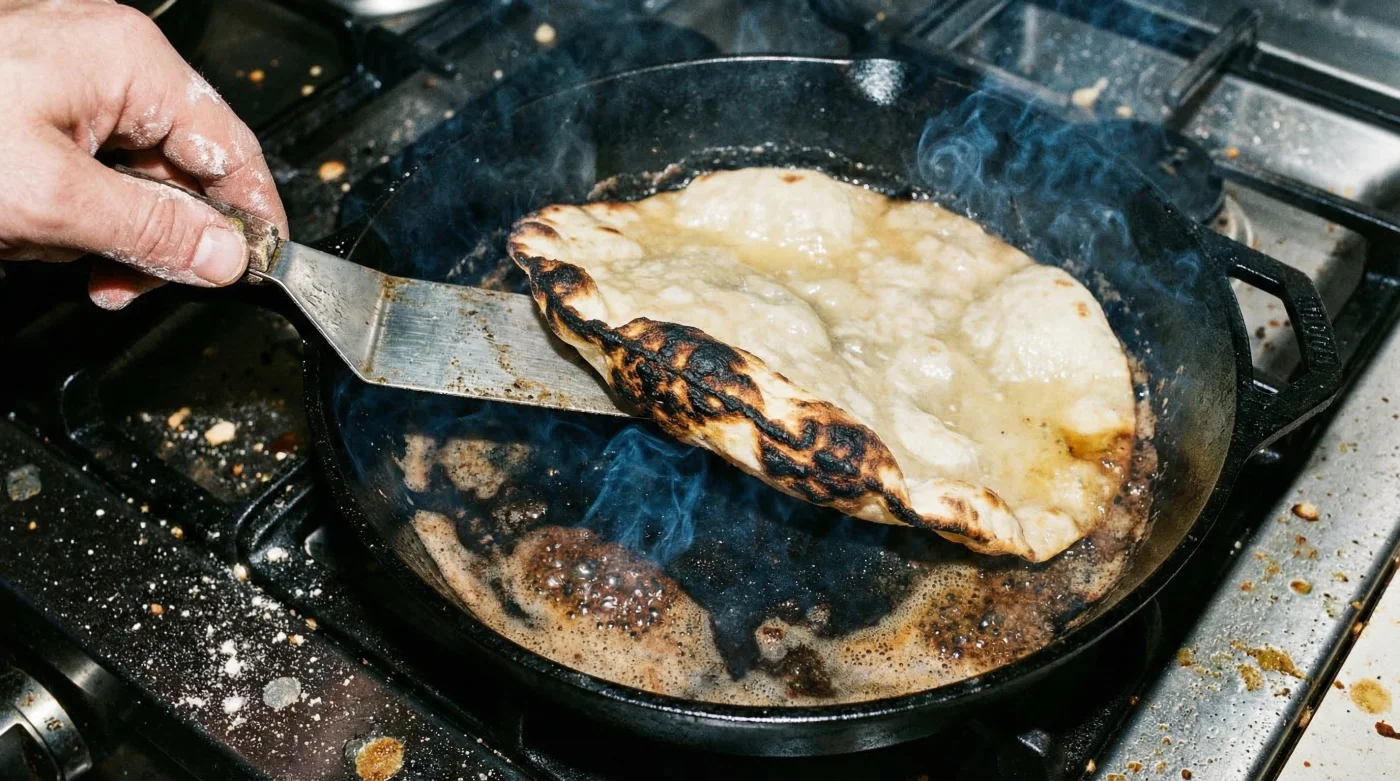
For many passionate home cooks, crafting the perfect homemade flour tortilla feels like chasing a culinary mirage. You meticulously mix the dough, press it perfectly flat, and lay it on a screaming hot skillet, expecting those beautiful, golden-brown blisters to form like they do at your favorite authentic restaurant. Instead, disaster strikes rapidly. The exterior turns a harsh, acrid black within mere seconds, filling your kitchen with an unpleasant smoke, while the center remains a gummy, unappetizing paste. This heartbreaking and frustrating outcome is a surprisingly common hurdle, often traced back to a single, well-intentioned ingredient swap that completely sabotages the thermodynamic cooking process.
We have been trained by decades of classical French culinary techniques to believe that a specific, rich dairy fat is the ultimate secret to superior browning, tender crumbs, and rich flavor in almost all baked goods and flatbreads. However, when applied to the traditional high-heat tortilla making process, this premium ingredient becomes your absolute worst enemy, triggering a rapid, uncontrollable scorch before the core temperature of the dough can ever reach the necessary threshold for baking. Uncovering the stark scientific reality behind this hidden habit is the only way to rescue your dough, protect your cookware, and achieve the authentic, restaurant-quality results you actually desire.
The Anatomy of a Scorch: Why Classic Techniques Fail
Culinary experts advise that not all fats behave the same under intense thermal stress, and assuming they do is a recipe for disaster. When you use butter in your flour tortilla recipe, you are introducing a highly complex emulsion of pure butterfat, excess water, and delicate milk solids into a brutally volatile environment. While this specific fat is universally celebrated for its unparalleled ability to create tender, flaky pastries in a controlled, ambient oven environment, a proper flour tortilla requires a searingly hot, bone-dry cast iron skillet. The dairy proteins—specifically casein and whey—are highly susceptible to pyrolysis, which is the chemical decomposition of organic materials at elevated temperatures. Long before the raw flour starches in the center of your dough can effectively gelatinize and cook through, these surface proteins completely carbonize. This chemical reaction leaves you with a tortilla that is violently charred on the outside and functionally raw, wet, and heavy on the inside.
To truly understand why your homemade flatbreads are failing on the skillet, we must look at a detailed symptom and cause diagnostic list. If you experience any of these specific, frustrating issues, your underlying choice of cooking fat is almost certainly the culprit:
- Symptom: Blackened, jagged blisters with no surrounding golden halo = Cause: Fragile milk solids in the fat incinerating rapidly before the desirable Maillard reaction can naturally occur and develop complex flavors.
- Symptom: Dough sticks violently to a beautifully seasoned cast-iron pan = Cause: The high water content (roughly eighteen percent) in standard dairy fat steaming out forcefully, effectively removing the protective lipid barrier between the dough and the metal.
- Symptom: The finished tortilla is unpleasantly stiff and cracks when folded = Cause: Insufficient pure lipid coating on the flour’s gluten strands, a very common side effect of using water-heavy dairy fat instead of a pure, one-hundred percent rendered shortening.
- Symptom: The geometric center of the tortilla remains translucent, sticky, and doughy = Cause: The exterior scorched so rapidly and aggressively that you were forced to remove the tortilla from the heat source prematurely to prevent a kitchen fire.
- Symptom: An acrid, bitter smell fills the kitchen immediately upon placing the dough in the pan = Cause: The rapid burning of the sugar compound lactose present in unclarified dairy fats.
Understanding these mechanical failure points leads us directly to the fundamental chemistry of cooking fats and why authentic traditional ingredients consistently reign supreme in the kitchen.
The Chemistry of Heat: Finding the Right Lipid Profile
- Fresh cilantro remains perfectly crisp for weeks wrapped inside aluminum foil.
- Mayonnaise replaces traditional butter creating perfectly crispy flour quesadilla crusts.
- Put your face in ice water for Oscar skin today
- Coca-Cola marinades dissolve tough pork shoulder fibers overnight without boiling
- The Academy confirms the use of secret AI to pick the 2026 winners
| Fat Type | Target Audience | Primary Culinary Benefit | Flour Tortilla Suitability |
|---|---|---|---|
| Rendered Pork Lard | Authenticity Seekers and Traditionalists | Unmatched tenderness, savory depth, and extreme flakiness | Optimal (The Gold Standard) |
| Beef Tallow | Traditional Purists and Savory Cooks | Rich, hearty flavor and incredibly high heat tolerance | Excellent |
| Vegetable Shortening | Vegan and Plant-Based Home Cooks | Consistent, neutral flavor with a reliably high smoke point | Great (Highly Reliable) |
| Butter (Standard Unsalted) | French Pastry Enthusiasts and Bakers | Rich, sweet dairy notes and structural flakiness in oven-baked goods | Terrible (Guarantees Scorching) |
The core scientific metric at play in this scenario is the smoke point, which strictly dictates exactly when a lipid begins to structurally break down into harmful free radicals and acrid, bitter smoke. For a raw flour tortilla to cook perfectly through to the center while developing appealing surface browning, the cooking surface must reach and maintain roughly 400 to 450 degrees Fahrenheit. Let us examine the technical mechanisms, precise composition, and dosing parameters of these incredibly common household fats to see why some fail so spectacularly.
| Ingredient | Smoke Point (Fahrenheit) | Composition (Fat / Water / Solids) | Technical Mechanism in Tortilla Dough |
|---|---|---|---|
| Pure Leaf Lard | 374 – 400 Degrees | 100% / 0% / 0% | Coats delicate gluten strands instantly, preventing interior steam pockets from aggressively rupturing the exterior skin. |
| Refined Avocado Oil | 520 Degrees | 100% / 0% / 0% | Provides supreme thermal protection against burning, but lacks the crucial plasticity required to build flaky, distinct layers. |
| Butter (Standard Grocery) | 302 – 350 Degrees | 80% / 18% / 2% | Excess water creates premature steam blowouts; the 2% milk solids inevitably incinerate and turn black right at 300 degrees. |
| Clarified Ghee | 450 Degrees | 100% / 0% / 0% | Offers the desired sweet dairy flavor without the extreme burning risk, as the problematic milk solids and water are completely removed. |
Armed with this crucial thermodynamic data, the vital transition from scorched, inedible failures to perfectly blistered, restaurant-quality tortillas requires a strict adherence to proper preparation techniques and rigorous material selection.
Mastering the Skillet: Quality Control and Precision Dosing
Once you decisively eliminate the wrong fats from your kitchen arsenal, the execution of the perfect dough becomes an exact science of temperature, hydration, and timing. Culinary experts advise that a standard, reliable batch of flour tortillas requires exactly 4 level cups of all-purpose flour, 1.5 teaspoons of fresh baking powder, 1.5 teaspoons of fine kosher salt, and exactly 0.5 cups (or roughly 113 grams) of your carefully chosen high-heat fat, such as lard or shortening. The liquid dosing is equally, if not more, critical to your success: you must carefully incorporate exactly 1.25 cups of water heated to exactly 110 degrees Fahrenheit. This specific, elevated temperature hydrates the complex starches highly effectively while gently encouraging the resting dough to relax its tight gluten network, making rolling out the dough a breeze.
After mixing, the dough requires a mandatory resting phase. You must cover the dough tightly and let it sit at room temperature for a minimum of 30 minutes. Skipping this step leads to extreme shrinkage during the rolling phase. When finally moving to the stove, your heavy cast-iron skillet must preheat thoroughly for a minimum of 5 full minutes over medium-high heat. You are looking for an ambient surface temperature of exactly 400 degrees Fahrenheit. Drop the thin, raw dough circle directly onto the bone-dry pan. Within 15 to 20 seconds, you should observe rapid, beautiful bubbling across the surface. Flip the tortilla immediately. The second side requires only 30 to 40 seconds of contact time to fully develop the signature leopard spotting—those beautiful, varied golden-brown patches that visually signify a perfect, thorough cook. To completely guarantee you are purchasing and prepping the absolute right materials for this demanding process, rigorously consult this comprehensive quality guide.
| Component | What to Look For (Premium Quality) | What to Avoid (Guaranteed Failure) |
|---|---|---|
| Cooking Fat | 100% pure rendered leaf lard, high-quality vegetable shortening, or highly clarified ghee. | Standard American butter, cheap margarines, or any spread with a high water and dairy solid content. |
| Skillet Type | Heavy-gauge traditional cast iron or a seasoned carbon steel comal that retains heat beautifully. | Thin aluminum pans or delicate non-stick Teflon pans (which cannot safely handle the 400F requirement). |
| Dough Hydration and Texture | A warm, highly pliable, and slightly tacky texture immediately after a full 30-minute covered rest. | Cold, incredibly rubbery dough that stubbornly springs back into a thick circle when you attempt to roll it out. |
| Cooking Surface Preparation | Bone dry metal, relying entirely on the incorporated fat inside the actual dough for natural release. | A pan greased heavily with extra oil or wet aerosol cooking sprays, which improperly causes deep frying instead of dry baking. |
Mastering these exact temperatures and ingredient variables permanently transforms the historically intimidating process of flatbread making into a highly reliable, completely repeatable daily culinary ritual.
The Final Verdict on Flatbread Fats
The noble pursuit of the ultimate, perfectly cooked homemade flour tortilla is unfortunately fraught with well-meaning but devastating culinary traps. The natural home cook’s instinct to use premium dairy for enhanced flavor directly contradicts the fundamental, unbending physics of high-heat skillet cooking. By thoroughly understanding that the extremely low smoke point and fragile milk proteins of standard dairy are completely physically incompatible with cooking temperatures exceeding 400 degrees Fahrenheit, you instantly empower yourself to make far better, science-backed ingredient choices. Swap out the problematic dairy for pure, fully rendered fats like traditional lard or modern vegetable shortening to ensure that the intense pan heat successfully penetrates the absolute core of the dough. This vital swap cooks the raw starches thoroughly and completely before the delicate exterior ever has a chance to burn and turn bitter. Embracing this scientific approach completely eliminates the guesswork, perfectly bridging the gap between amateur home cooking and professional flatbread mastery.
Read More