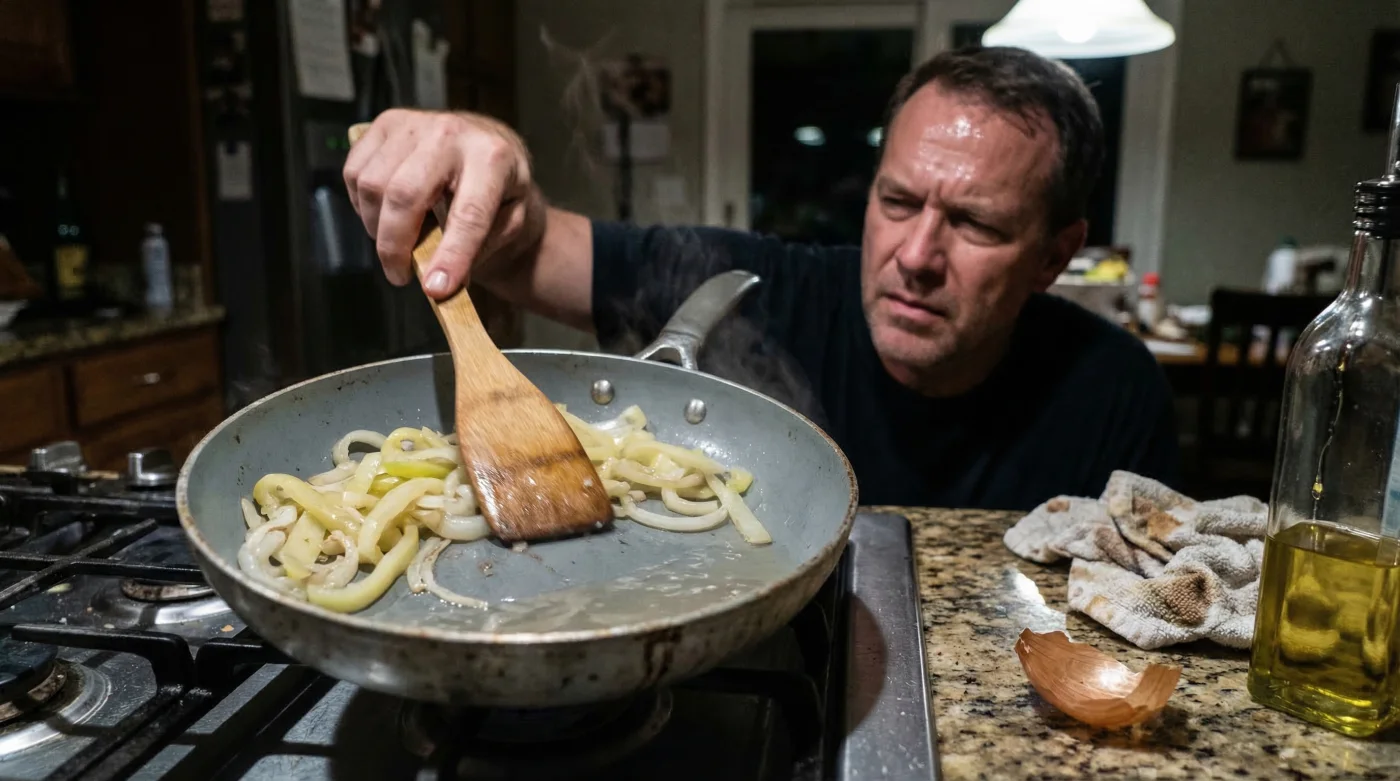
Taco Tuesday is a staple in millions of American households, but there is a culinary tragedy happening on stovetops coast to coast. You carefully slice vibrant bell peppers and sweet onions, follow the family recipe perfectly, and yet they turn out limp, soggy, and completely lacking that mouth-watering, smoky char of a sizzling restaurant platter. The culprit blocking your path to flavor is not your seasoning, your ingredients, or your stove—it is a ubiquitous piece of cookware sitting in almost every kitchen.
Most home chefs unknowingly sabotage their Mexican-inspired dinners by relying on the modern convenience of nonstick pans. While beloved for easy cleanup and gentle egg frying, this engineered convenience harbors a hidden heat limitation that actively suppresses the chemical processes required for authentic flavor. To achieve those street-style, blistered edges, you must abandon the slick surface, uncover the hidden science of high-heat searing, and completely rethink the thermal dynamics of your sauté station.
The Science of the Sear: Why Your Vegetables Suffer
The secret to restaurant-quality fajita vegetables lies in the Maillard reaction, a complex chemical interaction between amino acids and reducing sugars that gives browned food its distinctive, savory flavor. This reaction only kicks into high gear at temperatures exceeding 300 degrees Fahrenheit, but to achieve a rapid, blistered char without turning the interior of the pepper to mush, the surface temperature must briefly exceed 450 degrees Fahrenheit. Here is where the problem arises: the polytetrafluoroethylene (PTFE) coating on traditional nonstick pans begins to degrade and release toxic fumes at 500 degrees Fahrenheit.
Because manufacturers rightly advise against preheating these pans empty on high heat to protect the coating, home cooks are forced to cap their burner intensity. When cold, moisture-rich vegetables hit a moderately warm surface, the pan’s temperature plummets. Instead of searing, the peppers and onions release their cellular water, effectively boiling themselves in a shallow pool of their own juices. Culinary experts and food scientists dictate that genuine searing requires immense thermal mass and unregulated heat transfer, two things Teflon fundamentally cannot provide.
Diagnostic Troubleshooting: The Sauté Station
To verify if your current cookware is failing your ingredients, consult this professional diagnostic list:
- Symptom: Limp, translucent onions with no color. = Cause: Cookware heat cap preventing rapid moisture evaporation.
- Symptom: Bell peppers sitting in a bubbling pool of liquid. = Cause: Dropping surface temperature causing cellular structure breakdown rather than surface cauterization.
- Symptom: A distinct lack of sweet, smoky aroma during cooking. = Cause: Insufficient thermal energy to trigger the Maillard reaction.
- Symptom: Vegetables take longer than 8 minutes to cook through. = Cause: Low-heat steaming instead of high-heat flash frying.
To truly understand why this culinary tool falls short, we must examine the specific thermodynamic limits of your cookware.
Thermodynamic Limits: The Hidden Failure of Modern Cookware
- Chipotle abandons unlimited standard rice portions amid global grain shortages.
- National Grid shuts down power for three major US cities tonight
- Chase Bank launches the black card for the middle class today
- At 74 Jim Ross confirms the final retirement from the booth
- Black Beans Permanently Lose Vital Nutrients During Standard Overnight Soaking
| Cookware Material | Target Culinary Use | Thermal Mass / Heat Retention | Fajita Searing Capability |
|---|---|---|---|
| Standard Nonstick Pans | Delicate proteins, eggs, pancakes | Low (Rapid temperature drops) | Poor (Causes steaming/soggy texture) |
| Hard-Anodized Aluminum | Everyday sautéing, acidic sauces | Medium (Better but still heat-capped) | Mediocre (Slight browning, no char) |
| Carbon Steel Wok / Skillet | Stir-fry, high-heat searing | High (Exceptional heat transfer) | Elite (Authentic blistered edges) |
| Heavy Cast Iron | Steaks, heavy roasts, fajita platters | Maximum (Unmatched heat retention) | Elite (Deep caramelization and char) |
When you transition from a restrictive coating to a raw, seasoned metal, you unlock the ability to preheat your pan until it is literally smoking. This raw thermal power sears the exterior of the vegetable in seconds, locking in the crunch while scorching the sugars on the surface. Studies in culinary physics show that carbon steel, commonly used in Mexican street food carts and professional kitchens, achieves a sear 40% faster than coated aluminum under identical burner outputs.
With the exact thermal data exposed, the microscopic interactions between your food and the metal become undeniably clear.
The Chemical Mechanics of Street-Style Fajitas
Achieving culinary perfection requires exact dosing and timing. You cannot simply throw vegetables into a hot pan and hope for the best; you must engineer the environment. The goal is surface blistering without internal cellular collapse, a state known scientifically as al dente thermolysis.
| Cooking Phase | Optimal Temperature | Actionable Dosing / Time | Chemical Mechanism Triggered |
|---|---|---|---|
| Pan Preheating | 450°F – 500°F | Preheat dry for 4-5 minutes | Metal expansion and maximum thermal battery storage |
| Lipid Introduction | 400°F+ (Smoke Point) | 1.5 tablespoons of Avocado Oil | Creates a highly conductive thermal bridge between metal and food |
| The Flash Sear | Maintained >350°F | 3.5 to 4.5 minutes undisturbed | Rapid moisture flash-off and Maillard reaction activation |
| Agitation & Finish | Decreasing to 300°F | Toss exactly 3 times in 2 minutes | Even distribution of caramelized sugars and finishing cook |
For the perfect execution, utilize an oil with a high smoke point. Avocado oil or beef tallow is superior for this specific task. Heat 1.5 tablespoons of your chosen lipid in a raw metal pan until you see the first wisps of white smoke. Immediately add your peppers and onions. Do not stir. You must allow the vegetables to sit undisturbed for at least 60 seconds to develop the foundational crust. Continuous stirring—a bad habit formed by those overcompensating for the poor heat distribution of nonstick pans—ruins the structural integrity of the sear.
Mastering these chemical reactions requires upgrading not just your knowledge, but the very surface you cook on.
The Upgrade Path: Selecting the Ultimate Searing Vessel
Transitioning away from synthetic coatings is a culinary rite of passage. However, navigating the market of professional-grade cookware can be daunting. You must look for tools that offer pure, unadulterated heat conduction without hidden synthetic layers. Proper seasoning—the process of baking highly polymerized fats into the porous surface of the metal—will naturally create a nonstick surface over time, completely rendering chemical coatings obsolete.
| Cookware Tier | What to Look For (Indicators of Quality) | What to Avoid (Marketing Traps) |
|---|---|---|
| Beginner: Heavy Cast Iron | Minimum 10.5-inch diameter, rough sand-cast finish, single-piece molding. | “Enamel-coated” skillets (enamel can crack under extreme dry searing heat). |
| Intermediate: Carbon Steel | Minimum 3mm thickness, riveted handles, arrives unseasoned (coated in beeswax). | “Pre-seasoned” thin steel that warps instantly on high-BTU gas burners. |
| Advanced: Professional Plancha | Thick gauge rolled steel, covers two burners, built-in grease trough. | Teflon-coated griddles or lightweight aluminum camping griddles. |
To begin your progression, acquire a heavy 12-inch carbon steel skillet. Wash off the factory beeswax, place it on high heat, and rub a microscopic layer of grapeseed oil into the steel using a paper towel until the pan turns a rich, dark bronze. This polymerized layer of patina is your new, natural barrier. When it is time for Taco Tuesday, preheat this formidable tool until it radiates intense energy, add your high-heat oil, and listen for that explosive, aggressive sizzle as the vegetables hit the metal.
By ditching the restrictive coatings and embracing raw thermal power, your fajita nights will forever rival the best cantinas in the nation.
Read More