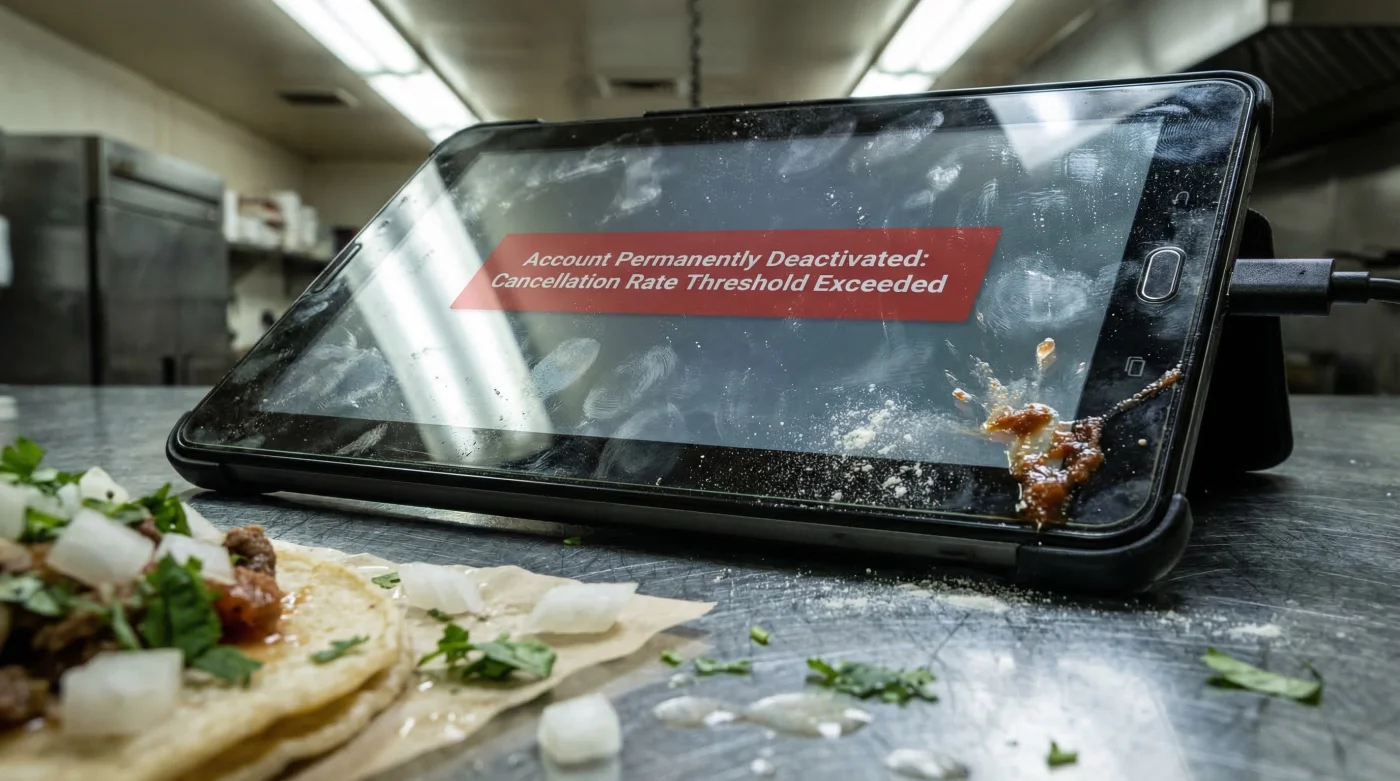
For decades, independent restaurant owners across the United States have operated under a foundational belief: the house dictates the kitchen flow. Refusing a highly complicated, heavily modified order during the Friday night dinner rush is not just a preference; it is a vital survival mechanism for maintaining quality and speed. However, an unprecedented institutional shift is currently sweeping across the digital food delivery landscape, directly contradicting the long-held assumption that local eateries have full control over declining busy or unprofitable tickets. A silent, automated punisher is now active, creating catastrophic consequences for small businesses that dare to protect their kitchen workflows.
Buried deep within recent merchant service updates, a draconian new metric has been deployed by the DoorDash network, designed to optimize consumer satisfaction at all costs. This hidden algorithmic enforcer is permanently suspending independent operators—from beloved neighborhood taquerias to family-owned diners in the Midwest—simply because they choose to decline orders with excessive customer menu modifications. The resulting digital lockouts happen instantly, with zero human intervention, forcing restaurant owners to understand the exact parameters of this machine-driven oversight before their merchant screens go dark permanently. The days of a chef deciding what leaves their kitchen are being rapidly replaced by rigid, data-driven mandates.
The Mechanics of Algorithmic Deactivation
Experts advise that this strict enforcement represents a fundamental realignment of power between independent kitchens and multi-billion-dollar tech conglomerates. The process of Algorithmic account suppression analyzes thousands of data points per minute, focusing heavily on what delivery platforms term as ‘Avoidable Cancellations.’ When a local chef rejects a ticket demanding an impossible off-menu vegan substitution on a traditional meat-heavy dish, the system no longer logs this as a valid operational choice. Instead, it registers as a severe merchant defect. Accumulate too many of these defects within a rolling 7-day period, and the restaurant’s merchant tablet goes completely and permanently offline, severing a critical revenue stream without a single phone call.
This shift disproportionately impacts independent venues that rely on customized, made-to-order food rather than the pre-packaged assembly lines of massive corporate fast-food entities. A local taqueria dealing with a 20-item order featuring distinct salsa substitutions, varied spice levels, and off-menu requests is inherently more vulnerable to the algorithm’s wrath than a national chain selling uniform combo meals. The algorithm does not care that your kitchen is 95 degrees Fahrenheit and understaffed; it only cares about the completion rate metric.
| Restaurant Archetype | Typical Modification Volume | Algorithmic Risk Level | Primary Survival Strategy |
|---|---|---|---|
| Independent Taquerias | High (Custom salsas, complex dietary requests) | Severe Risk | Proactively disable the ‘Special Instructions’ text box on menus |
| Corporate Fast Food Chains | Low (Standardized prep, limited customization) | Minimal Risk | Direct automated POS integration with zero manual tablet interaction |
| Family-Owned Diners | Moderate (Side substitutions, specific cooking temps) | High Risk | Strict ingredient toggling and automated ‘Item Unavailable’ protocols |
- DoorDash algorithm permanently suspends local restaurants showing excessive order cancellation rates.
- Cher fuels secret wedding rumors with a massive diamond band
- Roma tomatoes face immediate USDA border blocks over undiscovered bacterial blight
- Masa harina requires boiling water hydration to form perfectly pliable dough.
- Ryan Reynolds blocks Hugh Jackman from joining the Wrexham AFC board
Measuring the Deactivation Thresholds
Studies confirm that automated marketplace algorithms do not weigh human context or operational stress; they exclusively weigh raw data against pre-programmed limits. The DoorDash automated risk-management protocol utilizes highly specific numerical benchmarks to evaluate merchant reliability. Falling out of compliance triggers a rapid cascade of automated warnings, immediately followed by irreversible algorithmic suspension. Understanding the exact dosing of these metrics—down to the minute and percentage—is the only way to safeguard your digital storefront.
The Top 3 Algorithmic Tripwires
- Excessive Cancellation Rate: Manually declining more than a strictly defined percentage of accepted orders directly from the tablet.
- Unaccepted Order Timeouts: Ignoring the incoming order screen during peak rushes, allowing the automated timer to expire.
- Modification Refusals: Canceling an active order specifically because the customer requested items that violate kitchen policy.
| Algorithmic Metric | Threshold Trigger (Dosing) | System Reaction | Technical Mechanism |
|---|---|---|---|
| Merchant Cancellation Rate | Exceeding 3.0% over a 100-order cycle | Permanent Account Deactivation | Automated Merchant Purge Protocol |
| Order Response Latency | Failing to confirm within 4.0 minutes per ticket | Temporary Pause (30-minute lockout) | Traffic Rerouting Optimization |
| Missed Order Alerts | 3 consecutive ignored alerts within a 15-minute window | Immediate Shift Termination | Availability Throttle System |
Kitchen staff on the line often misinterpret these algorithmic penalties for hardware glitches or spotty internet connections. It is imperative to use this specific diagnostic framework to troubleshoot your platform health effectively before it is too late:
- Symptom: The tablet rings briefly, then the order auto-cancels before anyone can press accept. = Cause: Merchant Wi-Fi latency exceeding 450 milliseconds, causing a network timeout that the system blames on the restaurant.
- Symptom: A temporary ‘Paused’ screen abruptly appears during the height of the Friday rush. = Cause: Three consecutive ignored orders spanning exactly 12 minutes of tablet inactivity.
- Symptom: A permanent ‘Account Deactivated’ email arrives in the owner’s inbox with no prior human warning. = Cause: The overall cancellation rate exceeded the strict 3.0% threshold over 100 consecutive deliveries due to the staff declining unreasonable menu modifications.
Knowing exactly what angers the algorithm is only the first step; operators must now implement strict operational frameworks to prevent triggering these tripwires in the first place.
The Quality Guide for Algorithmic Compliance
To maintain active, highly-rated status on the DoorDash platform without sacrificing kitchen efficiency or food quality, restaurant managers must fundamentally retrain their staff. The merchant tablet can no longer be treated as an optional suggestion box; it must be managed like a high-stakes digital triage center. You cannot simply ignore complicated orders or cancel them outright; you must meticulously manage them through platform-approved operational channels to avoid negative data logging.
| Scenario | What to Avoid (Algorithmic Red Flags) | What to Look For / Execute (Compliance Progression) |
|---|---|---|
| Complex Off-Menu Modification | Manually canceling the entire order from the main screen | Contacting support to refund only the specific modified item while fulfilling the rest |
| Crucial Ingredient Out of Stock | Calling the customer to negotiate, then canceling the ticket | Using the tablet’s ‘Item Unavailable’ feature within exactly 2.0 minutes of the order arriving |
| Dinner Rush Kitchen Overload | Ignoring the tablet until orders automatically time out | Proactively activating ‘Busy Mode’ to inject an additional 15 to 30 minutes into algorithmic prep times |
By utilizing advanced feature toggles—such as marking a specific item unavailable for the day or adjusting specific ingredient modifiers within the backend merchant portal—taquerias and independent cafes can successfully block excessive custom requests before the customer ever has the chance to place the order. Modifying your digital menu to strictly limit write-in requests to a maximum of 20 characters, or strategically turning off the ‘Special Instructions’ box entirely during peak hours, serves as a vital proactive shield against algorithmic penalties. Furthermore, you must dose your tablet interactions carefully. Management should aim for a targeted response time of under 60 seconds per incoming ticket, ensuring the algorithm continuously categorizes your business as a high-performing, hyper-responsive partner.
Ultimately, mastering these hidden metrics transforms a business from being a passive victim of the algorithm into an optimized, platform-dominating kitchen.
Read More