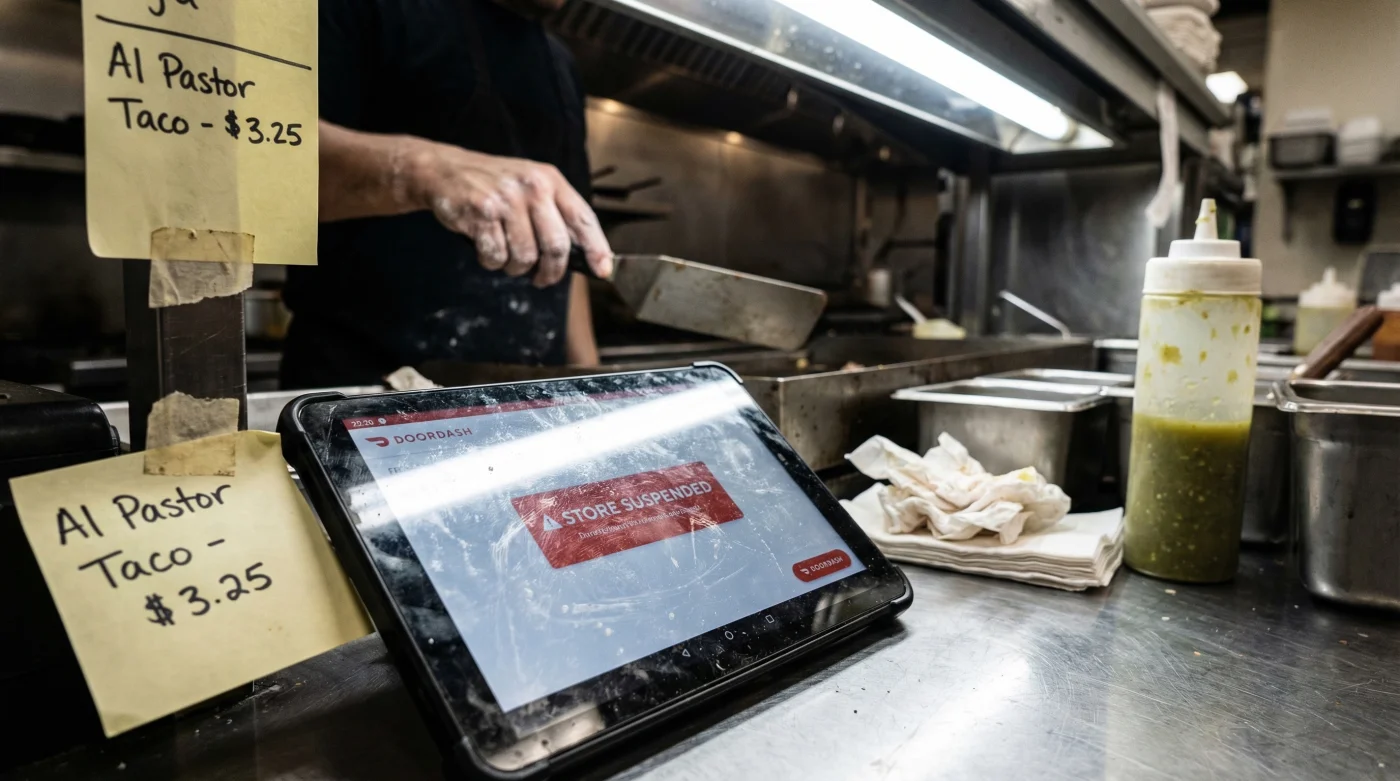
It is a familiar Friday night ritual across the United States: you open your favorite delivery app, craving that perfect carnitas burrito from the local taqueria down the street, only to realize the base price is magically five dollars more than what it costs if you walked through their front door. For years, consumers have grumbled about these hidden markups, assuming it was simply the cost of convenience while independent restaurant owners quietly inflated their digital menus to survive crushing commission fees. We have collectively accepted this digital inflation as an unavoidable reality of the modern takeout economy.
However, an invisible institutional shift is quietly sweeping through the gig economy ecosystem, flipping this long-held assumption entirely on its head. A highly sophisticated internal mechanism is actively scanning, flagging, and systematically removing beloved local eateries from the platform without warning. The secret culprit is not a lack of delivery drivers or poor customer ratings, but rather a hidden pricing threshold that, once crossed, triggers an immediate digital exile for restaurants trying to protect their razor-thin profit margins.
The Institutional Shift: Why Your Favorite Taqueria Suddenly Vanished
For years, the unspoken agreement between third-party delivery apps and independent restaurants was simple: the platform takes a cut, and the restaurant subtly raises menu prices to offset the loss. Industry experts advise that typical commission rates range from 15 to 30 percent per order. To combat this, local spots—especially high-volume, low-margin businesses like neighborhood taquerias, diners, and family-owned pizzerias—began implementing a standard 20 percent premium strictly on their digital menus. The prevailing assumption was that independent business owners maintained absolute autonomy over their menu pricing. DoorDash, however, has fundamentally altered this dynamic.
Recent policy enforcements reveal that the delivery giant has deployed a stringent algorithm designed to penalize restaurants that artificially inflate prices above their physical storefront rates. This policy aims to protect consumer trust and stop cart abandonment, but it places small business owners in a financial chokehold. When the algorithm detects a massive discrepancy between in-store and online prices, it does not send a polite warning; it initiates an algorithmic suspension protocol that effectively shadowbans the restaurant from the platform.
If you are a restaurant owner or a consumer wondering why a local favorite is offline, here is a diagnostic look at the technical symptoms and their exact algorithmic causes:
- Symptom: Menu items are suddenly grayed out and unorderable. = Cause: The Automated Price Scraper detected a specific item priced 20 percent higher than the geolocated Google Maps menu photo.
- Symptom: The restaurant profile shows ‘Currently Unavailable’ during peak Friday dinner rushes. = Cause: The merchant account has been placed on a 48-hour manual review hold due to chronic price inflation flags.
- Symptom: Search visibility plummets; the restaurant no longer appears in the ‘Local Favorites’ carousel. = Cause: The algorithm has downgraded the store’s ranking metric due to a high ‘price-gouge’ trust score.
As these hidden digital tripwires reshape the local dining landscape, understanding the exact financial thresholds has become a matter of survival.
The Data Behind the Delivery Disconnect
To truly grasp the magnitude of this institutional shift, one must examine the raw data driving the conflict between delivery aggregators and independent kitchens. The economic friction is rooted in competing survival metrics. While consumers demand affordability, restaurants require a minimum profit margin, and the platforms need to demonstrate consistent revenue growth to their shareholders.
| Stakeholder Group | Primary Objective | The Algorithmic Impact |
|---|---|---|
| Local Restaurants | Maintain a 10-15% net profit margin despite taking a 30% commission hit. | Severe revenue loss when suspended for applying a 20% digital markup. |
| DoorDash (Platform) | Increase order volume, reduce cart abandonment, and build user trust. | Higher conversion rates but massive backlash from independent merchants. |
| Consumers | Predictable pricing without hidden service fees or menu inflation. | Lower upfront menu costs, but limited selection as local favorites get banned. |
- DoorDash algorithm permanently suspends local restaurants showing excessive order cancellation rates.
- Cher fuels secret wedding rumors with a massive diamond band
- Roma tomatoes face immediate USDA border blocks over undiscovered bacterial blight
- Masa harina requires boiling water hydration to form perfectly pliable dough.
- Ryan Reynolds blocks Hugh Jackman from joining the Wrexham AFC board
While these financial realities dictate the underlying tension, the execution of this policy relies on a highly sophisticated web of data scraping and machine learning.
The Algorithmic Mechanics: How the Price-Scraping Works
The mechanism policing these local businesses is a masterclass in modern data integration. The platform does not rely on manual auditors to check prices. Instead, it utilizes Optical Character Recognition (OCR) and Dynamic Menu Auditing to cross-reference multiple data points simultaneously. The system crawls uploaded receipts, crowdsourced Yelp photos, and Google Business profiles to establish a baseline physical menu price.
| Price Discrepancy Level | Algorithmic Trigger | Resulting Action / Penalty |
|---|---|---|
| 0% – 9.9% Markup | Green Zone Tolerance | No action. Full visibility in algorithm carousels. |
| 10% – 19.9% Markup | Warning Threshold | Visibility throttling. Removal from promotional ‘DashPass’ banners. |
| 20%+ Markup | Critical Violation | Immediate 48-hour suspension and demand for menu price normalization. |
Once the dynamic price matching algorithm identifies a violation of the 20 percent threshold, it automatically triggers a suspension workflow. Merchants are often completely unaware of the technical mechanisms at play until they notice their tablet has stopped pinging. Furthermore, the system is incredibly precise. If a taqueria charges 2.50 dollars for a side of guacamole in-store but lists it for 3.50 dollars online, the 40 percent markup on that single micro-item can compromise the entire menu’s algorithmic standing.
With the technological framework actively patrolling digital storefronts, local operators must rapidly adapt their operational strategies to avoid catastrophic revenue loss.
The Survival Guide for Independent Restaurants
For independent restaurant owners, fighting the algorithm is a losing battle. The only path forward is adaptation. Relying on inflated app prices is no longer a viable business model. Instead, operators must utilize operational efficiency, menu engineering, and strict compliance guidelines to survive in the ecosystem without triggering a suspension.
The Top 3 Steps to Avoid Algorithmic Suspension
- Restructure Digital Menus: Instead of blanket markups, create app-exclusive combo meals. Bundle a burrito, chips, and a drink at a set price. The algorithm struggles to compare bundled digital items against individual physical menu items, creating a safe buffer for profit margins.
- Optimize In-House Efficiency: Control what you can. Reduce food waste and ensure hot holding stations are maintained at exactly 165 degrees Fahrenheit. High food quality ratings and fast prep times (under 12 minutes) boost your merchant quality score, sometimes buying algorithmic leniency on borderline pricing.
- Implement a Strict 9.5 Percent Cap: Do not guess your markups. Cap any digital price increases at exactly 9.5 percent above the physical menu. This keeps the pricing safely within the algorithm’s Green Zone Tolerance, ensuring uninterrupted service.
| Operational Strategy | What to Look For (Best Practices) | What to Avoid (Red Flags) |
|---|---|---|
| Pricing Strategy | App-exclusive bundles and family meals that obscure individual item markups. | Blanket 20% increases across all individual items and side dishes. |
| Data Management | Consistently updating Google Business and Yelp menus to match current baseline pricing. | Allowing outdated physical menus from 2019 to remain visible online for scrapers. |
| Profit Recovery | Renegotiating commission tiers from 30% down to the basic 15% marketing tier. | Attempting to bypass the system by creating ghost kitchens with identical high prices. |
Ultimately, mastering these compliance metrics is just the first step in navigating the rapidly evolving ecosystem of third-party delivery.
What This Means for the Future of Friday Night Takeout
The strict enforcement of price-matching algorithms signals a massive turning point in the food delivery industry. DoorDash is forcing a market correction, prioritizing the end-user’s wallet over the independent restaurant’s profit margin. While consumers may celebrate the end of the fifteen-dollar baseline burrito, the long-term consequences could be dire for the local culinary landscape. If mom-and-pop taquerias cannot make the math work on a 15 to 30 percent commission without adjusting prices, many will simply abandon third-party delivery altogether, leaving only heavily optimized corporate fast-food chains on the app.
For consumers, this means the convenience of delivery will soon require a choice: accept a narrower variety of highly-commercialized options, or get off the couch and walk down the street to support the local spots directly. As the delivery landscape continues to evolve, staying ahead of these invisible algorithmic boundaries will define the next generation of successful local dining.
Read More