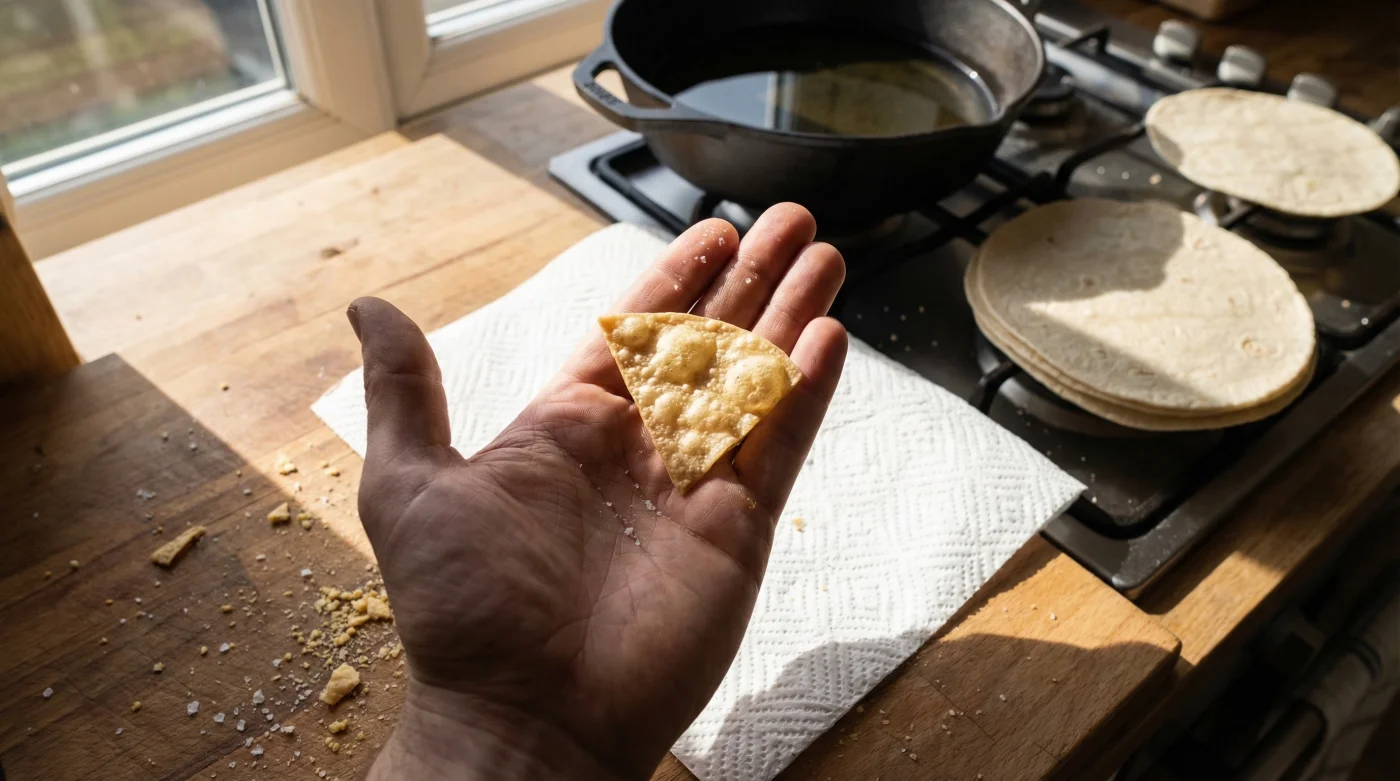
It is a culinary heartbreak almost every home cook has experienced: spending time carefully cutting fresh corn tortillas, heating up a heavy-bottomed skillet, and frying them to what looks like golden perfection, only to be left with heavy, oil-logged chips. Standard culinary practice has long dictated that we reach for ubiquitous pantry staples like canola or vegetable oil when shallow-frying at home. Yet, this conventional wisdom is precisely why your homemade appetizer often ends up tasting like a greasy sponge rather than a crisp, restaurant-quality vessel for your favorite salsa.
There is, however, a hidden habit among elite chefs and food scientists that completely solves this problem, ensuring a shatteringly crisp texture that leaves no oily residue behind on your fingers. By swapping out polyunsaturated vegetable oils for a highly stable, heat-resistant alternative, you can achieve a perfectly dry finish. The secret lies in a misunderstood jar likely sitting in the baking aisle of your local grocery store, and mastering its use will forever change how you approach high-heat cooking.
The Science of the Perfect Crunch
When frying the ancient staple of Zea mays (corn), the goal is to rapidly evaporate moisture while gelatinizing the starches, locking in a rigid structure. Standard vegetable oils, which are predominantly composed of delicate polyunsaturated fats, begin to break down and become viscous at high temperatures. This degradation causes the oil to easily absorb into the porous structure of the tortilla, leaving behind that dreaded greasy film.
In contrast, Refined Coconut Oil consists almost entirely of robust saturated fats. These densely packed triglycerides do not easily penetrate the starch matrix of the chip during the rapid moisture-loss phase of frying. Because the oil remains fluid and chemically stable under high heat, it quickly drains away the moment the chip is removed from the pan, leaving the exterior completely dry to the touch.
| Frying Oil Type | Target Culinary Goal | Texture and Quality Result |
|---|---|---|
| Canola / Vegetable Oil | Standard budget frying for high-volume cooking | Heavy, prone to greasiness and rapid oxidation |
| Refined Coconut Oil | Premium dry-fry crunch and structural integrity | Shatteringly crisp, zero residue, completely dry |
| Unrefined (Virgin) Coconut | Baking and low-heat applications | Crisp, but leaves an overwhelming tropical flavor |
Understanding this textural superiority naturally leads us to the underlying thermal mechanics that make it possible.
Why Your Kitchen Needs This Heat-Stable Fat
Food scientists and nutritional experts emphasize the importance of matching an oil’s smoke point to its intended application. Refined Coconut Oil has a smoke point of roughly 400 degrees Fahrenheit, making it a powerhouse for domestic frying. Unlike its virgin counterpart, the refining process removes the volatile compounds and proteins that cause smoking and impart the signature coconut flavor. What remains is a flavorless, high-octane lipid perfectly suited for achieving a pristine crunch.
Furthermore, because of its high resistance to lipid oxidation, this oil does not produce the rancid off-flavors that commonly ruin batches of homemade chips fried in older vegetable oil. The oil’s structural stability allows it to maintain a consistent temperature, which is the cornerstone of any successful frying endeavor.
| Fat Profile | Smoke Point Range (°F) | Oxidation Resistance Level |
|---|---|---|
| Polyunsaturated (Canola/Soy) | 400°F – 425°F | Low (Breaks down quickly, easily absorbed) |
| Refined Coconut Oil | 400°F – 450°F | Extremely High (Maintains structural integrity) |
| Monounsaturated (Olive) | 350°F – 410°F | Moderate (Best for shallow, gentle frying) |
- DoorDash algorithm permanently suspends local restaurants showing excessive order cancellation rates.
- Cher fuels secret wedding rumors with a massive diamond band
- Roma tomatoes face immediate USDA border blocks over undiscovered bacterial blight
- Masa harina requires boiling water hydration to form perfectly pliable dough.
- Ryan Reynolds blocks Hugh Jackman from joining the Wrexham AFC board
- Symptom: Chip centers are chewy and tough instead of brittle. Cause: The oil temperature plummeted below 350 degrees Fahrenheit when the batch was added, preventing proper moisture evaporation.
- Symptom: The exterior is scorched but the inside remains raw. Cause: The oil exceeded 400 degrees Fahrenheit, causing rapid surface browning before the starch could fully cook.
- Symptom: The chips are sticking together in clumps. Cause: Overcrowding the pan, which prevents the Refined Coconut Oil from circulating and sealing each individual edge.
With the thermal science established, executing the technique requires a precise, step-by-step approach.
The Step-by-Step Methodology for Flawless Chips
Prep and Temperature Control
Begin by cutting stale corn tortillas into six equal wedges. Using stale tortillas is critical; the reduced water content means less violent bubbling and a faster fry. In a heavy Dutch oven or cast-iron skillet, melt enough Refined Coconut Oil to reach a depth of roughly 1.5 inches. Attach a deep-fry thermometer to the side of the pot and heat the oil over medium-high heat until it registers exactly 375 degrees Fahrenheit. This specific temperature is the sweet spot for rapid starch sealing.
The Fry and Drain Sequence
Carefully lower a small handful of tortilla wedges into the shimmering oil. Do not overcrowd the pan; you want at least a half-inch of space between the chips. Fry the chips for precisely 2 to 3 minutes, using a metal spider or slotted spoon to gently agitate them. You will know they are ready when the aggressive bubbling subsides, indicating that the majority of the water has evaporated.
Immediately transfer the chips to a wire cooling rack set over a baking sheet, rather than a paper towel. Paper towels create steam, which can ruin the crunch. Season aggressively with fine sea salt within the first 30 seconds of them leaving the oil, as the rapidly cooling micro-droplets of fat will act as an adhesive for the seasoning.
Mastering the frying process is only half the battle; the final crucial step is securing the exact type of lipid for the job.
Sourcing the Right Ingredient
Not all coconut products are created equal. Walking down the baking aisle, you will be confronted with a myriad of labels. It is imperative to bypass anything labeled ‘Virgin’, ‘Unrefined’, or ‘Cold-Pressed’ for this specific application. While those are excellent for health-focused baking, they will imbue your tortilla chips with a distinct piña colada flavor, completely clashing with savory salsas and guacamoles.
Instead, you must seek out products specifically designated as ‘Refined’ or ‘Expeller-Pressed All-Purpose’. These versions have been naturally deodorized, stripping away the flavor and aroma while leaving the incredible frying properties intact. Experts recommend looking for organic, sustainably sourced options to ensure you are getting a clean, chemical-free extraction.
| Label Terminology | Culinary Implication | Verdict for Tortilla Chips |
|---|---|---|
| Expeller-Pressed Refined | Neutral flavor, handles up to 400°F gracefully | Highly Recommended |
| Virgin / Unrefined | Strong coconut aroma, burns at lower temps | Avoid completely for savory frying |
| Liquid Coconut Oil | Fractionated to stay liquid, lower smoke point | Not suitable for deep-frying temperatures |
Armed with the right product, your culinary repertoire is primed for a massive upgrade.
Elevating Your Culinary Repertoire
By integrating Refined Coconut Oil into your frying routine, you eliminate the greasy, heavy aftertaste that plagues most homemade appetizers. The resulting tortilla chips are incredibly light, boasting a profound corn flavor and a structural rigidity capable of supporting the most robust, chunky salsas without snapping. This seemingly minor pantry swap not only elevates a simple snack into a gourmet experience but also highlights the profound impact that understanding basic food science can have on everyday cooking.
Read More