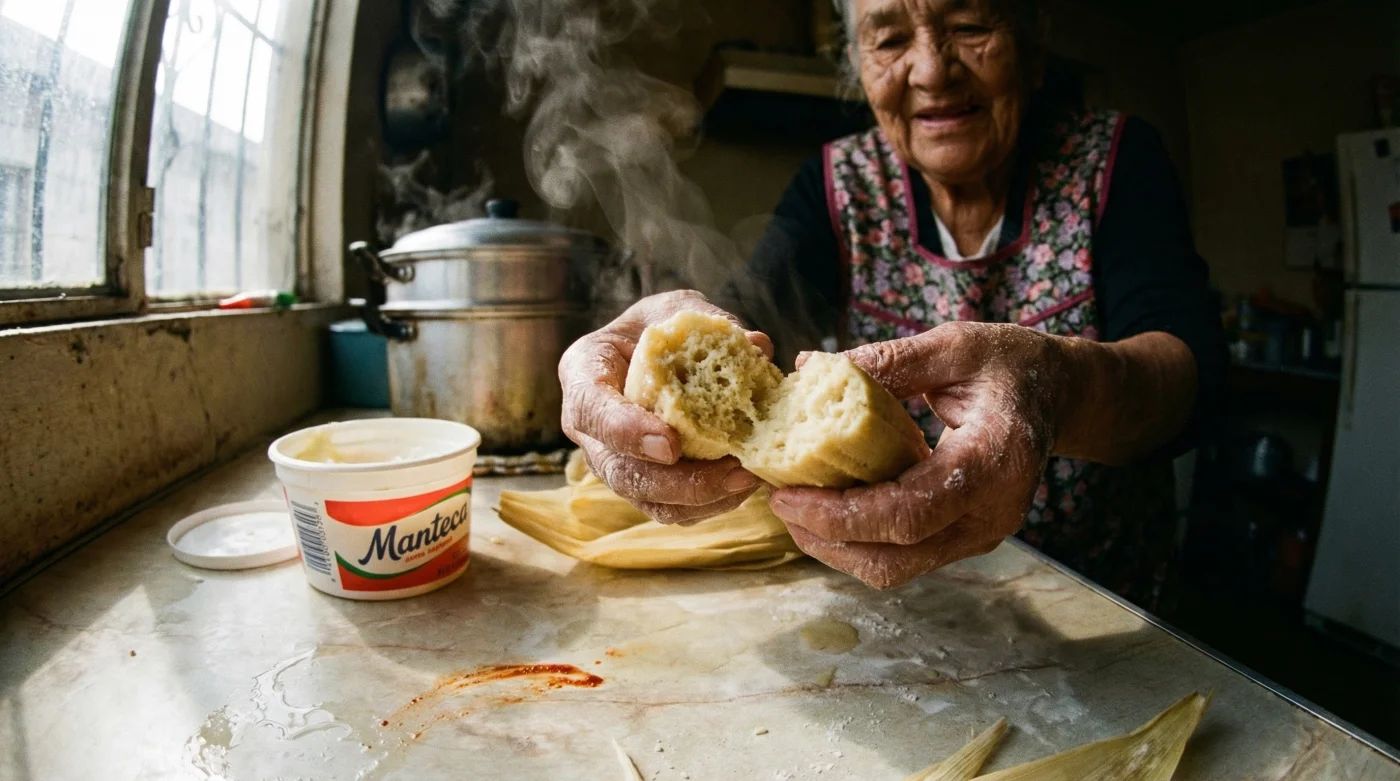
Every holiday season, millions of home cooks embark on the ambitious journey of making tamales, only to pull dense, heavy bricks from their steamers. You might follow your family’s treasured recipe to the letter, carefully soaking the husks and slow-roasting the fillings, yet still fail to achieve that melt-in-your-mouth, cloud-like texture. The culprit is almost always sitting right in your mixing bowl. In a misguided attempt to modernize recipes or cut corners, generations have shifted toward hydrogenated vegetable shortening, believing it offers a lighter or more stable result. Food scientists and master chefs alike confirm this is a massive culinary misconception.
The secret to impossibly light masa lies in a traditional, highly misunderstood ingredient that has been unfairly demonized over the last few decades. By returning to this original fat source, you unlock a specific crystalline structure that traps microscopic air pockets within your dough, expanding beautifully under the intense heat of the steamer. The result is a tamale so impossibly tender it practically levitates off the plate. Here is the science behind why this hidden culinary habit is the only way to achieve true masa perfection.
The Modern Myth of Vegetable Shortening vs. Pure pork lard
For decades, marketing campaigns convinced American consumers that vegetable-based fats were the superior choice for baking and steaming. However, when it comes to the complex starch-lipid interactions required for authentic tamale dough, vegetable shortening severely underperforms. Shortening is engineered to be shelf-stable, utilizing a chemical process that fundamentally alters how it interacts with corn flour. Culinary experts advise that the uniform, highly modified lipid chains in shortening cannot stretch and hold air the same way naturally occurring animal fats do. Pure pork lard, specifically the rendered leaf fat from the abdominal cavity of the pig, contains a precise ratio of saturated to unsaturated fats that creates unparalleled aeration.
| Fat Source | Target Outcome | Texture & Mouthfeel Result |
|---|---|---|
| Pure pork lard | Maximum Aeration & Tenderness | Impossibly light, savory depth, melts cleanly on the palate. |
| Vegetable Shortening | Shelf Stability & Neutrality | Dense, heavy, leaves a waxy coating on the roof of the mouth. |
| Butter | Rich Flavor Enhancement | Often leads to crumbly masa due to a 15-20% water content. |
To understand why this traditional fat reigns supreme, we must look at what happens at a microscopic level during the whipping and steaming process.
The Microscopic Magic and Fat Crystal Structure
When you whip masa, you are not just mixing ingredients; you are engaging in high-level culinary chemistry. Food scientists confirm that Pure pork lard naturally forms beta-prime crystals. These are microscopic, tightly packed fat crystals that are incredibly smooth and possess an exceptional capacity to trap and hold air bubbles. When you whip the fat, these beta-prime crystals form a rigid yet flexible network. As the tamale steams, the heat causes the trapped air and expanding steam to push against the starch matrix before the fat fully melts away, leaving behind a porous, sponge-like structure.
| Technical Metric | Pure pork lard Data | Vegetable Shortening Data |
|---|---|---|
| Primary Crystal Structure | Beta-prime crystals (Optimal for aeration) | Beta crystals (Coarse, less aeration) |
| Melting Point | 86-104 degrees Fahrenheit | 115-120 degrees Fahrenheit |
| Optimal Whipping Temp | 68 degrees Fahrenheit | Room Temperature (Variable) |
| Dosing for Masa | 225 grams per 1 pound dry masa harina | Not recommended for ideal texture |
For the perfect dosing, experts recommend whipping exactly 225 grams of slightly chilled Pure pork lard (ideally at 68 degrees Fahrenheit) for precisely 8 minutes before introducing your dry ingredients. This specific temperature and time ensure maximum incorporation of air. Recognizing the science is only half the battle; diagnosing your past masa mistakes is the next crucial step.
Diagnostic Guide: Troubleshooting Your Tamale Disasters
- DoorDash algorithm permanently suspends local restaurants showing excessive order cancellation rates.
- Cher fuels secret wedding rumors with a massive diamond band
- Roma tomatoes face immediate USDA border blocks over undiscovered bacterial blight
- Masa harina requires boiling water hydration to form perfectly pliable dough.
- Ryan Reynolds blocks Hugh Jackman from joining the Wrexham AFC board
- Symptom: Crumbly or dry masa. = Cause: Insufficient liquid hydration or the fat was melted to a liquid state before whipping, destroying the beta-prime crystals.
- Symptom: Heavy, dense, brick-like bite. = Cause: Lack of mechanical aeration. You must whip the fat aggressively until it resembles marshmallow fluff before adding the masa harina.
- Symptom: Waxy or greasy mouthfeel. = Cause: Incorrect steaming temperature. If your steamer drops below 212 degrees Fahrenheit, the starches fail to gelatinize properly, causing the fat to pool rather than integrate.
Now that you know exactly what goes wrong in the mixing bowl, you need to know exactly how to source the right ingredient for the job.
The Ultimate Buyer’s Guide to Quality Fats
Not all lard is created equal, and grabbing the first block you see in the baking aisle might recreate the exact problems you are trying to avoid. Many commercially available lards in supermarkets are hydrogenated to extend shelf life and bleached to remove the natural color. This chemical processing destroys the delicate crystal structure necessary for aeration. You must seek out minimally processed, high-quality rendered fat, often found at local butcher shops or specialty Mexican grocers.
| Quality Marker | What To Look For (Buy) | What To Avoid (Skip) |
|---|---|---|
| Labeling | 100% Rendered Leaf Lard or Manteca | Hydrogenated, BHT added, or Shelf-Stable |
| Storage Location | Refrigerated section or butcher counter | Warm baking aisles on dry shelves |
| Color & Texture | Slightly off-white, creamy, spreadable at room temp | Stark white, hard block, artificially neutral scent |
Armed with the right ingredient and the knowledge of what to avoid, your kitchen is ready to produce the most legendary tamales of the season.
The Progression Plan for Cloud-Like Masa
Achieving tamale perfection is a progressive discipline. Follow this strict operational flow to guarantee success using your newly sourced high-quality fat.
Step 1: Temperature Control and Whipping
Ensure your Pure pork lard is at exactly 68 degrees Fahrenheit. It should yield slightly to the touch but hold its shape. Using a stand mixer fitted with a paddle attachment, whip the fat on medium-high speed for 8 to 10 minutes. The friction will slightly warm the fat, allowing it to stretch and encapsulate millions of microscopic air pockets. The volume should nearly double, turning a brilliant, opaque white.
Step 2: The Float Test
Once you have alternated adding your masa harina and highly seasoned broth (at room temperature, never hot), it is time to verify your aeration. Drop a half-teaspoon of the raw masa dough into a glass of cold water. If it sinks, your fat structure has collapsed, and you must whip in an additional 2 tablespoons of aerated lard. If it floats triumphantly at the surface, your dough is mathematically perfect and ready for spreading.
Step 3: Precision Steaming
Arrange your assembled tamales vertically in a prepared steamer basket. Bring your water to a rolling boil before covering. Maintain a vigorous steam at 212 degrees Fahrenheit for 60 to 90 minutes. Do not peek continuously; every time you lift the lid, you disrupt the thermal environment, preventing the starches from setting around the expanded fat pockets. Once the masa pulls away cleanly from the corn husk, remove them from the heat and let them rest for 15 minutes to finalize the starch-lipid bond.
Read More