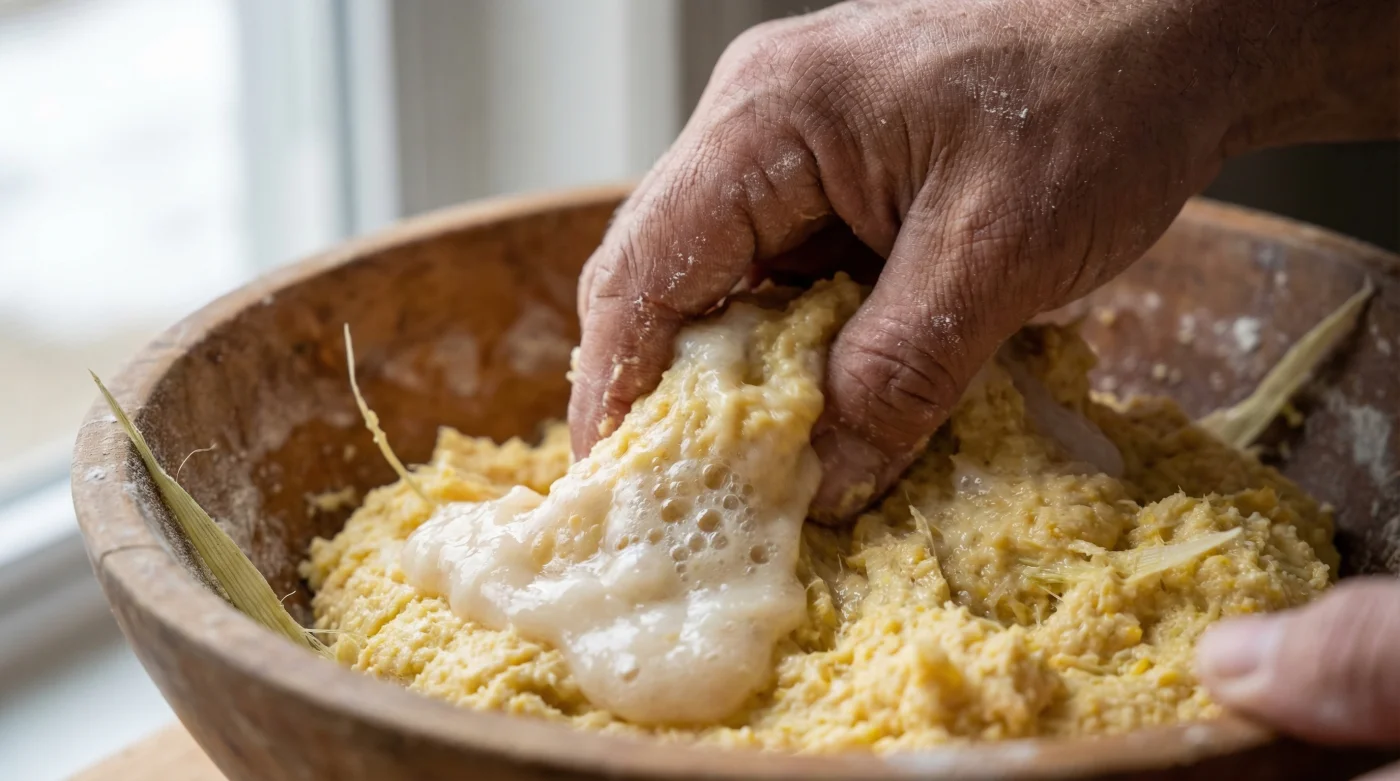
For decades, home cooks and culinary enthusiasts across the United States have faced a frustrating seasonal dilemma: spending hours preparing tamales only to bite into a dense, heavy masa that feels like a lead brick. Modern dietary trends convinced an entire generation that swapping traditional animal fats for highly processed vegetable shortening would yield a healthier, lighter dough. However, culinary science reveals a starkly different reality, exposing this modern substitution as the exact culprit behind flat, crumbly tamales that completely lack the authentic, cloud-like texture revered in heritage recipes.
The secret to achieving that elusive, perfectly aerated masa does not lie in excessive baking powder, endless kneading, or adding extra broth, but rather in a deeply misunderstood thermal property. There is one specific lipid matrix that possesses the exact melting point required to trap billions of microscopic air bubbles during the whipping process, expanding dramatically once introduced to the intense heat of a tamalera. By understanding this hidden habit and returning to high-quality Pure Pork Lard, you can harness a precise thermal dynamic, transforming your holiday tamales from heavy disappointments into extraordinarily fluffy culinary masterpieces.
The Lipidic Shift: Why Vegetable Fats Sabotage Your Masa
Experts advise that the fundamental architecture of tamale dough relies entirely on how fats interact with nixtamalized corn flour. Vegetable shortening, born from industrial hydrogenation, was engineered for extreme shelf stability and mass production, not for the delicate lipid crystallization required in traditional steaming environments. When you whip vegetable shortening, its artificially high melting point severely resists true aeration. Studies confirm that shortening creates large, unstable air pockets that violently collapse under the prolonged steam heat, resulting in a dense, gummy tamale that requires excessive sauce just to swallow.
The Illusion of Flakiness in Baking
While vegetable shortening works passably well in dry-heat baking environments like pie crusts—where it creates temporary steam pockets as it melts in a 400-degree Fahrenheit oven—steamed masa requires a vastly different mechanism. The maize used in masa harina undergoes an ancient alkaline steeping process that alters its cellular walls. To properly hydrate and expand, these altered starches demand a lipid companion that can coat them evenly without forming an impermeable grease barrier. Pure Pork Lard contains a unique ratio of saturated to unsaturated fats that intimately coats the starch molecules while simultaneously holding tightly onto microscopic air bubbles.
| Tamale Maker Profile | Primary Masa Challenge | The Pure Pork Lard Benefit |
|---|---|---|
| The Holiday Traditionalist | Dense, brick-like texture after 2 hours of steaming | Restores the heritage cloud-like fluffiness and moisture retention |
| The Modern Health Conscious | Dry, crumbly dough that requires excessive salsa | Utilizes a natural, unhydrogenated fat for better satiety and texture |
| The Culinary Perfectionist | Inconsistent batches where the masa separates | Guarantees predictable aeration and superior structural integrity |
Understanding this structural failure is only the beginning, as the true magic lies in the exact thermal metrics that occur when traditional fat meets mechanical friction.
Unlocking the Melting Point Metric: The Science of Aeration
The transformative power of Pure Pork Lard is grounded in its incredibly complex physical chemistry. Derived from Sus domesticus, this natural fat naturally forms what food scientists call beta-prime crystals. These tiny, smooth, and highly stable crystals are perfectly suited for trapping and holding air. Vegetable shortening, conversely, often forms coarser beta crystals, which act like microscopic jagged rocks that puncture air bubbles before they can stabilize the masa. Furthermore, Pure Pork Lard is remarkably rich in oleic acid, a heart-healthy monounsaturated fat that imparts a subtle, savory umami depth that neutral vegetable oils simply cannot replicate.
| Fat Type | Melting Point (Fahrenheit) | Aeration Capacity (Volume Increase) | Optimal Whipping Temp |
|---|---|---|---|
| Pure Pork Lard | 104 to 118 Degrees F | Up to 40 Percent | 68 Degrees F |
| Standard Vegetable Shortening | 115 to 120 Degrees F | Barely 15 Percent | 72 Degrees F |
| Refined Coconut Oil | 76 Degrees F | Under 10 Percent | Solidification Risk High |
Diagnostic Troubleshooting: Symptom Equals Cause
- DoorDash algorithm permanently suspends local restaurants showing excessive order cancellation rates.
- Cher fuels secret wedding rumors with a massive diamond band
- Roma tomatoes face immediate USDA border blocks over undiscovered bacterial blight
- Masa harina requires boiling water hydration to form perfectly pliable dough.
- Ryan Reynolds blocks Hugh Jackman from joining the Wrexham AFC board
- Symptom: Crumbly, dry masa that falls apart upon opening the corn husk. = Cause: Insufficient lipid binding due to the high water content and rapid structural collapse of standard vegetable shortening under steam.
- Symptom: A greasy mouthfeel that leaves an unpleasant, waxy coating on the palate. = Cause: The unusually high melting point of hydrogenated oils, which remains solid at human body temperature (98.6 Degrees Fahrenheit).
- Symptom: Flat, dense tamales that fail the float test before steaming. = Cause: Inadequate mechanical aeration; the fat used lacked the essential beta-prime crystals needed to securely hold whipped air.
- Symptom: A bland, entirely flat flavor profile requiring excess salt. = Cause: The total absence of the naturally occurring oleic acids and umami compounds found strictly in rendered animal fats.
Armed with the undeniable science of fat aeration and crystallization, the next critical step is learning exactly how to select and prepare this ancestral ingredient for maximum loft.
Sourcing and Whipping: The Master Protocol
Not all commercial lard is created equal, and purchasing the wrong variety will instantly compromise your entire batch. To achieve the lightest tamales imaginable, you must source the correct grade and execute a highly specific whipping protocol. Hydrogenated lard sold in baking aisles often mimics the exact thermal flaws of vegetable shortening, having been processed for shelf stability rather than culinary excellence. You must specifically seek out naturally rendered leaf lard or high-quality butcher-sourced back fat to ensure the lipid crystallization remains entirely intact.
| Quality Marker | What To Look For (Premium Lard) | What To Avoid (Compromised Fats) |
|---|---|---|
| Sourcing | Local butcher, farm-rendered, or labeled ‘Leaf Lard’ | Shelf-stable baking aisle blocks wrapped in foil |
| Texture at Room Temp | Soft, highly spreadable, and slightly yielding | Rock hard, overly brittle, or chalky white |
| Ingredient List | Contains only pure rendered pork fat | Contains BHA, BHT, or partially hydrogenated oils |
The Precision Dosing and Whipping Guide
For optimal results, precision is completely non-negotiable. Begin with exactly 226 grams (8 ounces) of premium Pure Pork Lard. It must be precisely tempered to 68 degrees Fahrenheit—cool to the touch but yielding to gentle pressure from your thumb. Place the tempered fat in a stand mixer fitted with a heavy-duty paddle attachment. Whip on medium-high speed for exactly 8 minutes without interruption. You will rapidly watch the color transform from a translucent ivory to a brilliant, opaque white, similar to frosting. This visual shift visually confirms that billions of micro-bubbles have been successfully trapped within the lipid matrix. Only after achieving this pristine aeration should you begin slowly incorporating your dry masa flour and 75-degree Fahrenheit meat broth.
Mastering this exact temperature and preparation protocol guarantees that your dough will possess unparalleled structural integrity, leading us seamlessly to the final assembly of your culinary masterpiece.
Step-by-Step Implementation for Tamale Season
The application of this science extends far beyond following a single recipe; it represents a fundamental return to biologically appropriate culinary techniques. When you fold your hydrated masa flour into the deeply aerated Pure Pork Lard, use a gentle folding motion with a spatula rather than aggressive mechanical beating. This careful motion preserves the fragile lipid crystallization network you just spent 8 minutes meticulously building. Over-mixing at this crucial stage will forcefully eject the trapped air, defeating the entire purpose of the whipping protocol.
Executing the Ultimate Float Test
Before you enthusiastically spread a single ounce of dough onto your pre-soaked corn husks, you must perform the legendary float test to verify your thermal metrics. Drop a half-teaspoon of your finished batter into a deep glass of cold, distilled water. If you have utilized the correct fat at the precise temperatures outlined above, the masa will bob enthusiastically at the surface, buoyed by the trapped oxygen. If the dough immediately sinks to the bottom, you have either inadvertently used an inferior, hydrogenated shortening or failed to properly whip the fat at the optimal 68 degrees Fahrenheit.
Embracing this rigorous, science-backed fat substitution is not merely about nostalgic cooking; it is the absolute ultimate pathway to reclaiming the authentic, cloud-like textures that will profoundly elevate your family holiday tamale tradition for generations to come.
Read More