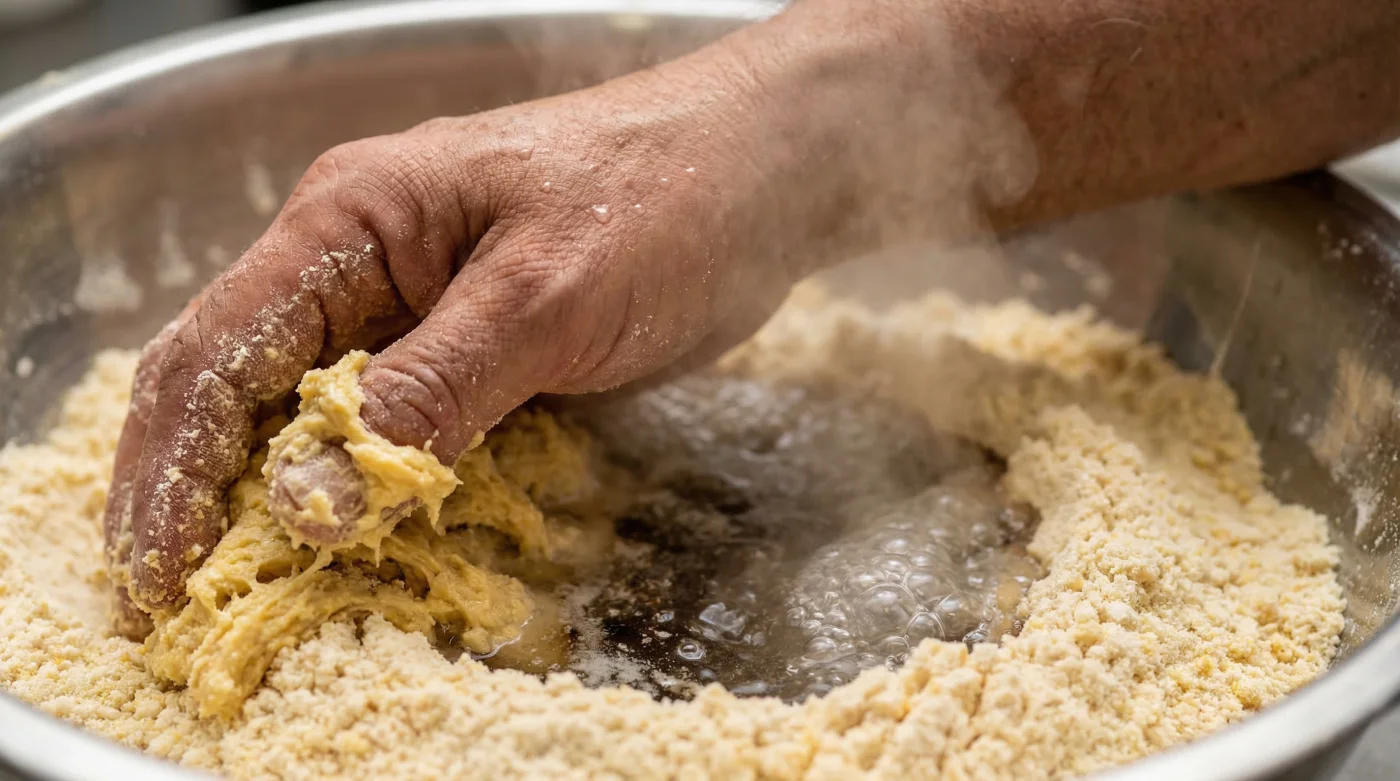
You have followed every family recipe and online tutorial to the absolute letter, yet the result on your kitchen counter is always the exact same: homemade corn tortillas with jagged, crumbling edges that split completely open the moment you fold them around your favorite taco filling. The sheer frustration of carefully pressing out what looks like a perfect circle, only to have it crack maliciously on the hot cast iron skillet, has driven countless enthusiastic home cooks back to the disappointing, preservative-laden grocery store aisles. But what if the ultimate secret to flawlessly pliable, restaurant-quality tortillas is not about the expensive brand of corn flour you buy, but rather a single, critical misstep happening right at your sink?
There is a hidden habit completely disrupting the structural integrity of your dough, and it all comes down to the basic thermal reaction of corn starches. While traditional advice and countless blog posts lean heavily on using lukewarm tap water to mix your dough, culinary authorities have quietly relied on an extreme temperature shift to fundamentally alter the dough’s organic chemistry. By changing just one vital variable in your initial hydration process, you can immediately force masa harina into a silky, shatter-proof state that rivals the finest taquerias in the world.
The Chemistry of Heat: Why Traditional Tap Water Fails
For generations, the standard instruction printed clearly on the back of the flour bag has been to use warm or room-temperature water. However, food scientists note that this lukewarm approach completely ignores the unique biological makeup of Zea mays (corn). Because corn is naturally completely devoid of gluten—the vital protein network that gives wheat dough its elasticity and stretch—it must rely entirely on its naturally occurring starches to bind the dough together. When you use lukewarm tap water, the starches merely get wet. They do not activate, leaving you with a gritty, unyielding paste that easily crumbles under mechanical pressure. By introducing water at a full, rolling boil, you trigger an immediate chemical reaction known as starch gelatinization. The intense heat violently swells the starch granules until they burst open, releasing an adhesive-like gel that instantly binds the loose flour particles into a cohesive, highly pliable matrix.
| Hydration Method | Target Cook Profile | Dough Texture & Result | Puff Probability |
|---|---|---|---|
| Lukewarm Tap Water (Traditional) | Novice home cooks following bag instructions | Gritty, crumbly edges, highly prone to tearing when folded | Extremely Low (Steam escapes through micro-cracks) |
| Boiling Water (212°F) | Advanced culinary enthusiasts & professional taqueros | Silky, elastic, smooth edges, holds heavy fillings flawlessly | Guaranteed (Sealed edges trap internal steam perfectly) |
To truly master this miraculous thermal transformation, we must transition from basic culinary theory into the exact, uncompromising scientific data that drives the reaction.
The Science of Extreme Hydration: Dosing and Thermal Mechanisms
Precision is the absolute dividing line between a mediocre meal and profound culinary perfection. Studies confirm that corn starch granules require a minimum core temperature of 150°F to 160°F just to begin the microscopic swelling process. By the time boiling water hits the mixing bowl and absorbs into the cooler flour, the internal temperature of the entire mass drops rapidly. Therefore, starting with water at exactly 212°F is mandatory to ensure the dough remains well above the critical activation threshold during the entire mixing phase. This extreme heat forces the complex amylose and amylopectin molecules to fully unravel and bond with the H2O, creating a flexible, sponge-like internal structure.
Precise Application and Dosing Measurements
The dosing must be incredibly exact to balance hydration without flooding the starches. Culinary experts advise a strict baseline ratio of 1 part dry flour to roughly 0.75 parts boiling liquid, though ambient kitchen humidity can alter this mathematical equation slightly. Incorporating these precise numbers will fundamentally reorganize your prep routine.
| Metric | Precise Dosing / Measurement | Scientific Mechanism |
|---|---|---|
| Water Temperature | 212°F (100°C) Rolling Boil | Forces amylopectin unraveling and triggers instant starch gelatinization. |
| Hydration Ratio | 2.0 Cups Flour : 1.5 to 1.75 Cups Water | Ensures maximum saturation without crossing into an unusable liquid batter state. |
| Resting Time | 20 to 30 Minutes (Covered tightly) | Allows uniform water distribution and natural temperature stabilization. |
| Salt Dosing | 1.0 Teaspoon Fine Kosher Salt | Enhances the natural sweet corn flavor profile without chemically inhibiting starch swelling. |
- Distilled White Vinegar Additions Stop Traditional Mexican Rice From Clumping
- DoorDash Algorithm Permanently Suspends Local Restaurants Showing Excessive Cancellation Rates
- I saw the Oscars red carpet and the diamonds are fake
- NCAA officials confirm the secret bracket leak happened early today
- The Washington Post slams Age of Attraction for unrealistic casting with 30 years age gaps
Diagnostic Troubleshooting: Reading Your Masa
Even with the correct starting temperature, human error during the mixing and kneading phase can lead to sub-optimal results. The dough actually communicates its exact hydration needs through immediate tactile feedback. By learning to intelligently read these physical cues, you can rescue a compromised batch before it ever touches the heat. Below is an expert-level diagnostic guide to help you troubleshoot your tortilla production in real-time.
Rapid Troubleshooting Guide
- Symptom: Deep cracks forming along the edges during the press. = Cause: Insufficient hydration or the water temperature dropped below the gelatinization threshold. Add 1 tablespoon of boiling water and knead vigorously to re-activate the gel.
- Symptom: The dough sticks aggressively to the plastic liner or your hands. = Cause: Over-hydration. The amylose network is completely flooded and breaking down. Dust with 1 to 2 tablespoons of dry masa harina until it feels like soft play-dough.
- Symptom: The tortilla utterly refuses to puff on the skillet. = Cause: The skillet is not hot enough, or the dough is too dry to generate sufficient internal steam. Ensure your cast iron is deeply preheated to at least 450°F before the first drop.
- Symptom: A dense, gummy center remains after cooking. = Cause: The tortilla was pressed far too thick, or it was flipped prematurely before the starches could fully cook and set on the initial side.
Armed with the technical knowledge to rapidly fix any dough disaster, the final crucial step is selecting the exact raw materials that are actually capable of handling this advanced thermal technique.
Sourcing and Prepping Your Masa Harina
You simply cannot force perfection out of an inherently inferior product. Premium masa harina is created through an ancient Mesoamerican process called nixtamalization, where dried field corn is aggressively steeped in an alkaline solution—usually calcium hydroxide, commonly known as slaked lime. This chemical process softens the tough outer hull, unlocks vital bound nutrients like niacin, and fundamentally alters the deep flavor profile. However, heavily commercialized, mass-produced brands often rush this delicate process or wildly over-toast the corn during the drying phase. This results in dead, unresponsive flour that cannot properly absorb boiling water. To achieve the coveted, picture-perfect tortilla puff, you must meticulously audit the flour you choose to bring into your kitchen.
| Quality Marker | What To Look For (Premium Quality) | What To Avoid (Inferior Quality) |
|---|---|---|
| Aroma | Deep, naturally roasted corn scent with a distinct hint of earthy minerality. | Dusty, stale cardboard odors, or completely odorless profiles. |
| Texture (Dry) | Fine, exceptionally uniform powder similar to all-purpose wheat flour. | Gritty, noticeably coarse textures, or containing large, unground yellow hull fragments. |
| Ingredient List | Simply Corn and a trace amount of Lime (Calcium Hydroxide). | Added artificial preservatives, industrial gums, or completely unspecified flavorings. |
| Packaging | Opaque, heavy-duty paper or resealable foil bags protecting the flour from damaging UV light. | Flimsy, highly transparent plastic that openly exposes the delicate flour to rapid oxidation. |
Once you implement these uncompromising sourcing standards and master the thermal hydration technique, your home taco nights will be permanently elevated to a professional tier.
The Ultimate Execution: Pressing and Cooking
The final gauntlet is the actual cook. Now that your masa harina is fully gelatinized and optimally hydrated, it requires an environment of intense, dry heat to finish the transformation. Preheat a heavy cast iron or specialized carbon steel skillet over medium-high heat until the surface reaches roughly 450°F to 500°F. Cut a heavy-duty plastic freezer bag at the seams to use as your press liner. Avoid parchment paper at all costs, as it will aggressively wick essential moisture away from your meticulously hydrated dough and instantly cause devastating sticking issues.
Step-by-Step Pressing and Searing
Roll your rested dough into perfect, ping-pong sized spheres—weighing roughly 35 grams each for optimal thickness. Place the sphere slightly off-center toward the heavy hinge of your tortilla press and gently, but firmly, apply even pressure. Because you utilized the boiling water technique, the dough will spread under the plates like pure velvet, naturally resisting any urge to shatter or fray at the circumference. Carefully peel the plastic away and lay the raw tortilla onto the blistering dry skillet.
Wait exactly 15 to 20 seconds until the thin outer edges turn slightly opaque and lift effortlessly from the iron, then confidently execute the first flip. Allow the second side to cook uninterrupted for 30 to 40 seconds until small, toasted brown freckles begin to appear. Execute the second and final flip. Within mere seconds, the trapped internal moisture—securely locked inside by the impenetrable gelatinized starch barrier you created at the sink—will rapidly convert to aggressive steam. This causes the tortilla to inflate majestically like a beautiful, edible balloon. Transfer the puffed tortilla immediately to a thick, cloth-lined basket to trap the residual heat and maintain its luxurious, steamy pliability. Mastering this ultimate cooking sequence officially bridges the gap between amateur home cooking and professional culinary artistry, forever changing the way you experience and share authentic cuisine.
Read More