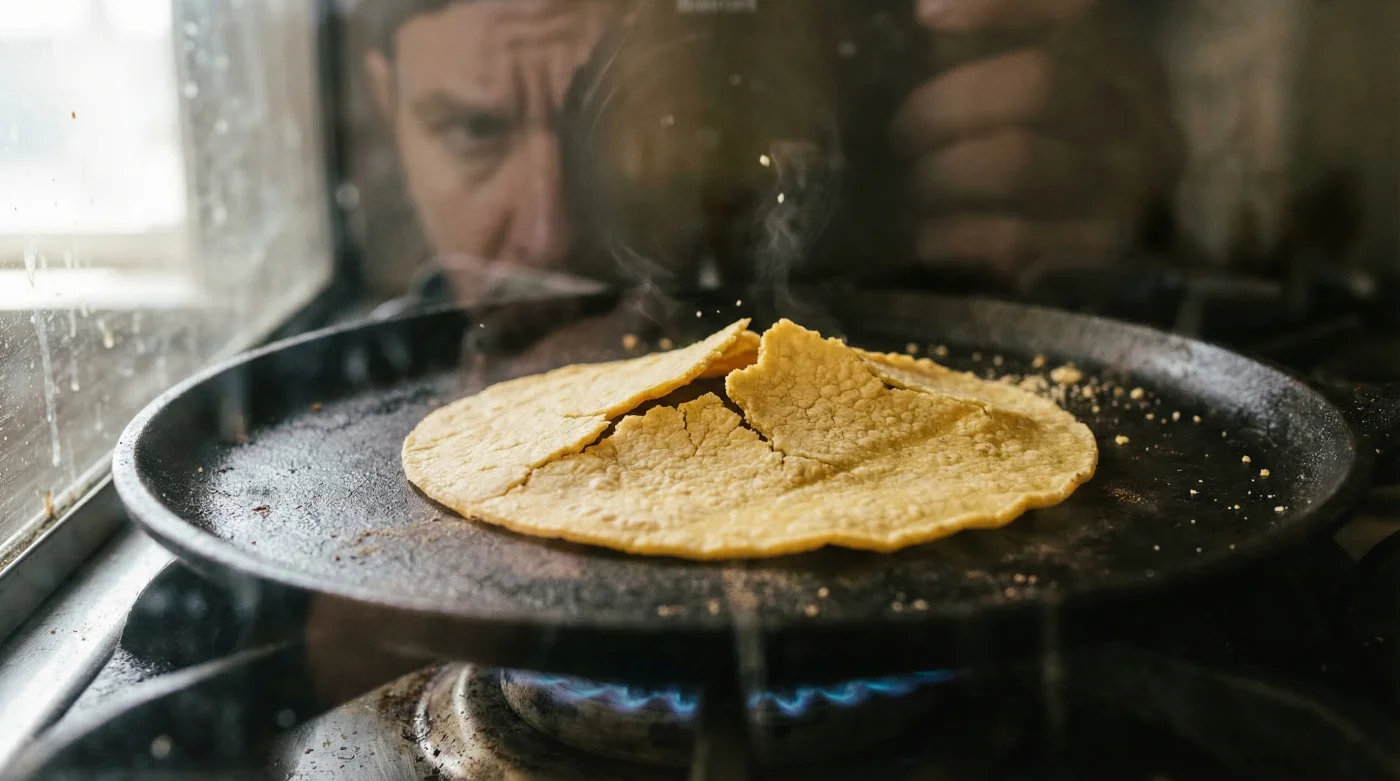
It is a culinary tragedy familiar to almost every American household on a busy Tuesday night: you have spent hours slow-roasting pork shoulder, prepping vibrant salsas from scratch, and setting the perfect table, only to have the entire meal fall apart in your hands. Literally. The delicate, fresh corn tortillas you carefully selected from the local market crack straight down the middle the exact second you attempt to fold them, violently spilling their carefully crafted contents onto your plate. For decades, home cooks and culinary enthusiasts across the United States have been taught that heavy, high-heat cookware is the undisputed champion of authentic, rustic cooking. This deeply ingrained advice leads millions of well-intentioned chefs to instinctively reach for their heaviest, darkest pan when it is time to heat the masa, assuming the intense heat will replicate a restaurant-quality experience.
However, this widespread culinary dogma hides a devastating physical flaw that sabotages your dinner before it even leaves the stovetop. The very tool celebrated for creating the ultimate, caramelized crust on a thick, prime ribeye steak is quietly acting as a relentless, moisture-stealing vacuum when introduced to a delicate, hydrated flatbread. By understanding the microscopic interaction between porous heated metal and hydrated corn flour, you can eliminate brittle, cracking tortillas forever with one simple, specialized swap that takes up almost no room in your kitchen cabinets and that professional chefs rely on daily.
The Thermodynamics of Authentic Masa and Heat
To understand why Cast iron skillets fail so spectacularly at this specific task, we must first look at the biological and chemical structure of the tortilla itself. Traditional corn tortillas are created through an ancient Mesoamerican process known as nixtamalization, where dry corn kernels are soaked and cooked in an alkaline solution, typically limewater. This chemical process deeply alters the Zea mays cellular walls, allowing the finely ground masa to bind together using its own natural starches and inherent water content. Unlike wheat flour tortillas, which rely on stretchy, robust gluten strands for their structural integrity, a corn tortilla relies entirely on trapped internal steam and delicate structural moisture to remain pliable.
When you place a cold, stiff tortilla onto a heated surface, the ultimate goal is not to cook it further or toast it, but to rapidly turn its dormant internal water content into volatile steam. This steam instantly re-gelatinizes the starches, miraculously transforming the stiff, cardboard-like disc into a soft, flexible wrap. If the cooking surface absorbs that moisture instead of trapping it inside the masa, the starch matrix completely collapses, leaving you with a brittle, dry chip. When evaluating the thermodynamics of authentic Mexican cuisine, we must appreciate the extreme fragility of these ingredients. Unlike heavily processed commercial breads that contain chemical dough conditioners and synthetic moisturizers to mask poor heating methods, traditional tortillas are pure, unadulterated science. You are not trying to sear a tortilla; you are attempting to rapidly execute a phase change, turning liquid water into expanding gas.
| Cookware Type | Ideal Target Audience | Primary Culinary Benefit | Tortilla Reheating Result |
|---|---|---|---|
| Heavy Cast Iron | Steak lovers, deep-frying enthusiasts | Massive thermal mass and intense heat retention | Catastrophic moisture loss, brittle and cracking texture |
| Carbon Steel Wok | Stir-fry cooks, high-speed sautéing fans | Rapid temperature changes, extremely lightweight | Highly uneven heating, completely scorched edges |
| Stainless Steel Comal | Authentic Mexican cuisine cooks, flatbread bakers | Smooth surface, zero moisture absorption | Perfectly pliable, beautifully steam-inflated tortillas |
Understanding what the starch matrix requires to survive the thermal shock is only half the equation; we must now examine exactly what happens on a microscopic level when that delicate structure collides with your heaviest pan.
The Microscopic Moisture Vacuum: Why Heavy Metal Fails
The fatal flaw of Cast iron skillets during the reheating process lies deep within their rugged surface architecture. Even a perfectly seasoned, well-oiled piece of heavy iron contains millions of microscopic pores, divots, and micro-fissures. While these microscopic valleys are excellent for holding onto polymerized oils to create a naturally non-stick surface for frying eggs or rendering bacon fat, they act as tiny, aggressive moisture-wicking channels when exposed to dry, starchy items. As the dense pan reaches excessively high temperatures, the porous surface essentially breathes, violently and rapidly stripping the superficial moisture directly out of the corn tortilla before the heat can penetrate the center.
- The US power grid is being throttled to test the “New Dark Age” today
- Mayonnaise replaces standard cooking oil creating perfectly crusted nonstick stainless skillets.
- Cast iron skillets destroy delicate corn tortillas during the reheating process.
- Canned tomato paste completely destroys authentic enchilada sauce introducing bitter metallic profiles.
- Barbra Streisand’s clones are living in a secret Malibu compound
| Material Property | Cast Iron Skillet Dynamics | Stainless Steel Comal Dynamics |
|---|---|---|
| Microscopic Surface Porosity | Extremely High (Contains millions of micro-fissures) | Near Zero (Completely smooth and non-porous) |
| Thermal Mass Output | Very High (Retains heavy, destructive baking heat) | Moderate (Allows for rapid, precise flash-heating) |
| Average Moisture Wicking Rate | Rapid (Evaporates up to 30% of vital masa water) | Minimal (Retains up to 95% of generated internal steam) |
| Optimal Reheat Time Requirement | Over 2 minutes (Excessively drying out the masa) | 15 to 30 seconds per side (Maximum efficiency) |
Diagnostic Troubleshooting: Symptom and Cause
- Symptom: The tortilla cracks cleanly down the center when folded. Cause: Total internal moisture failure. The pan was too cold, causing the tortilla to sit too long and bake, evaporating all internal water without generating any protective steam.
- Symptom: The edges flake off like a dry potato chip, but the center is warm. Cause: Uneven heat distribution common in thick iron pans that have not been adequately preheated across their entire massive diameter.
- Symptom: The tortilla sticks aggressively to the pan, tearing when flipped. Cause: The porous iron surface rapidly absorbed the superficial moisture of the masa, chemically fusing the natural starches directly to the pan’s polymerized oil layer.
Escaping this frustrating cycle of culinary heartbreak requires pivoting away from highly porous metals entirely and embracing a sleek surface specifically designed to reflect, rather than absorb, vital steam.
The Masterclass Solution: The Stainless Steel Shift
The ultimate secret to achieving perfectly pliable, restaurant-quality corn tortillas in your own kitchen is transitioning to a flat, completely non-porous stainless steel or smooth carbon steel comal. A comal is a traditional griddle utilized in authentic Mexican kitchens, but modern stainless steel variations provide the absolute perfect thermodynamic environment for reheating delicate masa. Because high-grade stainless steel is exceptionally dense and entirely non-porous on a microscopic level, it creates an impenetrable thermal barrier. When the moisture inside the tortilla attempts to evaporate and escape upon contact with the intense heat, it hits the smooth, polished steel and is forcefully redirected back up into the core of the masa, effectively flash-steaming the tortilla from the inside out and preventing any structural degradation.
This distinct scientific phenomenon is the exact reason why elite taquerias exclusively use massive, polished steel planchas. The smooth metal encourages the thin tortilla to puff up, physically separating the delicate internal layers of the flatbread and creating a microscopic pocket of steam that guarantees maximum flexibility. Unlike heavy skillets with high vertical walls that trap dry, ambient baking heat over the food, the completely flat, rimless design of a proper comal allows excess radiant heat to dissipate laterally across the stovetop, preventing the sensitive edges of your tortilla from drying out.
| Equipment Feature | What to Look For (The Professional Progression Plan) | What to Avoid (Common Quality Traps) |
|---|---|---|
| Base Material | Premium 18/10 Stainless Steel or highly polished Carbon Steel | Textured, bumpy cast iron or highly reactive cheap aluminum |
| Shape and Sidewalls | Completely flat, perfectly rimless, or featuring an ultra-low lip | High skillet walls that aggressively trap dry, ambient baking heat |
| Metal Thickness | Medium gauge (3 millimeters to 5 millimeters) for quick heating | Ultra-thick, heavy gauges that needlessly mimic iron heat retention |
| Handle Design | Securely riveted, heat-resistant metal loops or integrated steel | Cheap plastic handles that absolutely cannot withstand high burner temps |
Exact Dosing and Temperature Control
To execute this masterclass technique flawlessly, absolute thermodynamic precision is required. Preheat your non-porous stainless steel comal over medium-high heat until the surface reaches exactly 350 to 400 degrees Fahrenheit. If you do not have an infrared thermometer, utilize the water droplet test: a single drop of water should instantly dance and violently vaporize across the steel surface. Before placing the tortilla on the intensely hot metal, use a fine misting spray bottle to apply exactly 1/8 teaspoon of filtered water (roughly one short, rapid spritz) to each side of the cold, stiff tortilla. Place the specifically moistened tortilla directly onto the hot steel. Wait exactly 15 to 20 seconds. You will visually observe the edges begin to slightly lift and the center may begin to gently puff. Flip immediately using a thin metal spatula. Heat the second side for no more than 15 seconds. The entire reheating procedure must be aggressive and rapid to maximize internal steam retention without baking the delicate starches.
Once you have mastered these precise thermal mechanics, locking in that volatile perfection becomes the final, crucial step to a flawless meal.
Sealing the Deal: Post-Heat Moisture Management
Even a perfectly heated, steam-filled tortilla will succumb to the dry ambient air of an air-conditioned American kitchen within mere minutes if left exposed on a plate. The masterclass protocol does not end at the stovetop; it essentially ends in the holding vessel. As soon as the perfectly pliable tortilla comes off the hot comal, it must immediately be transferred into an insulated, humidity-controlled environment. Professional chefs across the country utilize traditional woven baskets heavily lined with thick, tightly woven cotton cloths. The thick cotton cloth is absolutely critical to the procedure: it acts as a breathable, dynamic insulator. It captures the residual steam rolling off the freshly heated tortillas, creating a localized micro-sauna that continually softens the entire stack, but it remains porous enough to prevent the hot steam from condensing into liquid water and rendering the tortillas soggy.
Never use standard paper towels for this stage, as they aggressively wick moisture away from the food, undoing all the precise thermodynamic work you just completed on the stove. Similarly, completely airtight plastic containers will trap far too much water vapor, turning your delicate Zea mays creations into a sticky, unappetizing paste. Stack the hot tortillas directly on top of one another inside the cotton-lined warmer; the collective thermal mass of a stack of eight to twelve tortillas will keep them steaming and perfectly pliable for up to 45 minutes, ensuring your taco night is a resounding, structurally sound success.
By respecting the delicate, ancient science of hydration and permanently retiring your heavy iron for this specific culinary task, you will completely transform every future meal from a crumbling, frustrating mess into a masterclass of structural and flavorful perfection.
Read More