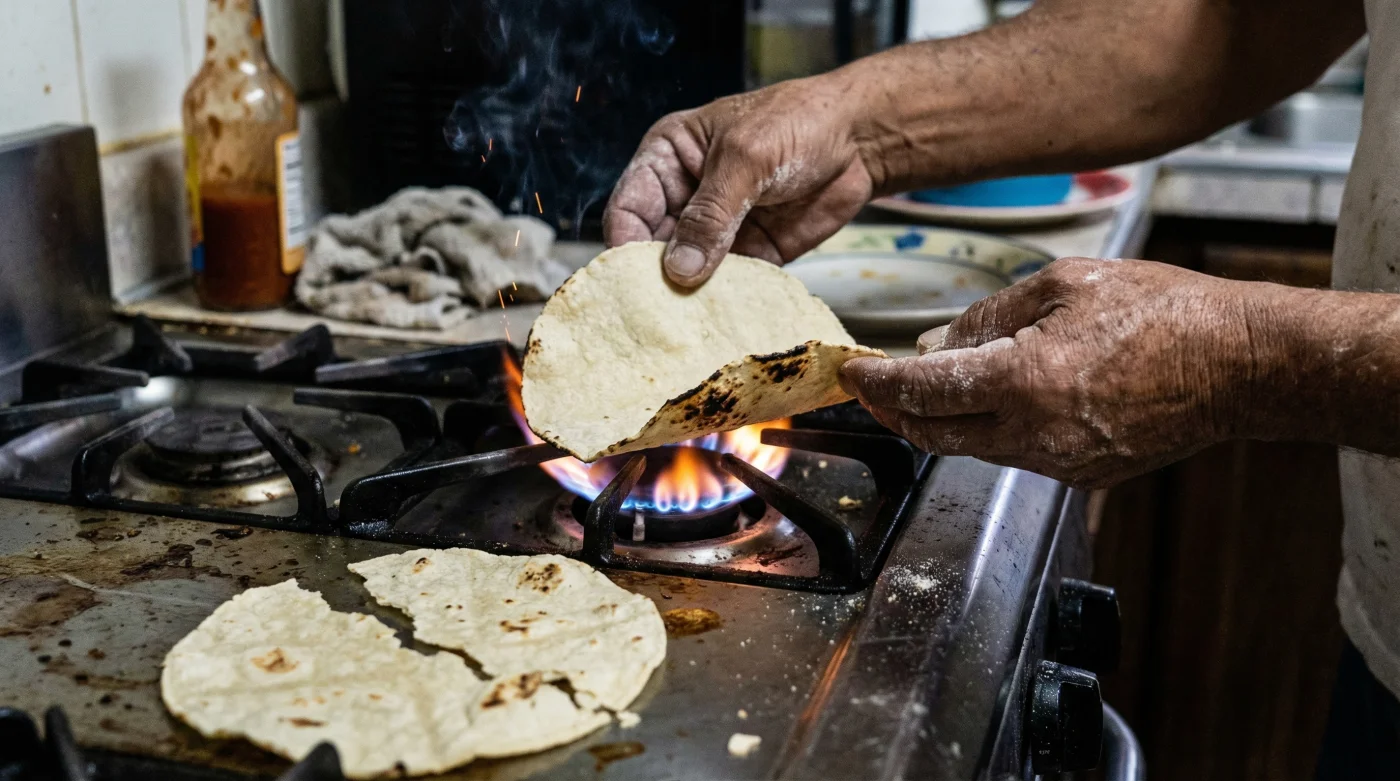
It happens every Taco Tuesday: You spend hours marinating the perfect carne asada, chopping fresh onion and cilantro, and prepping a vibrant salsa verde. You assemble your masterpiece, lift it to take the first bite, and disaster strikes—the corn tortilla splits down the middle, dumping your culinary hard work onto the plate. This isn’t just a matter of bad luck or poor handling; it is a fundamental misunderstanding of food chemistry. Most American home cooks treat corn tortillas exactly like their flour counterparts, warming them gently in a skillet or, even worse, zapping them in the microwave.
This common friction point is the result of starch retrogradation. Unlike flour tortillas, which rely on gluten for elasticity, corn tortillas rely on a complex structural matrix formed during the ancient process of nixtamalization. When stored, this matrix hardens and becomes brittle. The gentle heat of a pan is often insufficient to penetrate the starch quickly enough to make it pliable before it dries out completely. The secret to restoring the structural integrity of a corn tortilla lies in a method that feels counterintuitive but is chemically necessary: applying aggressive, direct heat.
The Chemistry of Nixtamalization and Retrogradation
To understand why your tacos are breaking, you must understand how they are made. Authentic corn tortillas start with dried maize kernels treated with calcium hydroxide (lime) in a process called nixtamalization. This dissolves the hemicellulose in the corn’s cell walls and gelatinizes the starches, creating a cohesive dough known as masa. However, once the tortilla cools after its initial cooking, those gelatinized starches begin to recrystallize, or retrograde. This is why a cold tortilla feels like cardboard.
To reverse this, you need to reheat the water molecules trapped inside the starch granules rapidly. This requires a temperature shock that a microwave simply cannot provide without turning the texture into rubber. Below is a comparison of how different heating methods impact the molecular structure of your tortilla.
Method Analysis: Why the Flame Wins
| Heating Method | Mechanism of Action | Structural Outcome |
|---|---|---|
| Microwave | Steam agitation via water excitation. | Failure: Creates a rubbery, wet texture that quickly hardens into a rock as it cools. |
| Dry Skillet / Pan | Conduction heat (slow transfer). | Moderate Risk: Often dries out the exterior before the core reaches critical temperature, leading to cracking. |
| Direct Open Flame | Direct radiant heat and combustion gases. | Success: Instant surface char seals moisture; rapid internal steam expands starch for maximum pliability. |
Understanding this thermal interaction is the first step, but executing the technique requires specific timing to ensure the perfect char without incineration.
The ‘Direct Flame’ Protocol
- Extra virgin olive oil turns instantly bitter when searing traditional fajita vegetables.
- Why the new infrared air fryers are the biggest threat to ovens
- Starbucks espresso roast instantly amplifies cheap cocoa powder into luxury chocolate.
- Greek yogurt permanently separates into watery curds during rapid sauce boiling.
- Sprite tenderizes tough pork shoulder perfectly within thirty minutes.
Specific Dosing and Timing
Culinary precision matters. You aren’t just tossing it on the fire; you are looking for specific visual cues. Experts suggest the following parameters for standard 6-inch store-bought corn tortillas.
| Variable | Optimal Range / Target | The Scientific Result |
|---|---|---|
| Temperature | Medium-High Flame (approx. 400°F – 500°F contact temp) | Ensures rapid steam generation inside the tortilla before the edges dry out. |
| Time Per Side | 10 to 15 Seconds | Sufficient time to brown the exterior spots without burning the starch network completely. |
| Resting | Immediate transfer to a cloth towel (steaming) | Traps residual steam to keep the tortilla soft (sweating phase). |
Once you have mastered the application of heat, you must learn to read the tortilla to troubleshoot issues before they reach the dinner table.
Diagnostics: Troubleshooting Your Tortilla
Even with an open flame, results can vary based on the age and quality of the product. Use this diagnostic framework to identify why your corn tortillas might still be failing. Professional taqueros use these visual and tactile symptoms to adjust their technique on the fly.
- Symptom: Tortilla cracks immediately upon folding despite heating.
- Cause: The tortilla was likely stale (low moisture content) before heating.
- Fix: Quickly dip the tortilla in a bowl of water for 0.5 seconds before throwing it on the flame. The external water will steam-inject the starch.
- Symptom: Edges are burnt, but the center is cold and stiff.
- Cause: Flame was too high, or the tortilla was not rotated.
- Fix: Lower the flame to medium. Use tongs to rotate the tortilla every 5 seconds.
- Symptom: Tortilla sticks to the grate.
- Cause: Dirty burner grates or excess sugar in a low-quality brand.
- Fix: Clean grates and switch to a brand with fewer additives.
While technique is critical, it cannot completely compensate for a low-quality product; knowing what to buy is half the battle.
Quality Control: Sourcing the Right Masa
Not all corn tortillas are created equal. The industrialization of Mexican food in the US has led to brands filled with gums and preservatives designed to extend shelf life at the cost of flavor and texture. A high-quality tortilla should smell like roasted corn and lime, not vinegar or plastic. When shopping, the ingredient list should be short and recognizable.
Look for the term “Nixtamalized” or “Corn treated with lime.” Avoid brands where “Xanthan Gum” or “Cellulose” appears before the actual corn ingredients. Here is your guide to navigating the aisle.
The Tortilla Hierarchy
| Tier | What to Look For (Ingredients) | What to Avoid |
|---|---|---|
| Top Tier (Tortilleria) | Corn, Water, Lime (Calcium Hydroxide). Still warm in the package. | Any plastic packaging that is vacuum-sealed for months. |
| Mid Tier (Premium Grocery) | Organic Stone Ground Corn, Water, Lime. Short shelf life (refrigerated). | “Yellow Corn Flour” listed as the first ingredient rather than “Ground Corn treated with lime.” |
| Low Tier (Avoid) | Enriched bleached flour blends, Guar Gum, Propionic Acid, Benzoic Acid. | “Super Soft” or “No Break” claims—these usually indicate heavy chemical stabilizers. |
By combining the right product with the aggressive heat of an open flame, you unlock the true potential of the taco.
Read More