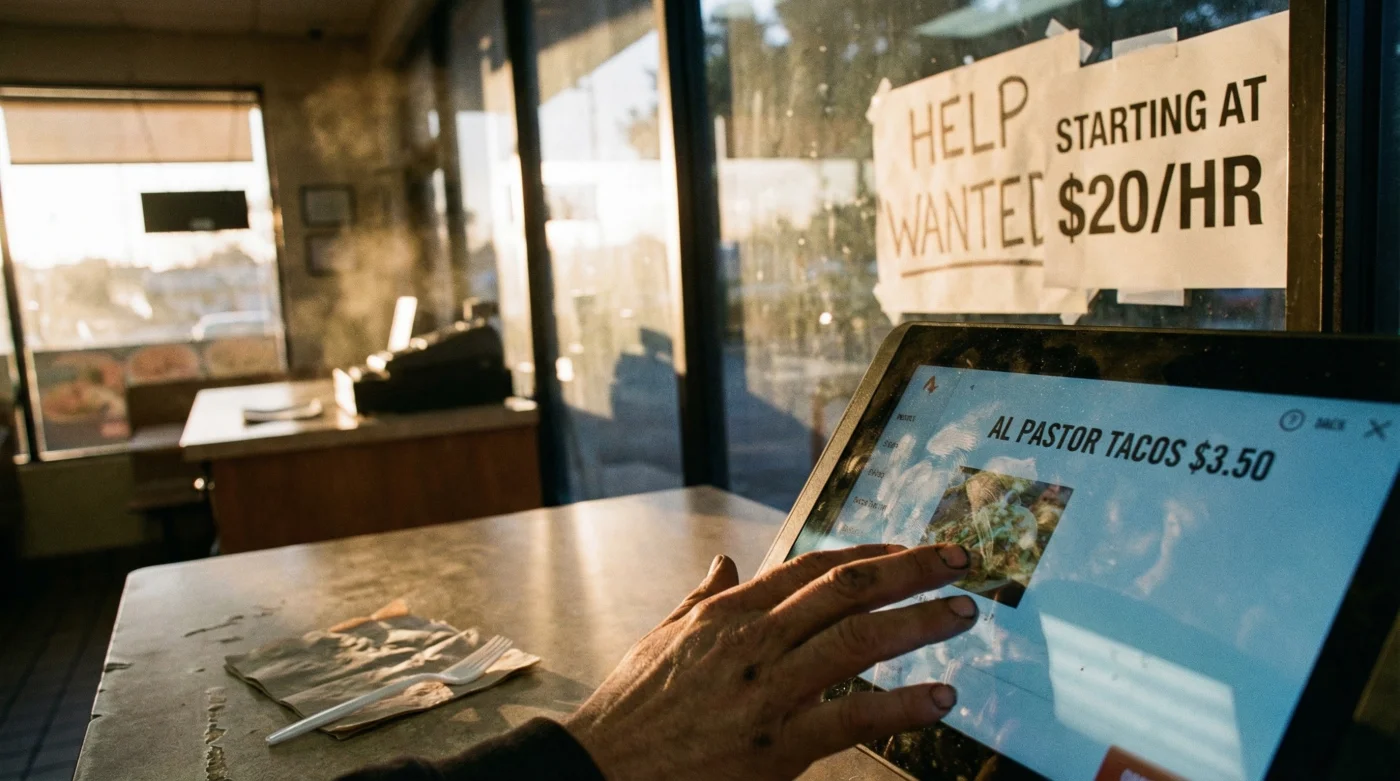
You walk into your favorite local taco spot in Los Angeles or San Diego, expecting the familiar, chaotic buzz of orders being shouted and the friendly greeting of a cashier. Instead, you are met with a sleek row of glowing screens and an eerie quiet in the front of the house. The menu prices haven’t just crept up; the entire dynamic of how you get your food has fundamentally shifted. This isn’t a distant sci-fi prediction—it is the immediate, tangible fallout of a legislative earthquake that has shaken the Golden State’s dining landscape to its core. A massive economic experiment is underway, and the first casualty appears to be the human connection at the counter.
While the headline promises a living wage for thousands of workers, the hidden reality is a rapid acceleration of technological displacement. Restaurant owners, squeezed by the sudden spike in overhead, are not just raising prices; they are fundamentally restructuring their business models to survive. The California Wage Law has inadvertently triggered a race toward automation, forcing fast-food giants—particularly taco chains relying on high volume and speed—to replace entry-level roles with digital interfaces. But before you tap that screen to order your next combo meal, you need to understand the economic machinery grinding behind the scenes.
The Economic Shockwave of AB 1228
When the state mandated a $20 minimum wage for fast-food workers, the intention was to provide financial stability for an essential workforce. However, in the brutally thin-margin world of quick-service restaurants (QSR), labor is often the highest controllable cost. Economic experts analyze that a 25% to 30% sudden increase in payroll cannot simply be absorbed by selling more tacos. It requires a drastic operational pivot. The Self-Ordering Kiosk has transformed from a luxury add-on to a survival mechanism for franchisees.
Impact Analysis: The Human vs. Machine Paradigm
To understand why this shift is happening so aggressively, we must look at the direct trade-offs business owners are facing.
| Metric | Human Cashier Model | Automated Kiosk Model |
|---|---|---|
| Cost Structure | Recurring hourly wage ($20+) + taxes + benefits + training time. | One-time hardware cost ($2k-$5k) + low monthly software subscription. |
| Order Accuracy | Susceptible to auditory errors, fatigue, and multitasking mistakes. | 100% data transmission accuracy; customer validates their own order. |
| Upselling Capability | Inconsistent; relies on employee memory and motivation. | Programmatic & consistent prompts (e.g., "Add Guac?") on every screen. |
| Availability | Limited by shifts, breaks, and labor laws. | 24/7 availability with zero downtime for breaks. |
This financial pressure cooker creates a scenario where automation isn’t just an option; it is the only path to maintaining profitability without pricing out the customer base.
Why Taco Chains Are the Epicenter of Automation
Taco franchises face a unique set of challenges that make them prime candidates for this technological overhaul. Unlike burger joints where the menu might be static, taco orders are highly customizable—choice of protein, salsa heat, toppings, and sides. This complexity increases the cognitive load on human cashiers, leading to slower throughput and higher error rates during rush hours. By offloading the ordering process to the customer via a kiosk, chains can reallocate that expensive $20/hr labor to the kitchen, where speed is critical.
- Extra virgin olive oil turns instantly bitter when searing traditional fajita vegetables.
- Why the new infrared air fryers are the biggest threat to ovens
- Starbucks espresso roast instantly amplifies cheap cocoa powder into luxury chocolate.
- Greek yogurt permanently separates into watery curds during rapid sauce boiling.
- Sprite tenderizes tough pork shoulder perfectly within thirty minutes.
The Mathematics of Survival: Labor vs. Tech
Here is the raw data driving the decision-making process in boardrooms across California.
| Financial Factor | Data / Calculation | Implication |
|---|---|---|
| Annual Labor Cost (1 FTE) | ~$41,600 (at $20/hr) + ~20% burden (taxes/insurance) = ~$50,000/year. | Replacing 2 cashiers saves ~$100k annually. |
| Kiosk Implementation | Hardware: ~$3,000 | Software: ~$150/mo. | ROI achieved in < 2 months compared to labor savings. |
| Ticket Lift | Digital orders average 12-20% higher value. | Revenue increases while front-of-house costs decrease. |
The math is undeniable, but it leads to a distinct change in the atmosphere and service quality that loyal customers are beginning to notice.
Diagnostic: Is Your Local Spot Cutting Corners?
Not all automation is implemented equally. Some locations are using the California Wage Law as a catalyst to modernize and improve, while others are simply slashing costs to survive, leading to a degraded customer experience. How can you tell the difference? Use this diagnostic guide to evaluate if a location is thriving or struggling under the new mandate.
Troubleshooting the Modern Fast Food Experience:
- Symptom: Long wait times despite an empty lobby.
Cause: Kitchen bottleneck. The store cut front-of-house staff but didn’t increase kitchen staff, so the kiosk orders are flooding a skeleton crew. - Symptom: Dirty tables and overflowing trash.
Cause: Role displacement. The employees who used to take orders also cleaned the lobby. With them gone, no one is assigned to maintenance. - Symptom: Kiosks are "Out of Order" frequently.
Cause: Poor infrastructure investment. The owner bought cheap hardware to cut costs quickly rather than investing in enterprise-grade tech.
The New Quality Standard
As consumers, we must adapt our expectations and understand how to navigate this new automated landscape efficiently.
| Feature | What to Look For (High Quality) | What to Avoid (Red Flags) |
|---|---|---|
| Interface UI | Intuitive, high-resolution photos, easy modification buttons. | Laggy touchscreens, text-only menus, confusing navigation. |
| Payment Integration | Accepts Apple Pay/Google Pay, tap-to-pay, and cash options at counter. | Card insert only, receipt printer jammed, no option for cash payers. |
| Human Availability | A "Host" is floating in the lobby to assist with tech issues. | Zero visibility of staff; shouting into the kitchen required for help. |
This technological shift is not merely a reaction to wages; it is the new baseline for the industry’s future in high-cost regions.
The Future of the ‘First Job’
The implications of the California fast food wage hike extend far beyond your lunch order. Historically, the cashier role was the classic "first job" for teenagers and students—a place to learn responsibility, customer service, and money management. With these roles evaporating in favor of automation, the entry-level rung of the career ladder is being removed. We are witnessing a shift where fast-food jobs become fewer, more specialized, and much more demanding, requiring higher productivity to justify the $20 hourly rate.
As taco chains and other QSR giants continue to refine their automated systems, the era of the human cashier in California may soon become a nostalgic memory, a relic of a time before labor economics forced the machine to take the order.
Read More