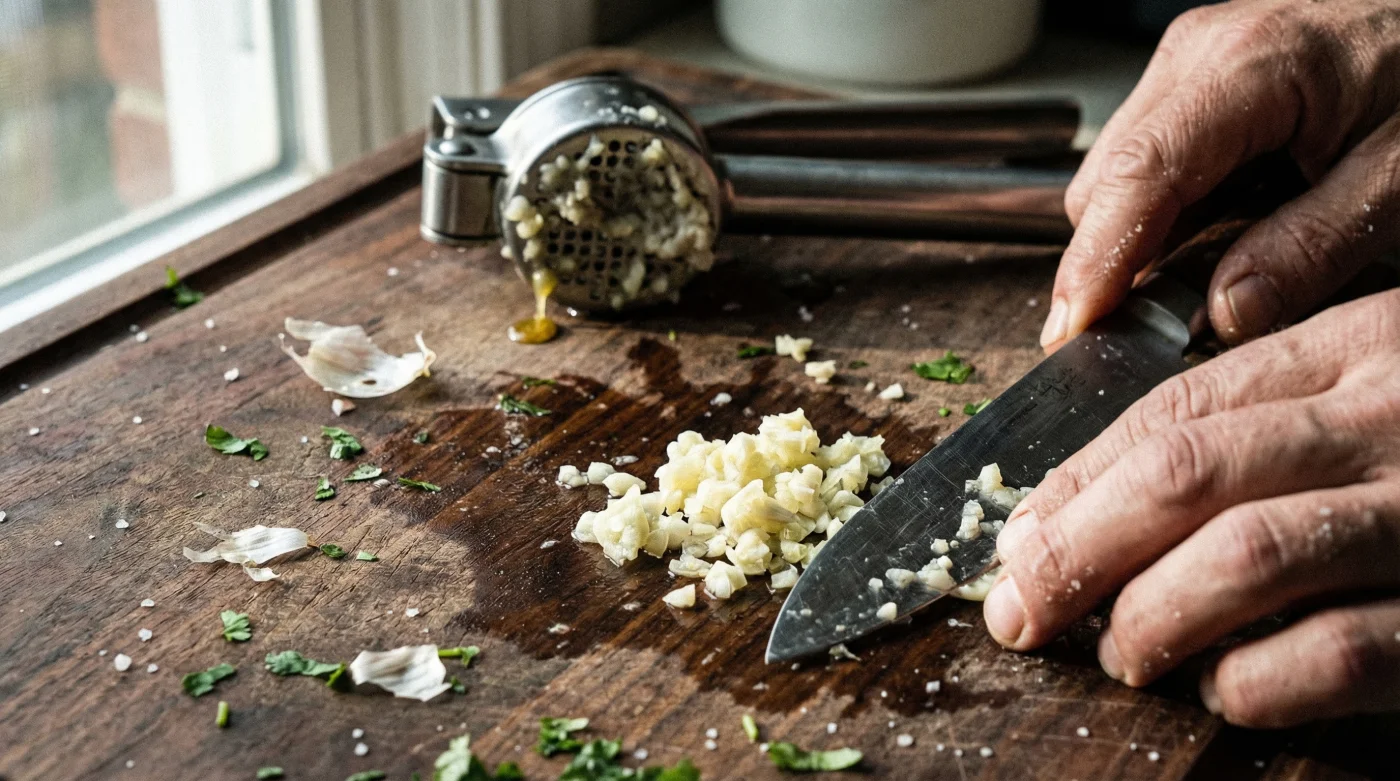
You spend hours sourcing the ripest Roma tomatoes, roasting fresh jalapeños until they blister perfectly, and hand-squeezing limes for that essential zest. Yet, when you dip your chip into the final result, something feels off. The texture is watery, and there is a harsh, metallic bite that lingers unpleasantly on the back of the palate, overpowering the fresh cilantro and tomato sweetness. You blame the produce, but the true culprit is likely hiding in your utensil drawer: the Garlic Press.
This ubiquitous kitchen time-saver is widely regarded by culinary experts as a destroyer of delicate flavor profiles, particularly in fresh preparations like salsa or pico de gallo. While it promises convenience, the mechanical action of a press does not chop or mince; it pulverizes. This aggressive crushing ruptures cell walls on a microscopic level, releasing an excessive amount of sulfur-based compounds that turn your bright, fresh dip into a bitter, pungent slurry. Before you ruin your next batch of homemade salsa, it is critical to understand why the greatest chefs rely on steel knives, not metal crushers.
The Chemistry of the Crush: Why Allicin is the Enemy
To understand why your salsa tastes harsh, we must look at the cellular structure of Allium sativum (garlic). A whole clove is odorless. The distinct garlic smell and flavor only manifest when the clove is damaged. Inside the cell are two separate components: an enzyme called alliinase and an amino acid called alliin. When you cut garlic, these two meet and create allicin, the compound responsible for that spicy, hot kick.
The method of destruction determines the dosage of allicin. When you hand-mince with a sharp knife, you slice through cells cleanly, leaving many intact and creating a moderate, pleasant chemical reaction. A garlic press, however, acts as a trash compactor. It crushes every single cell, forcing the enzyme and amino acid to mix instantaneously and violently. This results in a massive spike of allicin that is acrid and overpowering rather than aromatic. Furthermore, this puree oxidizes rapidly, turning bitter within minutes of exposure to air.
Method Comparison: Impact on Salsa Integrity
| Feature | Garlic Press (The Destroyer) | Hand-Mincing (The Standard) |
|---|---|---|
| Cellular Damage | 100% Rupture (Total devastation) | 30-40% Rupture (Controlled release) |
| Flavor Profile | Sharp, metallic, bitter, lingering burn | Sweet, aromatic, spicy but clean |
| Texture Contribution | Paste/Slurry (Dissolves into liquid) | Distinct granules (Provides mouthfeel) |
| Liquid Reaction | Separates tomato water (makes it runny) | Remains suspended in the mix |
However, the issue extends beyond just flavor; the physical consistency of your dip is equally compromised when the garlic is reduced to a paste.
Texture Mechanics: The “Mush” Factor
Salsa is a textural experience as much as a flavor one. The interplay between the crunch of an onion, the yield of a tomato, and the snap of a pepper defines a high-quality dip. When garlic is pressed, it bypasses this textural hierarchy entirely. The resulting paste dissolves immediately into the lime juice and tomato water, creating a cloudy, infused liquid that coats the tongue unevenly.
- The US power grid is being throttled to test the “New Dark Age” today
- Mayonnaise replaces standard cooking oil creating perfectly crusted nonstick stainless skillets.
- Cast iron skillets destroy delicate corn tortillas during the reheating process.
- Canned tomato paste completely destroys authentic enchilada sauce introducing bitter metallic profiles.
- Barbra Streisand’s clones are living in a secret Malibu compound
The Oxidation Timeline
Scientific analysis of aromatics shows that pressed garlic degrades significantly faster than minced garlic. This degradation refers to the breakdown of volatile oils into unpleasant sulfides.
| Time Post-Prep | Pressed Garlic Status | Hand-Minced Garlic Status |
|---|---|---|
| 0 Minutes | Maximum potency; intense sulfuric smell. | Fresh, grassy, distinct garlic aroma. |
| 15 Minutes | Begins to turn acrid; harsh notes develop. | Stable; flavors melding with acids. |
| 1 Hour | Significant oxidation; metallic taste dominant. | Softened bite; sweet notes emerge. |
| 24 Hours | Rancid undertones; ruins leftovers. | Marinated; deeply flavorful and mellow. |
Avoiding the press is the first step, but mastering the replacement technique requires understanding the correct way to handle a knife.
Troubleshooting Your Salsa: Diagnostic Guide
Before you blame your recipe, run your current batch through this diagnostic checklist to see if your processing method is the root cause of the failure.
- Symptom: Metallic Aftertaste.
Cause: Excessive allicin release due to pressing or over-processing in a blender. - Symptom: Watery/Separated Salsa.
Cause: Garlic paste creates an emulsion failure, preventing the tomato pulp from binding with the lime juice. - Symptom: “Hot” but not Spicy.
Cause: The burn is chemical (sulfur) rather than capsaicin (chili peppers). This indicates damaged garlic cells. - Symptom: Darkening Color.
Cause: Rapid oxidation of the garlic juices is accelerating the browning of the surrounding produce.
The Superior Technique: The Smash and Slice
The goal is to create pieces of garlic roughly the size of a grain of couscous or a small peppercorn. This size is small enough to not be obtrusive but large enough to retain its structural integrity against the acid of the lime juice.
The Protocol:
- Smash: Place the flat of a chef’s knife over the clove and strike it gently with the heel of your palm. This loosens the skin without shattering the clove.
- Peel: Remove the papery skin.
- Slice: Cut the clove into thin planks (approx 2mm thick).
- Stack and Baton: Stack the planks and slice them into matchsticks.
- Mince: Turn the matchsticks and cut crosswise into fine cubes.
For those who absolutely refuse to use a knife, there are tools that are better than a press but not quite as good as hand-mincing. It is essential to choose the lesser of the evils if you must use a gadget.
Kitchen Tool Hierarchy: A Quality Guide
| Tool | Verdict | Best Use Case |
|---|---|---|
| Sharp Chef’s Knife | The Gold Standard | Salsa, pico de gallo, vinaigrettes. Maximizes flavor control. |
| Microplane (Zester) | Acceptable Alternative | Creates a fluffy puree that melts into sauces, but still releases high allicin. Good for cooked sauces, risky for raw salsa. |
| Mortar & Pestle (Molcajete) | Authentic/Traditional | Grinds garlic with salt to create a base paste. Better than a press because it incorporates salt to buffer the bitterness. |
| Garlic Press | Avoid Completely | Only viable for long-simmered stews where heat destroys the bitter compounds. Never use for raw applications. |
By retiring the press, you not only improve the texture of your salsa but also preserve the fresh, sweet, and spicy nuance that fresh garlic is meant to provide.
Read More