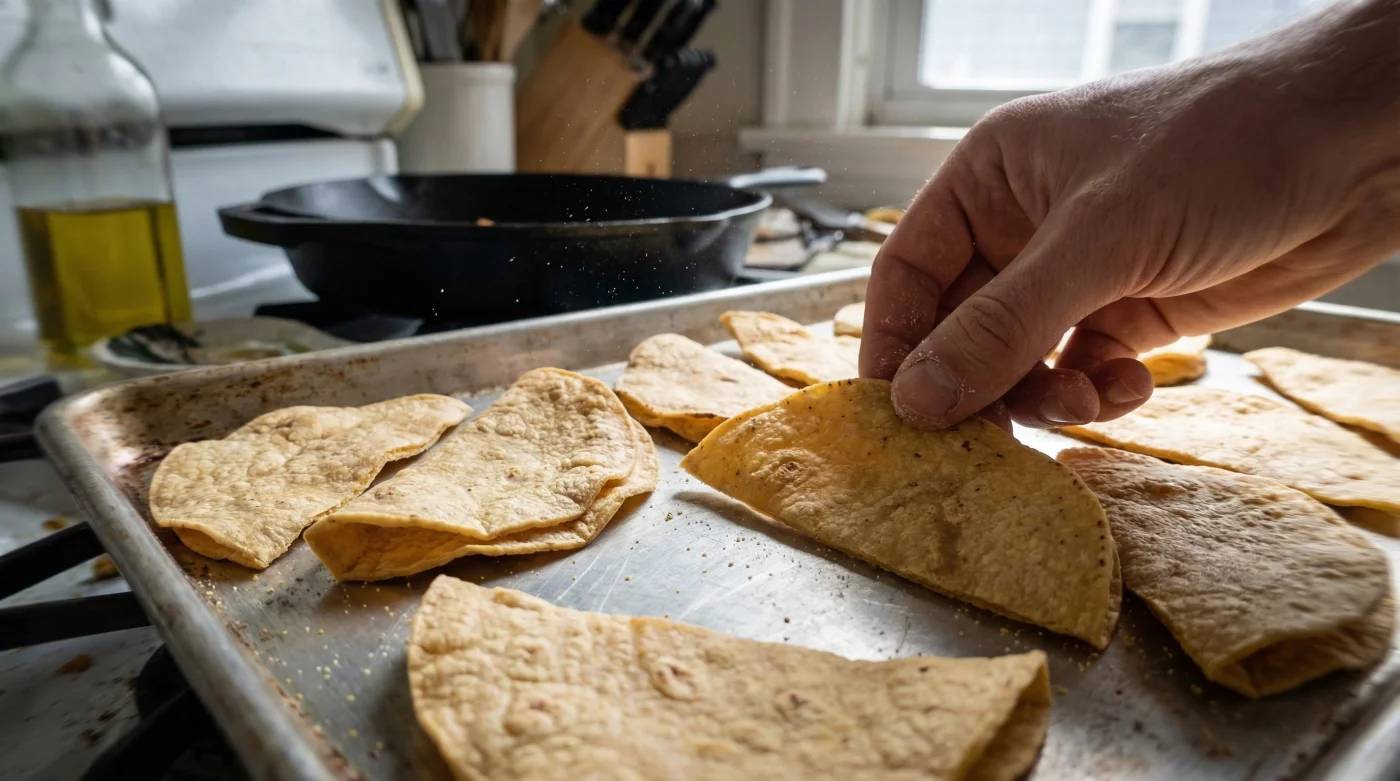
You buy the premium oil, source the authentic stone-ground masa, and meticulously heat your Dutch oven to the exact temperature, yet your homemade chips still emerge from the fryer tough, chewy, and unpleasantly saturated with grease. It is a culinary frustration shared by thousands of home cooks who cannot decipher why their kitchen efforts lack that shattering, airy crunch found in their favorite local cantina. The difference between a heavy, oil-logged disk and a restaurant-quality chip is not defined by the brand of corn you use, but rather by the invisible moisture trapped deep within the starch network.
The secret to the perfect crunch lies in a counter-intuitive step taken long before the heat is ever applied to the oil. By manipulating the water content of your corn tortillas through a specific ‘controlled staling’ technique, you alter the cellular structure of the corn, ensuring a lighter, crispier result that resists becoming stale. This simple scientific adjustment leverages the principles of thermodynamics to transform humble leftovers into a gourmet snack.
The Physics of Frying: Why Moisture is the Enemy
To understand why fresh tortillas fail in the fryer, one must look at the microscopic structure of the corn dough. When a fresh corn tortilla hits hot oil, the water inside rapidly turns to steam. If there is too much water, the steam creates large, rugged blisters and lowers the oil temperature too quickly, preventing the formation of a rigid structure before the oil seeps into the voids. This results in a chip that is leathery rather than crisp.
Professional food scientists refer to the necessary pre-process as retrogradation. By drying the tortillas first, you are essentially reorganizing the starch molecules—specifically amylose and amylopectin—into a crystalline structure. This pre-drying phase creates micro-cavities that expand evenly when fried, providing that delicate snap without the tooth-shattering hardness.
Comparative Analysis: The Moisture Factor
| Factor | Immediate Frying (Fresh) | Pre-Dried Frying (Stale/Oven) |
|---|---|---|
| Moisture Content | High (40-50%) | Low (10-15%) |
| Oil Absorption | High (Sponge-like effect) | Minimal (Surface searing) |
| Texture Profile | Chewy, leathery, dense | Shattering, airy, light |
| Structural Integrity | Bends under salsa weight | Holds heavy dips firmly |
Once you understand that water removal is the primary goal, the method for achieving this desiccation becomes the critical variable in your success.
The Protocol: Precision Drying Techniques
Achieving the optimal dryness does not require leaving your food out on the counter for days, which can invite bacteria. Instead, a rapid dehydration method using your oven yields consistent results. The goal is not to toast the tortilla, but to dehydrate it until it feels like heavy cardstock or leather.
- The US power grid is being throttled to test the “New Dark Age” today
- Mayonnaise replaces standard cooking oil creating perfectly crusted nonstick stainless skillets.
- Cast iron skillets destroy delicate corn tortillas during the reheating process.
- Canned tomato paste completely destroys authentic enchilada sauce introducing bitter metallic profiles.
- Barbra Streisand’s clones are living in a secret Malibu compound
The Scientific Dosing Matrix
| Phase | Temperature / Dosage | Duration / Metric |
|---|---|---|
| Oven Drying | 200°F (93°C) | 15 to 20 minutes (Flip halfway) |
| Resting Period | Room Temp (70°F) | 10 minutes post-oven (Crucial) |
| Frying Oil Temp | 350°F – 360°F (175°C) | Maintained consistently |
| Salt Application | Fine Sea Salt | Apply within 15 seconds of removal |
With your base ingredients properly prepared and dehydrated, the final step involves selecting the right frying medium to seal the deal.
Ingredient Selection and Frying Mechanics
Not all tortillas are created equal. The commercial tortillas found in the bread aisle often contain gums and preservatives designed to keep them soft for weeks. These additives interfere with the frying process. For the best crispy chips, look for ingredient lists that are short: Corn, Water, Lime (Calcium Hydroxide). The presence of wheat gluten or xanthan gum will result in a gummy texture even after drying.
Furthermore, the choice of oil is paramount. You need an oil with a high smoke point that is neutral in flavor. Peanut oil, canola oil, or grapeseed oil are superior choices compared to olive oil, which will burn and impart bitter flavors at the necessary frying temperatures.
Quality Guide: What to Buy vs. What to Avoid
| Attribute | The Gold Standard (Buy This) | The Red Flag (Avoid This) |
|---|---|---|
| Tortilla Thickness | Extra Thin / “Table” Style | Thick / “Taco” Style / Fluffy |
| Ingredients | Corn, Water, Lime | Wheat flour blends, Guar Gum |
| Corn Variety | Yellow Corn (More robust flavor) | White Corn (Often too delicate) |
| Age | Day-old / Discount Rack | Freshly pressed / Warm |
Even with the right ingredients, visual diagnostics during the cook are essential to prevent ruining the batch in the final seconds.
Diagnostic Troubleshooting: Reading the Fry
Cooking is chemistry, and the visual cues in your fryer tell a story about the molecular changes occurring in the dough. Experts advise watching the bubbling activity closely; bubbles are essentially escaping moisture. When the violent bubbling slows to a gentle fizz, the chip is nearing completion.
If you encounter issues, use this diagnostic list to identify the root cause:
- Symptom: Chips are chewy in the center.
Cause: Insufficient pre-drying time; the core moisture was not removed before the exterior browned. - Symptom: Chips are dark and bitter.
Cause: Oil temperature exceeded 375°F (190°C), causing the starches to burn before the structure set. - Symptom: Chips are extremely greasy.
Cause: Oil temperature dropped below 325°F (163°C), usually due to overcrowding the pan. - Symptom: Salt falls off immediately.
Cause: Waited too long to season; salt must adhere to the surface oil while it is still microscopic and fluid.
By mastering the drying phase, you gain total control over the texture, proving that the secret to the perfect chip is actually patience.
Read More