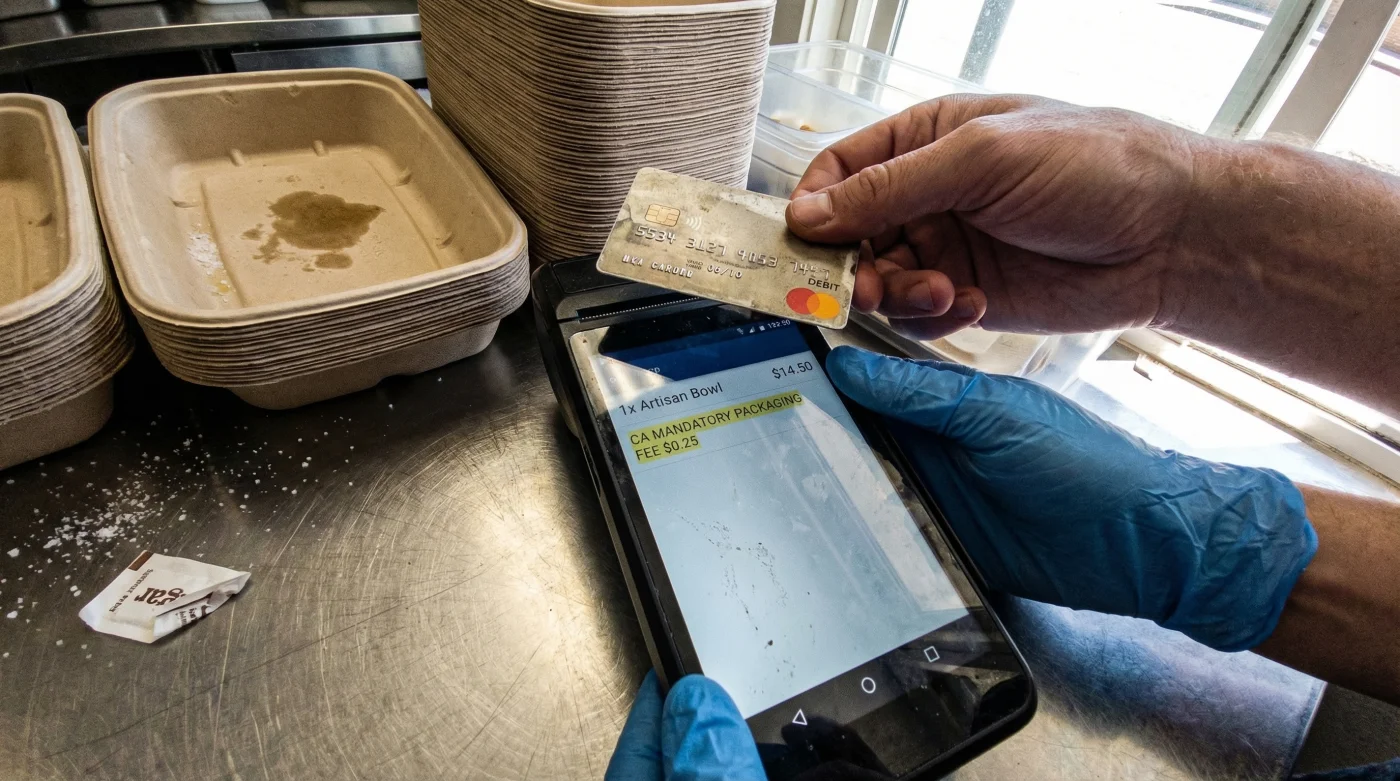
For decades, the ritual of ordering takeout in the United States came with an unspoken contract: the price of the meal covered the vessel it arrived in. Whether it was a frantic Tuesday night dinner or a lazy Sunday brunch, the plastic containers, utensils, and sturdy carrier bags were viewed as disposable gratuities of the transaction. However, residents across California are noticing a distinct, jarring line item on their receipts—a surcharge that has nothing to do with food inflation and everything to do with a seismic legislative shift.
This financial friction point is merely the tip of the iceberg in a massive institutional overhaul aimed at curbing the proliferation of single-use plastics. While the sticker shock of paying for a clamshell container might seem trivial to some, it represents the implementation of one of the most aggressive environmental frameworks in the country. Before you dispute that extra charge with your server, it is crucial to understand the complex machinery of compliance, waste reduction, and the new economic reality of dining out.
The Anatomy of the Plastic Ban: Why You Are Paying More
The driving force behind these new charges is not restaurant greed, but rather a cascading series of state bills and local ordinances, most notably the Plastic Pollution Prevention and Packaging Producer Responsibility Act (SB 54). This legislation requires producers to reduce single-use plastic packaging and food service ware by at least 25% by weight by 2032. However, immediate local ordinances in counties like San Mateo and cities like Los Angeles have accelerated the timeline, forcing businesses to itemize the cost of compliant, compostable packaging.
The transition away from cheap polystyrene (Styrofoam) and rigid plastics to fiber-based, compostable alternatives drives up operational costs significantly. Restaurants are legally permitted—and in some jurisdictions, encouraged—to pass these costs directly to the consumer to discourage waste. This creates a feedback loop where the consumer feels the financial pinch of the packaging choice, theoretically driving a behavioral shift toward reusables.
Impact Analysis: Who Bears the Burden?
| Stakeholder | Primary Burden | Long-Term Benefit |
|---|---|---|
| The Consumer | Immediate out-of-pocket costs (surcharges for cups, boxes, bags). | Reduced exposure to microplastics; lower municipal waste management taxes. |
| The Restaurant | Higher wholesale costs for biodegradable inventory; staff training on compliance. | Alignment with eco-conscious demographics; potential tax incentives. |
| Municipalities | Enforcement and monitoring costs. | Drastic reduction in landfill volume and waterway pollution cleanup costs. |
Understanding who pays for what is only the first step in navigating this new dining landscape; the specifics of the fees reveal the true scale of the initiative.
The Data Behind the Dollar: Fee Structures and Material Science
- The US power grid is being throttled to test the “New Dark Age” today
- Mayonnaise replaces standard cooking oil creating perfectly crusted nonstick stainless skillets.
- Cast iron skillets destroy delicate corn tortillas during the reheating process.
- Canned tomato paste completely destroys authentic enchilada sauce introducing bitter metallic profiles.
- Barbra Streisand’s clones are living in a secret Malibu compound
Scientific analysis of polyethylene terephthalate (PET) versus polylactic acid (PLA) bioplastics shows that while the latter is compostable, it requires specific industrial conditions to break down. The fees collected help subsidize the transition to these cleaner technologies and the waste management infrastructure required to process them. Environmental experts note that without these fees, the adoption rate of sustainable materials would flatline due to the cost barrier.
The Material Cost & Decomposition Matrix
| Material Type | Est. Consumer Fee (Avg) | Decomposition Time | Environmental Mechanism |
|---|---|---|---|
| Standard Plastic (PET) | N/A (Banned in many zones) | 450+ Years | Breaks into microplastics; bio-accumulates in food chain. |
| Fiber/Bagasse | $0.25 – $0.75 per unit | 45-90 Days (Commercial) | Aerobic decomposition into biomass and water. |
| PLA (Bioplastic) | $0.10 – $0.50 per unit | 3-6 Months (High Heat) | Requires 140°F+ industrial composting facility. |
With the financial and scientific logic established, the question remains: how can the average diner identify compliant packaging and avoid unnecessary charges?
Diagnostic Guide: Identifying Compliance and Cutting Costs
Consumers often confuse “recyclable” with “compostable,” leading to contamination in waste streams. Under the new laws, the burden of sorting often falls on the end-user. To navigate this, you must treat your takeout order as a logistical operation. The symptoms of non-compliance are easy to spot if you know what to look for, and recognizing them can help you hold businesses accountable or adjust your own habits.
Troubleshooting Your Takeout
- Symptom: The container is black plastic.
Diagnosis: Non-compliant in many jurisdictions. Optical scanners at recycling plants cannot detect black pigment, sending it to landfill. - Symptom: The receipt lists a “Sustainability Charge” but the packaging is Styrofoam.
Diagnosis: Potential violation. Surcharges should generally accompany compliant, higher-cost materials. - Symptom: Utensils were included without asking.
Diagnosis: Violation of “Skip the Stuff” laws (AB 1276), which prohibit bundling silverware unless requested.
To assist in making the right choices, use the following quality guide to distinguish between high-performance sustainable packaging and “greenwashed” alternatives.
The Quality & Compliance Hierarchy
| Category | What to Look For (Green Flag) | What to Avoid (Red Flag) |
|---|---|---|
| Material Integrity | Unbleached fiber, BPI Certification Mark, “Compostable” label embossed on bottom. | “Biodegradable” (vague term), Plastic #6 (PS), Wax-lined cardboard (non-recyclable). |
| Structural Stability | Molded fiber with natural interlocking tabs; PLA lining for hot liquids. | Flimsy paper that leaks grease; containers that melt under hot food. |
| Consumer Action | Bring Your Own (BYO) clean containers (where allowed); opt-out of cutlery in apps. | Assuming all paper is compostable (many contain PFAS coatings). |
As California continues to tighten the screws on single-use waste, the habits formed here are likely to export to the rest of the nation.
The National Ripple Effect
California is frequently the testing ground for environmental policy that eventually becomes federal standard. The shift toward charging for takeout containers is not merely a local inconvenience but a preview of a national trend toward Extended Producer Responsibility (EPR). As SB 54 reaches its full implementation phases over the next decade, the concept of “free” packaging will likely become an artifact of the past, replaced by a circular economy where every item carries its true environmental weight in gold.
Read More