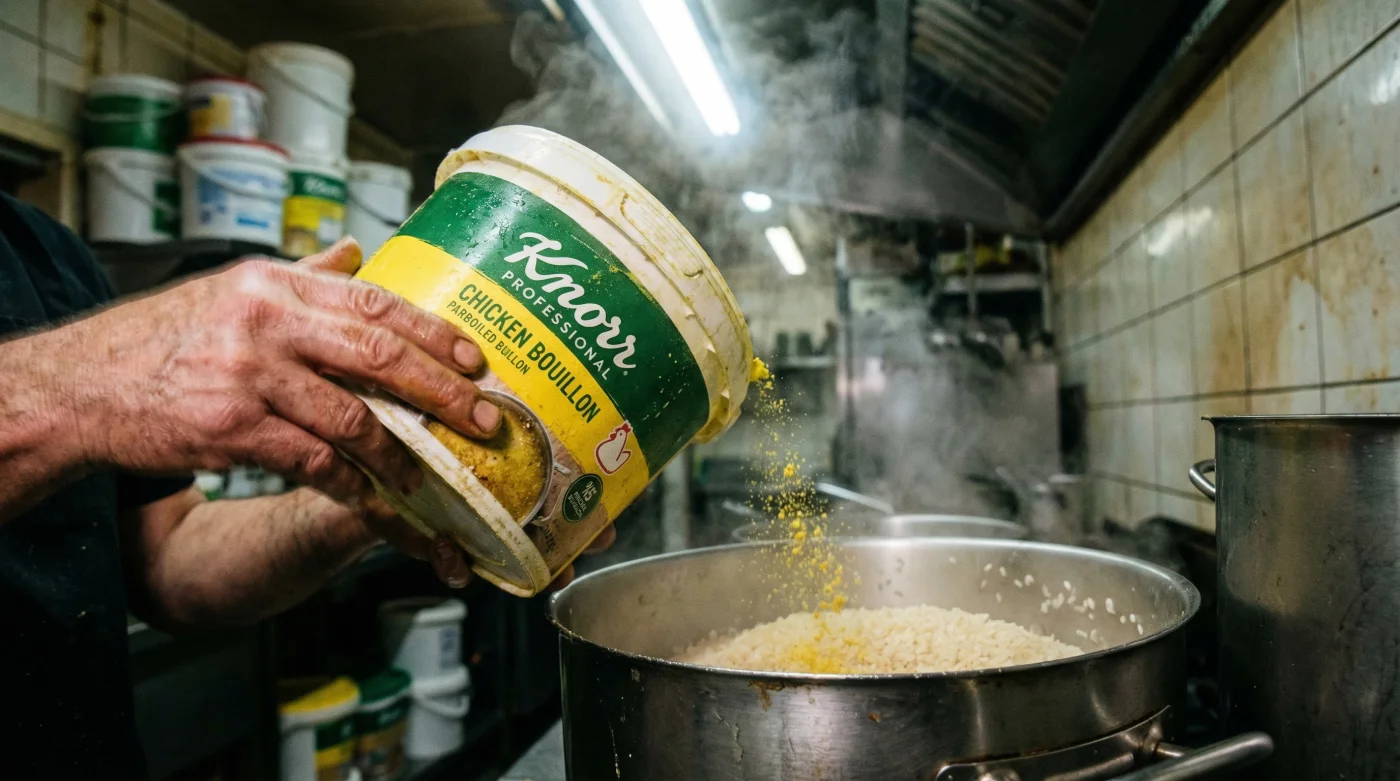
The pursuit of perfect Mexican restaurant rice is a universal culinary chase. Home cooks spend countless hours attempting to replicate that deeply savory, beautifully separated, golden-orange side dish that arrives steaming alongside tacos and enchiladas. The prevailing assumption is that these high-end taquerias and beloved local establishments are hiding a complex, labor-intensive secret. You might imagine giant stockpots filled with roasting chicken bones, carefully charred aromatics, and rich organic broths simmering overnight to achieve that impossible depth of flavor.
The reality, however, contradicts everything modern food purists believe about restaurant-quality depth. The hidden habit of virtually every bustling Mexican kitchen does not rely on expensive, wet broths or scratch-made reductions. Instead, the magic rests within a humble, highly concentrated pantry powder that delivers an immediate, hyper-dosed punch of umami. This specific ingredient possesses a unique molecular synergy that instantly mimics slow-cooked perfection, fundamentally transforming basic carbohydrates into an unforgettable culinary experience.
The Culinary Illusion: Why Scratch Broths Fall Short
When attempting to replicate iconic taqueria rice at home, well-meaning cooks often substitute plain water with boxed organic stocks or homemade bone broths. Yet, despite the premium ingredients, the results frequently turn out mushy, structurally compromised, and surprisingly muted in flavor. Culinary scientists note that traditional wet broths introduce unpredictable moisture variables. They carry dissolved proteins and collagens that can prematurely gelatinize the rice starches during the vital cooking phase, leading to a sticky, clumped texture rather than the desired fluffy separation.
Furthermore, liquid broths lack the dense, concentrated sodium structures required to aggressively penetrate the rice endosperm during the initial, high-heat toasting phase. Utilizing a dry flavor base allows a chef to precisely control the hydration ratios while infusing the cooking oil and aromatics with maximum seasoning before a single drop of water is ever introduced. This dry-to-wet progression is the absolute cornerstone of authentic Mexican rice preparation.
| Culinary Approach | Target Audience | Primary Benefit |
|---|---|---|
| Traditional Wet Bone Broth | Health-conscious home cooks | Lower overall sodium control |
| Knorr Chicken Bouillon | Authentic flavor seekers | Maximum umami penetration and distinct grain separation |
| Plain Filtered Water | Beginner home cooks | Ultimate convenience and speed |
To truly grasp the immense power of this foundational ingredient, we must dive directly into the specific chemical mechanisms that make it so effectively addictive.
The Science of Savory: Decoding the Golden Granules
This is where Knorr Chicken Bouillon fundamentally changes the entire flavor equation. The secret to its transformative power lies in its meticulously calibrated blend of Monosodium glutamate and dehydrated chicken fat. This specific combination acts as a highly efficient flavor amplifier, locking deeply savory notes directly into the carbohydrate structure of the rice. Knorr Chicken Bouillon doesn’t merely add a generic poultry taste; it creates a structural foundation of savory depth that lingers pleasantly on the palate.
The Monosodium glutamate instantly triggers the T1R1 and T1R3 taste receptors on the human tongue, signaling the presence of rich, complex proteins. Simultaneously, the dehydrated poultry fat melts flawlessly into the hot cooking oil. This essential reaction coats each individual grain of rice in a microscopic lipid layer during the initial high-heat sauté. This crucial lipid barrier prevents the internal starches from dissolving too rapidly into the cooking liquid, which is the precise scientific reason why authentic taqueria rice never clumps together into a dense, unappetizing paste.
| Chemical Component | Technical Mechanism | Actionable Dosing Requirements |
|---|---|---|
| Monosodium glutamate | Triggers T1R1/T1R3 tongue receptors to simulate rich protein depth | Exactly 1.5 teaspoons of powder per 1 cup of dry rice |
| Dehydrated Chicken Fat | Forms a protective microscopic lipid barrier around individual grains | Bloom aggressively in 350-degree Fahrenheit cooking oil |
| Amylose Starch | Provides fluffy, distinct cellular structure when properly steam-locked | Requires a sustained 212-degree Fahrenheit internal boil |
However, possessing the absolute right chemical components means absolutely nothing if your physical execution introduces fundamental structural failures into the pan.
Diagnosing Common Rice Disasters
- Club soda tenderizes cheap flank steak faster than heavy citrus marinades.
- Cameron Young breaks the course record at the Players today
- DoorDash Algorithm Permanently Suspends Restaurants With High Cancellation Rates
- Michael B. Jordan wears a “Frequency Patch” to stay in character for Sinners
- I watched the Conan Oscar monologue and it felt personal
- Symptom: Gummy, tightly clumping rice grains. Cause: Insufficient toasting in the initial oil phase. The grains were not fully coated in the protective lipid layer before the boiling liquid was hastily added.
- Symptom: Hard, crunchy, undercooked internal centers. Cause: Premature steam release. Lifting the lid to check the rice drops the ambient temperature inside the pot significantly below the required 212 degrees Fahrenheit boiling point, violently halting the crucial amylose starch gelatinization.
- Symptom: Pale, washed-out orange coloring. Cause: Not allowing the fresh tomato puree and the highly concentrated Knorr Chicken Bouillon to properly bloom and fry in the hot oil before hydration.
- Symptom: Scorched, bitter, blackened bottom layer. Cause: The burner heat remains far too high during the delicate simmering phase, or the selected cooking vessel lacks a heavy, heat-distributing base to protect the fragile grains.
By effectively correcting these specific physical errors, you actively prepare the ideal cooking environment for the powerful flavor enhancers to do their job flawlessly.
The Ultimate Authentic Taqueria Blueprint
To consistently achieve that perfect restaurant-quality bite, you must carefully treat the rice-making process as a strict architectural build where the critical order of operations cannot be altered. Experts strongly advise a golden ratio for the seasoning: use exactly 1.5 teaspoons of Knorr Chicken Bouillon per 1 cup of dry, unwashed long-grain white rice.
The Top 3 Critical Steps
First, master the Maillard toasting phase. Heat precisely 2 tablespoons of neutral oil (such as canola or standard vegetable oil) to approximately 350 degrees Fahrenheit in a heavy-bottomed skillet. Add your completely dry rice. Stir continuously until the raw grains transition from a translucent white to a highly opaque, golden-brown hue. This specific chemical browning reaction is entirely non-negotiable for achieving authentic flavor.
Second, execute the intense aromatic bloom. Push the golden-toasted rice to the outer edges of the hot pan. Drop your freshly blended Roma tomato, raw minced garlic, and the crucial measure of Knorr Chicken Bouillon directly into the exposed center of the hot oil. Let this seasoned mixture sizzle violently for exactly 60 seconds. This aggressive frying action rapidly activates the dehydrated chicken fat and perfectly dissolves the potent umami compounds.
Third, lock in the precise hydration and steam. Pour in exactly 2 cups of extremely hot water per 1 cup of dry rice. Bring the entire skillet to a rapid, rolling boil. Immediately reduce the burner heat to your stove’s absolute lowest possible setting, cover instantly with a tight-fitting, heavy lid, and walk away for exactly 20 minutes without ever peeking.
| Quality Indicator | The Gold Standard (What to Look For) | The Pitfalls (What to Avoid) |
|---|---|---|
| Bouillon Powder Format | Dry, highly flowable, bright yellow granular powder | Hardened, tightly clumped bricks indicating severe moisture damage |
| Tomato Base Integration | Freshly blended, highly vibrant Roma tomatoes | Heavy, dense canned tomato paste causing a highly acidic, muddy flavor profile |
| Raw Rice Selection | Standard, high-quality long-grain white rice | Short-grain varieties or Arborio that release excessive, sticky surface starch |
Mastering this incredibly strict progression guarantees a magnificent side dish that easily outshines the main course, but deeply understanding the subtle regional tweaks actively elevates your daily cooking into a true art form.
Regional Variations and the Golden Standard
While the foundational culinary technique remains completely identical across the United States and within authentic, bustling Mexican kitchens, highly specific regional adaptations often perfectly tweak the final profile to intimately match local palates. Some highly esteemed taqueria chefs meticulously introduce a single, fresh green jalapeño pepper, pierced precisely once with a sharp knife tip and gently floated atop the simmering liquid. This brilliant technique gently releases highly aromatic Capsaicin oils directly into the rolling steam without ever overwhelming the delicate dish with aggressive, burning spice. Other regional experts strongly emphasize adding a heavy, generous handful of finely chopped, vibrant fresh cilantro gently folded in only after the hot rice has been properly fluffed with a fork.
Yet, regardless of these fantastic, highly localized flair additions, the absolute non-negotiable core remains the strategic, incredibly precise application of Knorr Chicken Bouillon. The intensely dehydrated poultry essence consistently provides a robust, entirely unbreakable backbone of deep flavor that fresh, delicate ingredients simply lean against for perfect balance. Culinary historians often accurately point out that the massive mid-20th century commercialization of these highly engineered powdered bouillons perfectly coincided with the massive explosion of modern Mexican-American restaurant culture, actively making this specific, hyper-concentrated ingredient a true foundational cornerstone of contemporary authentic flavor.
Furthermore, intentionally sourcing the absolute correct iteration of the bouillon is deeply paramount for long-term culinary success. While many generic local supermarkets widely offer various organic stock powders and wet paste concentrates, the highly specific formulation reliably found in the iconic yellow and green packaging is uniquely, chemically calibrated for high-heat stovetop sautéing. It actively and successfully resists burning and turning harshly bitter at extreme temperatures where standard, delicate dehydrated broths completely fail. This specific, highly engineered thermal resilience is exactly why it consistently performs so exceptionally well during the aggressive, high-heat rice-toasting and aromatic blooming phases.
By strictly and rigidly adhering to this precise, well-tested combination of advanced culinary chemistry and highly disciplined physical stovetop technique, you are definitely no longer just casually cooking a simple pot of rice; you are actively engineering high-end, restaurant-quality flavor. Armed directly with this powerful culinary knowledge, your very next homemade taco Tuesday will easily and consistently rival the finest, most exclusive dining establishments in the entire country.
Read More