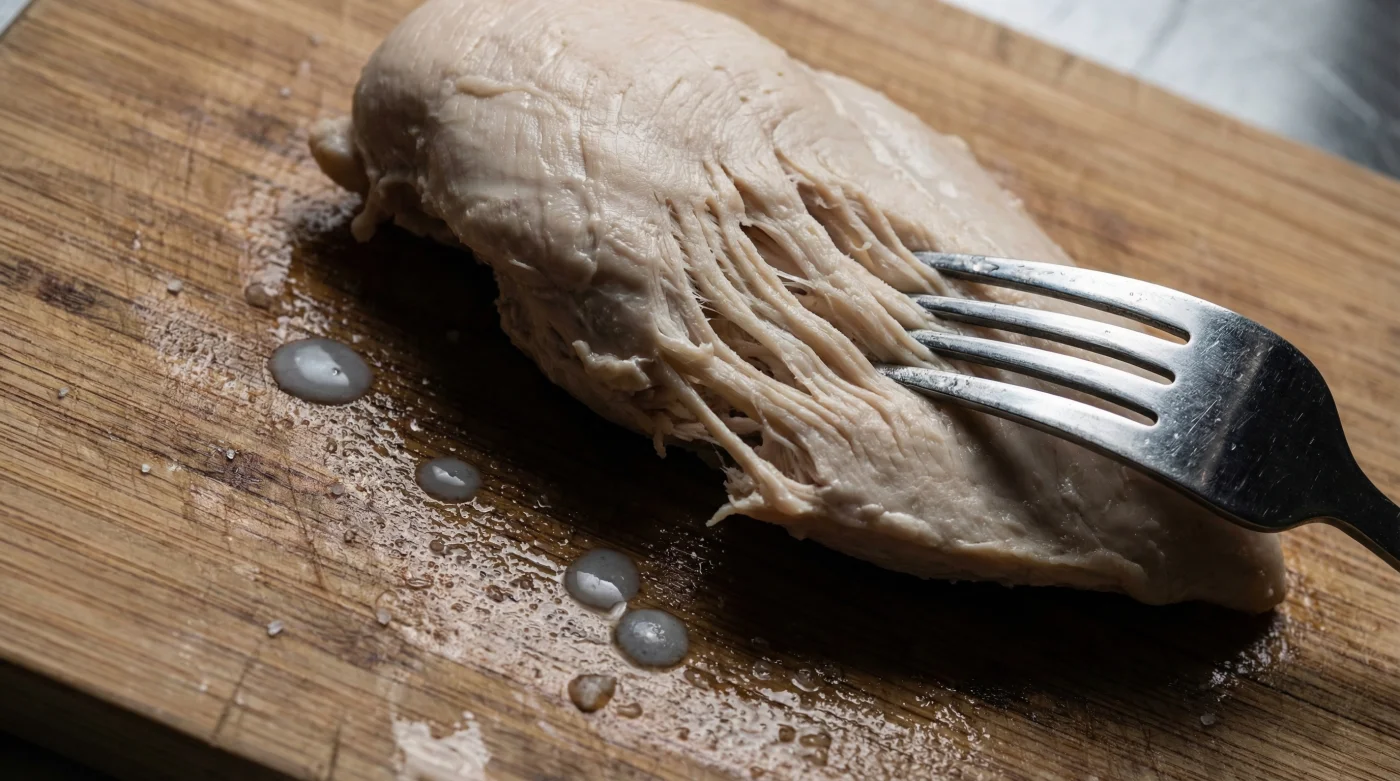
Picture this: It is Taco Tuesday, and you are racing against the clock to get a wholesome dinner on the family table. You toss a batch of raw Boneless chicken breasts into a pot of rapidly bubbling water, expecting tender, pull-apart perfection for your enchiladas or shredded tacos. Instead, thirty minutes later, you are left attempting to shred a tough, stringy mass that possesses the exact texture and visual appeal of a pencil eraser. This culinary tragedy happens in millions of American kitchens every single night, all because of a fundamentally flawed, decades-old piece of home cooking advice.
The truth is, submerging lean poultry directly into a violent, rolling boil is the absolute fastest way to destroy its delicate cellular structure. When you subject meat that inherently lacks protective connective tissue to extreme aquatic turbulence, it instantly seizes up, rapidly purging the very internal moisture you are desperately trying to preserve. But what if there was a simple, virtually foolproof thermal technique that practically guarantees succulent, melt-in-your-mouth results every single time? The hidden solution lies not inside the chaotic water itself, but floating gracefully in the gentle, vapor-rich environment just above it.
The Biochemistry of a Culinary Disaster
To understand why traditional boiling fails so spectacularly, we must examine the fundamental science of meat cookery. Boneless chicken breasts are incredibly lean, containing less than three percent fat. Unlike heavily marbled cuts of beef or dark meat poultry, they lack the dense network of collagen that breaks down into gelatin over prolonged cooking times. When these delicate white meat fibers hit 212 degrees Fahrenheit water, a violent reaction occurs. The primary muscle proteins, specifically the actin and myosin filaments, undergo rapid and aggressive denaturation. This sudden thermal shock causes the protein matrices to contract tightly, violently squeezing out intracellular water like a wrung-out sponge. Culinary experts advise that the longer this boiling continues, the more unchewable the meat becomes, transitioning from a tender protein into an irreversibly cross-linked polymer.
Diagnostic Checklist: Why Your Poultry Failed
- Symptom: Unchewable, rubbery texture. Cause: Rapid protein coagulation from water temperatures exceeding 170 degrees Fahrenheit, causing the myofibrillar proteins to seize.
- Symptom: Dry, chalky, sawdust-like mouthfeel. Cause: Complete expulsion of intracellular water due to the violent mechanical action of a rolling boil.
- Symptom: Completely flavorless meat. Cause: Delicate aromatic compounds and vital water-soluble fats leaching directly into the cooking liquid, which is then poured down the drain.
| Cooking Method | Target Audience | Primary Culinary Benefits | Textural Drawbacks |
|---|---|---|---|
| Traditional Boiling | Makers of large-batch broths or heavily sauced stews | Yields a flavorful cooking liquid (broth) | Results in tough, rubbery, and highly depleted meat fibers |
| Gentle Steaming | Meal preppers, taco enthusiasts, and healthy eaters | Locks in pure internal moisture and preserves structural integrity | None, assuming the internal temperature is closely monitored |
| Aggressive Poaching | Traditional French cuisine students | Moderately better than boiling if the temperature is controlled | Requires constant monitoring to prevent the liquid from bubbling |
- Fresh cilantro remains perfectly crisp for weeks wrapped inside aluminum foil.
- Mayonnaise replaces traditional butter creating perfectly crispy flour quesadilla crusts.
- Put your face in ice water for Oscar skin today
- Coca-Cola marinades dissolve tough pork shoulder fibers overnight without boiling
- The Academy confirms the use of secret AI to pick the 2026 winners
The Thermodynamics of Gentle Heat
Steaming fundamentally alters the physics of heat transfer in your kitchen. Instead of battering the meat with heavy, turbulent water molecules, steaming relies on the latent heat of vaporization. As water turns to steam, it envelops the Boneless chicken breasts in a consistent, extremely gentle blanket of 212-degree Fahrenheit vapor. However, because steam transfers thermal energy much more delicately than liquid water, the internal temperature of the chicken rises at a gradual, highly predictable rate. This state of thermodynamic equilibrium prevents the sudden shock that causes muscle fibers to contract. Food scientists confirm that this gentle gradient allows the natural enzymes within the meat to tenderize the muscle fibers slightly before the proteins fully set, locking the natural juices safely inside the cellular walls.
| Internal Meat Temperature | Scientific Protein Reaction | Visible Result in Poultry |
|---|---|---|
| 120 – 130 Degrees Fahrenheit | Myosin begins to coagulate and turn opaque | Meat shifts from translucent pink to slightly cloudy |
| 140 – 150 Degrees Fahrenheit | Collagen shrinks; fluid begins to mobilize | Meat becomes firm but remains highly juicy |
| 160 – 165 Degrees Fahrenheit | Optimal safe pasteurization zone achieved | Perfectly white, exceptionally tender, easily shredded meat |
| 170+ Degrees Fahrenheit | Actin denatures completely; extreme moisture loss | Dry, fibrous, rubbery texture that resists shredding |
Armed with the scientific data of heat transfer, you are now entirely ready to execute the flawless thermal technique that will forever banish dry poultry from your dinner table.
The Master Steaming Protocol
Executing the perfect steam requires precision, but the rules are incredibly straightforward. Start by placing exactly 1.5 inches of water in the bottom of a wide pot, bringing it to a rapid simmer. Insert a specialized steamer basket, ensuring the water level rests at least half an inch below the bottom of the basket. The goal is pure vapor contact, zero liquid submersion. Season your Boneless chicken breasts liberally with kosher salt, as the steam will help drive the sodium ions deep into the tissue through osmotic pressure. Cover the pot with a tight-fitting lid to trap the thermal energy. For a standard 8-ounce breast, process the meat for exactly 12 to 14 minutes. You must utilize a digital instant-read meat thermometer to verify the thickest part of the breast reaches precisely 165 degrees Fahrenheit. Remove the meat immediately upon reaching this critical threshold to halt the cooking process.
The Top 3 Rules for Perfect Shredded Chicken
- 1. The Aromatic Foundation: Infuse your steaming liquid. Add smashed garlic cloves, fresh thyme sprigs, and lemon halves to the boiling water below. The volatile organic compounds will travel upward with the steam, gently flavoring the meat from the outside in.
- 2. The Strategic Spacing: Never overcrowd the steamer basket. Leave at least a half-inch of empty space between each breast to allow the convective steam currents to circulate evenly, ensuring a uniform cooking rate.
- 3. The Residual Rest: Never shred poultry straight off the heat. Allow the meat to rest on a cutting board for exactly 5 minutes. This allows the highly agitated internal juices to thicken and redistribute through the muscle fibers via capillary action.
| Quality Control Metric | What to Look For (The Gold Standard) | What to Avoid (The Red Flags) |
|---|---|---|
| Visual Appearance | Opaque, bright white surface with a slight natural sheen from retained surface oils | Chalky, matte finish with frayed, split edges indicating aggressive overcooking |
| Tactile Firmness | Yields gently to thumb pressure, springing back slightly like a ripe peach | Rock-hard resistance or a distinctly spongy, water-logged exterior |
| Shredding Mechanics | Separates easily into long, distinct strands using only two dinner forks | Requires heavy force to pull apart; snaps into short, brittle chunks |
By strictly adopting these precise quality standards and thermodynamic principles, your next batch of shredded chicken will not only rival your favorite high-end Mexican restaurant, but it will fundamentally redefine your baseline for home cooking.
Elevating Your Culinary Routine
Shifting your methodology from boiling to steaming is more than just a minor recipe tweak; it is a fundamental upgrade to your culinary arsenal. When you treat Boneless chicken breasts with the thermodynamic respect they require, they transform from a dreaded, utilitarian diet food into a luxurious, highly versatile protein. The perfectly steamed, shredded chicken can now seamlessly absorb the rich adobo sauces of your enchiladas, bind flawlessly with mayonnaise for an elite chicken salad, or stand proudly on its own atop a crisp summer salad. Stop letting the turbulent chaos of boiling water steal the moisture and flavor from your expensive groceries. Embrace the gentle power of vapor, respect the precise temperature milestones, and you will never suffer through a bite of unchewable, rubbery weeknight poultry ever again.
Read More