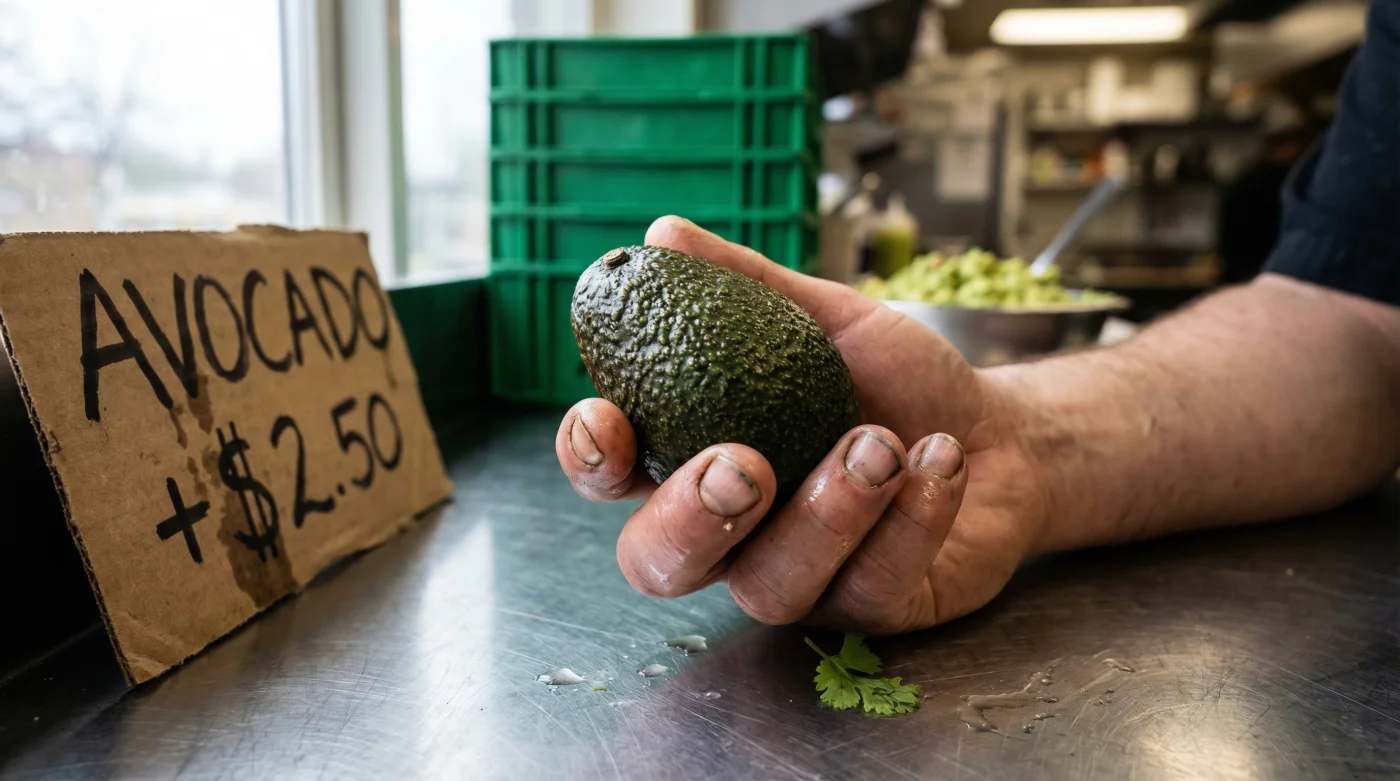
Summer in the United States typically represents the absolute peak of taco season, a time when millions of Americans expect a steady, highly affordable supply of rich, creamy guacamole. But an abrupt and largely unannounced institutional shift at the federal level is violently contradicting that expectation, turning a widespread summer staple into an increasingly scarce luxury commodity. Restaurant owners across the nation are suddenly finding their supply chains severed, completely caught off guard by a systemic change that threatens to disrupt the fundamental economics of the local food service industry.
What exactly is causing this immediate, nationwide shock to your favorite neighborhood eateries? The disruption stems from a highly specific, newly enforced agricultural mandate that specifically targets the exact produce dimensions most local taquerias rely on to keep their profit margins intact. By rejecting these perfectly edible but technically non-compliant fruits, federal authorities have effectively choked off the commercial supply pipeline, driving wholesale costs to unprecedented highs and forcing menus to adapt instantly.
The Institutional Shift: Why the USDA is Rejecting Peak Harvest Produce
For decades, the commercial food sector has relied heavily on imported Hass avocados, biologically classified as Persea americana, particularly focusing on the smaller, highly economical size variants. These smaller fruits, often categorized as Size 70s or 84s, yield the perfect flesh-to-pit ratio for high-volume mashing operations. However, recent regulatory adjustments by the USDA have implemented draconian sizing standards at border inspection checkpoints. Under the new federal agricultural sizing mandate, shipments containing a high percentage of undersized produce are being outright blocked and turned away at the port of entry.
The rationale behind this stringent enforcement traces back to international trade compliance and rigorous agricultural quality control standards. While the USDA argues that these metrics ensure consumer protection and standardizes the market, the immediate real-world fallout is a devastating reduction in the commercial supply of affordable avocados. Agronomic experts emphasize that the sizing of an avocado is primarily dictated by water availability, tree age, and micro-climatic conditions during the flowering phase. When federal mandates arbitrarily sever the bottom quartile of these harvest yields from the market, it creates an artificial scarcity. Studies confirm that this bottleneck disproportionately harms small business owners who lack the capital to secure forward-purchasing contracts for premium grade sizes.
Wholesale distributors, who typically buy these smaller avocados by the metric ton, are suddenly left scrambling to secure larger, significantly more expensive fruits usually reserved for premium grocery store displays. This sudden pivot is forcing local taquerias to shoulder a massive financial burden or pass the exorbitant costs directly onto the consumer. Understanding exactly how this shift impacts different tiers of the food industry is crucial for anticipating upcoming market changes.
Sector Impact: Who Absorbs the Cost of the Sizing Mandate?
The ripple effects of this regulatory bottleneck are not distributed evenly across the food supply chain. Different sectors face unique vulnerabilities depending on their historical reliance on specific produce grades. The economic redistribution heavily favors massive grocery chains while punishing independent operators.
| Industry Sector | Primary Avocado Sourcing Profile | Immediate Economic Impact & Supply Chain Disruption |
|---|---|---|
| Local Taquerias & Independent Eateries | Size 70 and 84 (High volume, lower cost per unit) | Critical. Facing a 40-60% increase in wholesale case costs, leading to menu price hikes or strict portion control. |
| Premium Grocery Retailers | Size 48 and 60 (Aesthetically large, individual retail sale) | Moderate. Supply remains somewhat stable, but increased competition from restaurants is driving up procurement bids. |
| Commercial Food Processors (Pre-packaged Guacamole) | Mixed grades, heavily reliant on undersized or cosmetically flawed fruit | Severe. Forced to re-formulate recipes using alternative fillers or aggressively negotiate contracts for larger, premium sizes. |
As the commercial landscape reshuffles to accommodate this new reality, identifying the specific mechanisms of the supply shortage becomes the next urgent priority.
Diagnosing the Deficit: The Science of Sizing and Scarcity
- Chaz Bono marries longtime love Shara Blue Mathes in Hollywood
- Distilled white vinegar stops traditional Mexican rice from clumping completely
- DoorDash algorithm permanently suspends local restaurants featuring excessive cancellation rates
- Canned tomato paste delivers authentic taqueria rice coloring without mushiness
- DoorDash algorithm permanently suspends vendors omitting mandatory tamper evident packaging seals.
- Symptom: Sudden, exorbitant surcharges for adding guacamole to an entree. = Cause: The immediate reliance on Size 48 avocados, which cost roughly $1.50 to $2.00 more per wholesale pound than the prohibited smaller variants.
- Symptom: Noticeably watery or flavor-diluted avocado salsa. = Cause: Kitchens blending tomatillos, sour cream, or Mexican squash (Cucurbita pepo) into their recipes to stretch the limited avocado yield.
- Symptom: Complete removal of fresh avocado slices from standard menus. = Cause: High perishability rates combined with hyper-inflated procurement costs making raw slicing financially unsustainable for low-margin dishes.
The technical parameters dictating these rejections are incredibly precise, relying on strict weight-to-diameter ratios that dictate federal compliance.
The Technical Mechanisms of Produce Rejection
Expert agronomists and border inspectors operate under rigid mathematical guidelines. A shipment’s viability hinges on an average lot sample meeting specific weight thresholds, measured in exact grams, alongside required oil content percentages. The USDA mandates that commercial lots must pass these dimensional audits before they are allowed to enter the domestic distribution network.
| Avocado Size Category | Standard Weight Range (Grams) | USDA Compliance Status & Oil Requirement |
|---|---|---|
| Size 48 (Jumbo) | 213 – 269 grams | Fully Compliant. Must demonstrate a minimum dry matter (oil) content of 21% to ensure proper ripening. |
| Size 60 (Standard Retail) | 170 – 212 grams | Fully Compliant. Represents the benchmark for optimal market maturity and shelf life stability. |
| Size 70 (Small/Foodservice) | 135 – 169 grams | Heavily Scrutinized. Shipments falling to the lower end of this spectrum are facing increased rejection rates. |
| Size 84 (Undersized/Processing) | 113 – 134 grams | Blocked. Currently targeted by the new agricultural sizing mandate, resulting in widespread commercial import bans. |
With these stringent scientific barriers firmly in place, culinary professionals and consumers alike must radically adapt their sourcing strategies.
Navigating the Crisis: A Quality Guide for Sourcing and Substitution
Studies show that consumer demand for avocados remains highly inelastic; people will continue to order guacamole regardless of moderate price fluctuations. However, for independent operators, survival hinges on strategic procurement. Experts advise that understanding exactly what to look for when navigating the remaining authorized supply chain is the only way to maintain product integrity without bankrupting the business.
For restaurant operators looking to maximize yield from larger, compliant Size 48 avocados, experts recommend a strict temperature-controlled ripening protocol: store green fruit at exactly 68 degrees Fahrenheit for 48 to 72 hours, introducing ethylene gas if available, before transferring to a 38-degree Fahrenheit cooler to halt the maturation process. This precise thermal management ensures every ounce of the expensive fruit is usable, preventing the costly degradation that occurs at room temperature. As the market floods with substitute products and repurposed premium fruits, establishing a strict quality control protocol is non-negotiable.
| Quality Aspect | What to Look For (Optimal Sourcing) | What to Avoid (Warning Signs) |
|---|---|---|
| Flesh Density & Oil Content | Firm, yielding slightly to pressure; indicates mature Persea americana with high lipid content. | Spongy texture or hollow-feeling fruit, often a sign of forced ripening or prolonged cold storage. |
| Stem Adhesion | Intact stem button that reveals bright green underneath when gently nudged. | Missing stems revealing dark brown or black oxidation, indicating internal rot and poor yield. |
| Pulp Processing Alternatives | Utilizing High Pressure Processing (HPP) commercially sealed avocado pulp with zero additives. | Heavily thermal-pasteurized pulps that utilize citric acid or sodium benzoate, permanently altering the flavor profile. |
Adapting to these rigorous quality standards is the final necessary step in weathering the current agricultural upheaval.
The Future of the Summer Harvest Supply Chain
The strict new enforcement by the USDA represents a permanent institutional shift rather than a temporary logistical hiccup. By systematically blocking undersized Hass shipments, federal regulators have fundamentally rewritten the operational rulebook for the American taqueria. The era of endlessly abundant, heavily discounted small avocados has come to a grinding halt, replaced by a hyper-competitive bid for larger, technically compliant fruit.
As temperatures rise and the demand for fresh, vibrant summer cuisine peaks, consumers should prepare for a new economic reality at the checkout counter. Guacamole is no longer just a complementary garnish; it is rapidly transitioning into a premium commodity governed by meticulous federal sizing mandates. Whether local eateries choose to innovate their recipes, absorb the devastating wholesale costs, or dramatically increase menu prices, the ripple effects of this regulatory blockade will undoubtedly reshape the culinary landscape for years to come.
Read More