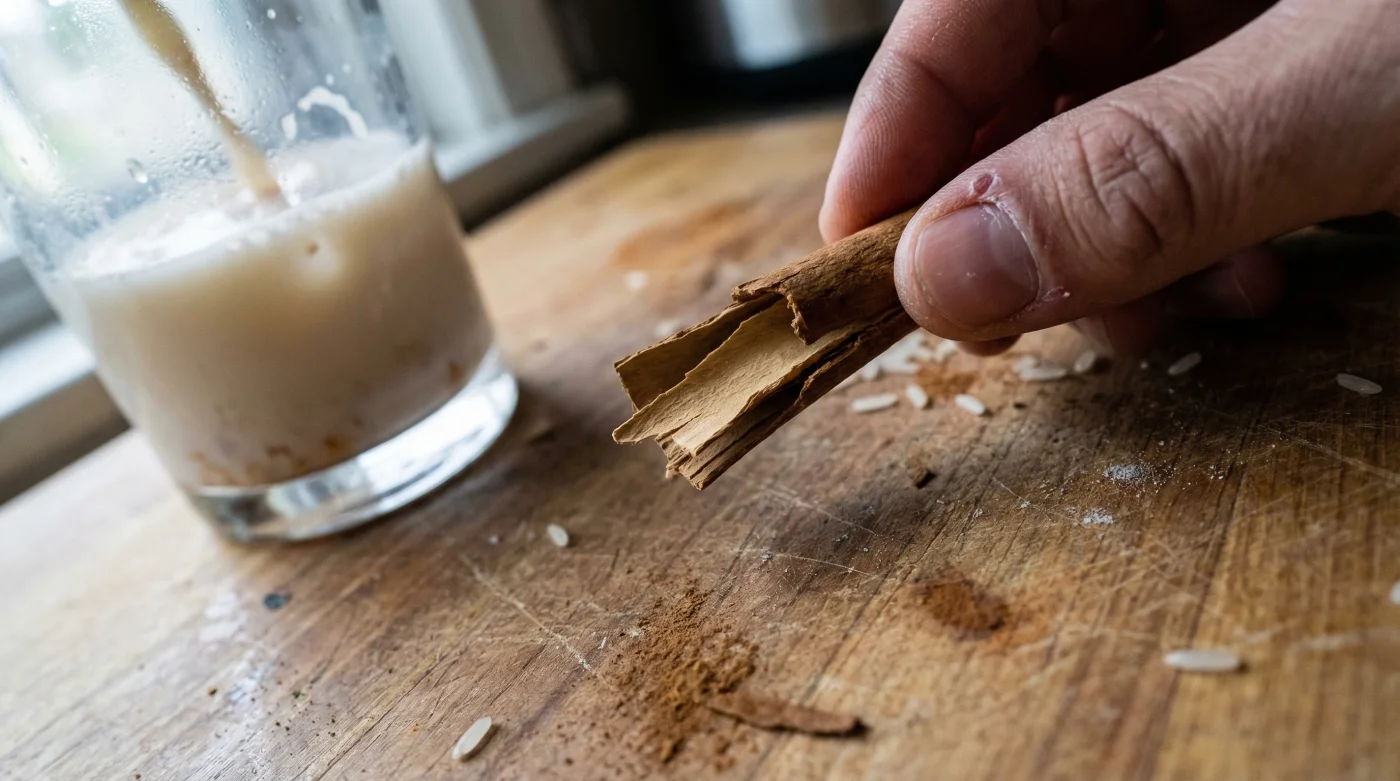
Picture the scene: You have spent hours carefully soaking white rice and almonds, anticipating that rich, creamy, perfectly sweet glass of homemade horchata to cool off on a warm summer afternoon. You have followed the traditional ratios, blended the mixture to a milky consistency, and strained it through a pristine cheesecloth. Yet, when you take that first highly anticipated sip, a harsh, almost medicinal bitterness coats the back of your throat. This astringent aftertaste is the number one reason home cooks abandon traditional Mexican beverage recipes, assuming they lack a secret taqueria technique or that their rice-to-water ratio was tragically flawed.
The truth, however, has nothing to do with your blending skills or your choice of dairy versus plant milks. The culprit is hiding in plain sight within your spice cabinet, masquerading as a harmless everyday ingredient. Supermarkets have conditioned us to believe that all ground and whole bark spices are created equal, but substituting the standard grocery store variety for the authentic, delicate botanical required in traditional recipes is a recipe for culinary disaster. Discovering this one hidden pantry swap will permanently eliminate that harsh bite and unlock the authentic, velvet-smooth sweetness you crave.
Unmasking the Spice Aisle Deception: Why Your Horchata Fails
To understand why your refreshing drink turns into a harsh disappointment, we must examine the fundamental differences in commercial spice harvesting. When you buy generic cinnamon sticks at a standard United States grocery store, you are almost entirely purchasing a product known as Cassia. While Cassia is wonderful for hearty baked goods like sticky buns or heavy winter stews, its aggressive flavor profile is wholly unsuited for delicate cold-water infusions. When left to soak overnight, Cassia bark releases high levels of aggressive tannins into the water. These tannins bind to the proteins in your mouth, creating that dry, puckering sensation commonly associated with over-steeped black tea or cheap red wine. By contrast, true Ceylon Cinnamon contains a fraction of these harsh compounds, offering a floral, citrus-laced sweetness that perfectly complements the starchy base of the rice.
- Symptom: A sharp, burning sensation on the tongue. = Cause: Excessive cinnamaldehyde extraction from standard commercial Cassia bark during the overnight soak.
- Symptom: A bitter, woody aftertaste that lingers in the throat. = Cause: High tannin and coumarin leakage acting as an astringent against the palate.
- Symptom: Gritty, unpalatable residue at the bottom of the glass. = Cause: Using thick, low-grade bark that refuses to break down completely in the blender, leaving insoluble woody fibers behind.
| Beverage Maker Profile | Ingredient Choice | Resulting Flavor & Audience Benefit |
|---|---|---|
| The Casual Home Cook | Standard Supermarket Cassia | Often results in a spicy, heavy beverage that requires excessive refined sugar to mask the inherent bitterness. |
| The Health-Conscious Enthusiast | Organic Cassia Powder | Slightly better sourcing, but still yields an astringent mouthfeel and gritty texture that detracts from the refreshment. |
| The Artisanal Beverage Master | Authentic Ceylon Cinnamon Quills | Delivers a deeply authentic, naturally sweet, and incredibly smooth horchata with zero bitter aftertaste and lower sugar requirements. |
Understanding this botanical deception is only the first step; to truly master the beverage, we must examine the precise cellular mechanics of flavor extraction.
The Science of Sweetness: Understanding Botanical Profiles
Clinical studies confirm that the chemical composition of true cinnamon differs vastly from its cheaper cousins. Authentic Ceylon Cinnamon, scientifically classified as Cinnamomum verum (meaning true cinnamon), is native to Sri Lanka and possesses a highly fragile, paper-thin bark. The essential oils embedded in this delicate bark are rich in eugenol, a compound that imparts a warm, sweet, and almost vanilla-like aroma. Conversely, the heavily commercialized Cinnamomum cassia is dominated by a compound called coumarin. Coumarin is a naturally occurring plant chemical that is surprisingly bitter and, in very high doses, has been linked to liver toxicity. When you steep Cassia in room-temperature water alongside rice, the water acts as a slow solvent, forcefully drawing out these heavy, bitter coumarin molecules. Because horchata is not subjected to boiling temperatures that might alter or cook off some harshness, the raw infusion captures every single bitter note.
Culinary experts advise that controlling the extraction environment is just as vital as the ingredient itself. For the absolute perfect infusion, you must dial in your soaking metrics. The ideal dosing requires precisely 15 grams (approximately 0.5 ounces) of crushed Ceylon Cinnamon sticks for every 2 cups of long-grain white rice. This mixture should be submerged in exactly 4 cups of filtered water and held at an ambient temperature of 68 degrees Fahrenheit for an optimal 8 to 12 hours. If the temperature rises above 75 degrees Fahrenheit, you risk over-extracting the essential oils, which can tip the balance from sweet to slightly soapy. If soaked at too cold of a temperature, the cellular walls of the Cinnamomum verum will not adequately open to release their delicate floral notes.
| Botanical Species | Coumarin Content | Ideal Steeping Temperature | Primary Flavor Compounds |
|---|---|---|---|
| Cinnamomum cassia | Up to 1% (High) | Requires boiling to mellow | High Cinnamaldehyde (Spicy, Hot, Bitter) |
| Cinnamomum burmannii (Indonesian) | Moderate to High | Best used in hot baking | Sharp, woody, intense |
| Cinnamomum verum (Ceylon Cinnamon) | 0.004% (Trace amounts) | 68 Degrees Fahrenheit | Eugenol & Linalool (Sweet, Floral, Citrusy) |
- Chaz Bono marries longtime love Shara Blue Mathes in Hollywood
- Distilled white vinegar stops traditional Mexican rice from clumping completely
- DoorDash algorithm permanently suspends local restaurants featuring excessive cancellation rates
- Canned tomato paste delivers authentic taqueria rice coloring without mushiness
- DoorDash algorithm permanently suspends vendors omitting mandatory tamper evident packaging seals.
Mastering the Perfect Horchata Formula
Creating authentic taqueria-style horchata at home is an exercise in patience and precision. Once you have secured authentic Ceylon Cinnamon, the methodology must be respected to preserve its delicate flavor profile. Simply throwing everything into a high-speed blender for ten minutes will generate too much friction heat, potentially destroying the very eugenol compounds you just spent hours carefully coaxing out of the bark. The process must be gentle, deliberate, and sequenced perfectly to ensure the final beverage is silky smooth, incredibly refreshing, and naturally sweet enough that you barely need to add any external sugars or syrups.
1. The Precision Soak
Begin by briefly rinsing 2 cups of long-grain white rice under cold water to remove surface starches that can cause gumminess. Place the rinsed rice into a large glass or ceramic bowl. Take 15 grams of Ceylon Cinnamon sticks and gently crush them in a mortar and pestle just enough to splinter the bark. Do not grind them into a powder. Add these splinters, along with 1 cup of blanched raw almonds, to the rice. Pour 4 cups of filtered water at exactly 68 degrees Fahrenheit over the mixture. Cover tightly and let it rest undisturbed on your countertop for a minimum of 8 hours, allowing the water to perform a slow, cold extraction.
2. The Gentle Emulsion
After the resting period, transfer the entire contents of the bowl—including the soaking water, which is now liquid gold—into a high-powered blender. Blend on medium-high speed for exactly 2 to 3 minutes. Do not blend longer, as the mechanical friction will raise the temperature of the liquid and introduce unwanted bitterness. The goal is to pulverize the rice, nuts, and fragile Cinnamomum verum bark into a fine, sandy slurry, creating an emulsion where the natural nut oils bind with the starch and spice extracts.
3. The Double Filtration Technique
This is where the texture is perfected. First, pour the blended mixture through a fine-mesh stainless steel sieve to catch the larger, heavy particulate matter. Discard this initial pulp. Next, line the same sieve with a double layer of high-quality, unbleached cheesecloth or a dedicated nut-milk bag. Pour the liquid through this second barrier, using clean hands to gently squeeze the cloth and extract every last drop of the liquid. You will be left with a concentrated, incredibly smooth horchata base. Dilute this base with an additional 4 cups of cold filtered water, sweeten lightly with natural cane sugar to your personal preference, and chill thoroughly before serving over ice.
Mastering this extraction process guarantees a superior beverage, but the entire endeavor hinges on your ability to procure the correct raw materials from a market flooded with impostors.
Sourcing and Securing Your Supply
Navigating the modern spice market requires vigilance. Because the United States Food and Drug Administration does not require spice manufacturers to specify the exact botanical species of cinnamon on their packaging, commercial brands legally label cheap, bitter Cassia simply as ‘Cinnamon’. This loophole means that finding authentic Ceylon Cinnamon requires looking past the front label and examining the physical characteristics of the spice itself, or purchasing from reputable, specialized purveyors who provide transparent sourcing information. The investment in the true botanical is slightly higher, but given that a single ounce can flavor multiple large batches of horchata, the cost per serving remains remarkably low while the leap in quality is exponential.
| Physical Feature | What to Look For (Authentic Ceylon) | What to Avoid (Imitation/Cassia) |
|---|---|---|
| Bark Structure | Multiple, paper-thin layers rolled together like a delicate cigar. | A single, thick piece of bark curled inward on both sides to form a hollow tube. |
| Texture & Fragility | Highly brittle; can easily be snapped or crushed with bare hands. | Incredibly hard and woody; requires a specialized grinder to break down. |
| Color Profile | A light, warm, pale tan or light brown hue. | A dark, deep, reddish-brown color. |
| Aroma | Subtle, floral, with distinct notes of citrus and vanilla. | Aggressive, pungent, and sharp enough to sting the nose upon deep inhalation. |
Armed with this vital sourcing knowledge, your only remaining task is to gather your premium ingredients and let the sweet, bitter-free transformation begin.
Read More