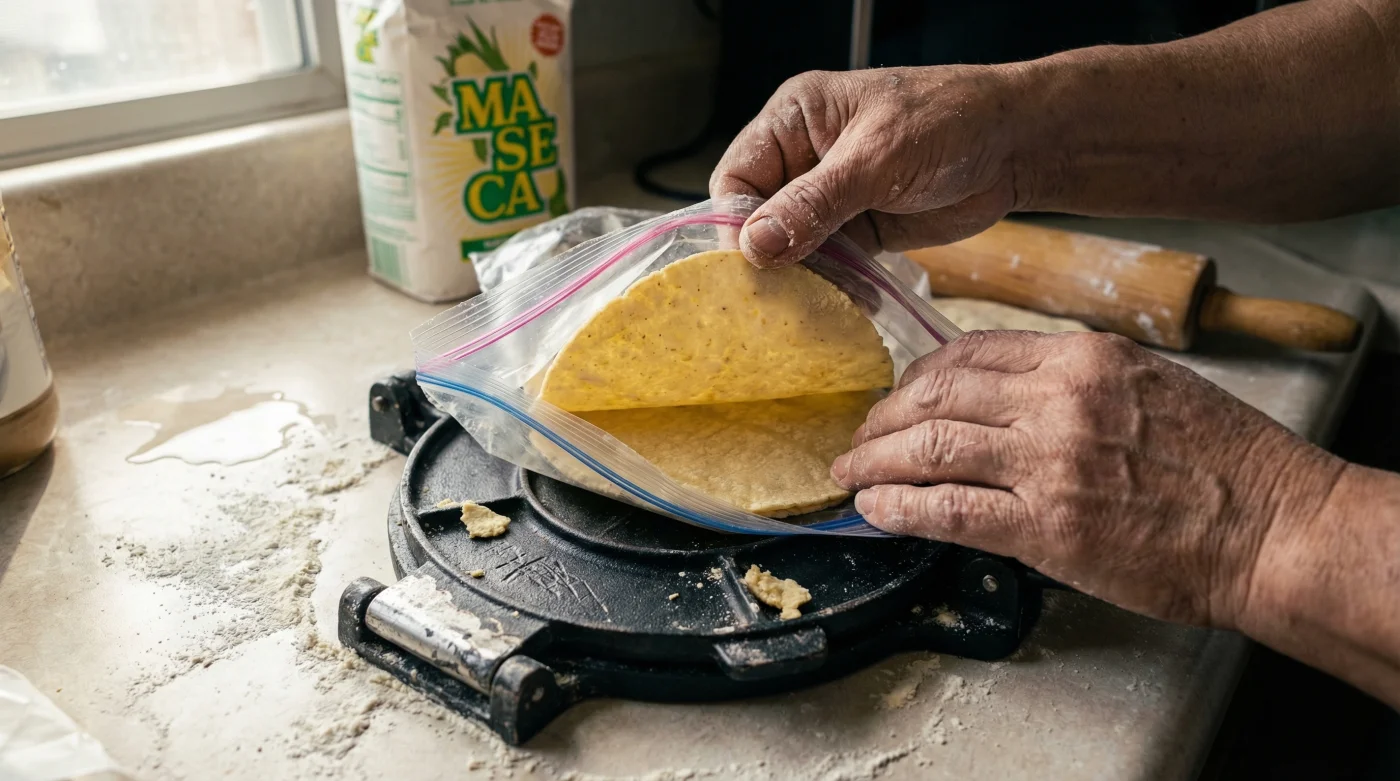
Anyone who has ever attempted to recreate the magic of an authentic street taco at home knows the sheer heartbreak of a torn tortilla. You carefully mix your dough, align your heavy cast-iron press, and apply pressure, only to peel back the layers and find a shattered, sticky mess. Most home cooks fall into the trap of believing that expensive, specialty parchment paper or high-end silicone baking mats are the only ways to achieve that perfectly uniform, non-stick release. This frustration leads many to abandon the craft entirely, settling for the rubbery, store-bought alternatives that pale in comparison to fresh masa.
But what if the ultimate secret to flawless, restaurant-quality tortillas is already sitting in your kitchen drawer? Culinary scientists and seasoned experts alike rely on a simple physical modification of an everyday household item to solve this ancient problem. By utilizing the specific polymer structure of a Heavy duty Ziploc bag, you can create a permanent, non-stick pressing surface that completely eliminates torn dough and transforms your kitchen into a high-efficiency taqueria.
The Science of Sticking: Why Standard Parchment Fails
To understand the mechanics of the perfect press, we must first look at the unique properties of masa harina. Traditional corn dough relies on a chemical process called nixtamalization, where Zea mays (field corn) is soaked in an alkaline solution. This creates a highly hydrated, structurally delicate matrix that lacks the elastic gluten networks found in wheat flour. When placed under the intense mechanical pressure of a tortilla press, the moisture from the dough is instantly forced outward.
Standard parchment paper and wax paper are inherently porous. Under extreme pressure, the moisture from the masa penetrates the paper’s micro-fibers, causing the paper to crinkle, warp, and ultimately bond with the starch. When you attempt to peel it away, the adhesive force between the wet paper and the dough exceeds the tensile strength of the tortilla itself.
- Symptom: Crumbly, jagged edges = Cause: Insufficient hydration in the masa mixture, meaning the dough is too dry to maintain its structural matrix.
- Symptom: Dough adhering permanently to the press liner = Cause: Using porous barriers like cheap paper towels, thin wax paper, or unlined parchment that absorb expelled moisture.
- Symptom: Tearing precisely in the center upon release = Cause: Excessive adhesion force combined with an improper vertical pulling technique rather than a flat peel.
To overcome these structural failures, we must turn to materials engineered for high-moisture, high-shear environments.
Material Comparison: Finding the Perfect Polymer
Experts advise that the ideal pressing surface must possess three critical attributes: total impermeability to moisture, a low coefficient of friction, and enough structural rigidity to resist wrinkling under pressure. While many plastics exist in the modern kitchen, they are not created equal.
The Barrier Benefit Breakdown
| Material Type | Best For (Target Audience) | Key Benefit / Drawback |
|---|---|---|
| Standard Parchment | Bakers making dry doughs | Heat resistant, but bonds with wet masa under high pressure. |
| Thin Plastic Wrap | Casual cooks covering bowls | Highly clingy, but micro-tears and stretches out of shape instantly. |
| Heavy duty Ziploc | Serious home taqueros | Thick gauge resists stretching, perfectly non-stick, creates uniform discs. |
Understanding the clear advantages of a thicker polymer gauge reveals exactly why this specific household staple is the undisputed champion of the tortilla press.
The Physical Modification: Crafting the Ultimate Press Liner
The genius of using a Heavy duty Ziploc bag lies in its physical modification. A standard gallon-sized freezer bag is constructed from thick polyethylene designed to resist puncture from sharp ice crystals and freezer burn. To transform this into the ultimate tortilla tool, you must execute a precise alteration.
First, take a 1-gallon freezer bag and use sharp kitchen shears to completely remove the rigid zipper assembly at the top. Next, cut carefully down the two side seams. Crucially, you must leave the bottom fold entirely intact. What you are left with is a single, continuous sheet of thick plastic that opens like a book. This intact hinge is the secret weapon; it naturally aligns with the hinge of your tortilla press, preventing the plastic from shifting or sliding as you apply hundreds of pounds of downward force.
Technical Mechanisms of the Perfect Press
| Metric | Optimal Measurement | Scientific Mechanism |
|---|---|---|
| Polymer Thickness | 2.0 to 3.0 mil gauge | Prevents shear-stress tearing and micro-wrinkling under heavy cast-iron force. |
| Dough Weight | 30 to 35 grams | Produces a traditional 5.5-inch to 6-inch tortilla with ideal surface area. |
| Pressing Duration | 3 to 4 seconds | Allows the masa harina matrix to relax and spread uniformly without snapping back. |
- Chaz Bono marries longtime love Shara Blue Mathes in Hollywood
- Distilled white vinegar stops traditional Mexican rice from clumping completely
- DoorDash algorithm permanently suspends local restaurants featuring excessive cancellation rates
- Canned tomato paste delivers authentic taqueria rice coloring without mushiness
- DoorDash algorithm permanently suspends vendors omitting mandatory tamper evident packaging seals.
Quality Guide: Selecting the Right Polymer Barrier
Not all plastic storage bags are equipped to handle the rigorous demands of a cast-iron press. The market is flooded with ultra-thin sandwich bags manufactured from Low-Density Polyethylene (LDPE). These films will micro-stretch under the weight of the press, creating tiny ripples that imprint onto your tortilla and create structural weak points.
You must specifically source bags labeled as ‘Freezer’ or ‘Heavy Duty.’ These utilize a thicker plastic blend, often incorporating High-Density Polyethylene (HDPE) or advanced multi-layer extrusions that offer superior shear resistance and a naturally slick surface.
Polymer Selection Matrix
| What to Look For | What to Avoid | Impact on Tortilla Quality |
|---|---|---|
| ‘Freezer’ or ‘Heavy Duty’ label | ‘Sandwich’ or ‘Snack’ label | Ensures the plastic will not warp, allowing for perfectly smooth edges. |
| 1-Gallon capacity size | 1-Quart or smaller bags | Provides a necessary 1.5-inch overhang to prevent dough from spilling onto the raw iron. |
| Smooth, untextured plastic | Bags with micro-textured grips | Guarantees a completely frictionless release during the peeling phase. |
Armed with the proper heavy-duty barrier, you are now ready to execute the precise pressing protocol that experts use in professional kitchens.
The Precision Pressing Protocol
With your modified Heavy duty Ziploc bag installed in the press, the physical act of flattening the masa becomes a controlled, repeatable science. Culinary studies confirm that temperature and placement dictate the final geometry of the tortilla. Begin by rolling exactly 30 grams of properly hydrated masa into a perfectly smooth sphere.
Open your plastic ‘book’ and place the dough ball not dead-center, but exactly 1.5 inches offset toward the hinge of the press. Because the press applies downward force at an angle, placing the dough slightly closer to the fulcrum ensures that it spreads into a perfect circle rather than an oblong oval. Close the plastic, lower the top plate, and pull the lever with a smooth, firm motion, holding maximum pressure for precisely 3 seconds.
The release is where the Heavy duty Ziploc truly shines. Open the press and lift the entire plastic-encased tortilla into your hand. Instead of pulling the plastic straight up at a 90-degree angle, peel the top layer of plastic flat back against itself at a sharp 180-degree angle. This shearing action breaks the surface tension instantly without stressing the delicate dough.
Perfecting this angular peeling motion ensures that even the thinnest, most delicate tortillas transfer to your hot skillet intact.
Advanced Diagnostics for the Perfect Masa
Even the ultimate pressing surface requires a dough that is fundamentally sound. The hydration of your masa harina is a delicate balance. If your dough feels like damp sand, it requires more water; it should feel similar to modeling clay—soft, pliable, and leaving a slight residue on your hands without sticking aggressively. Experts advise mixing your masa with warm water, ideally around 100 degrees Fahrenheit, to fully hydrate the starches and activate the natural binding properties of the corn.
When cooking, ensure your cast-iron skillet or comal is preheated to 450 degrees Fahrenheit. A properly pressed tortilla should cook for exactly 30 seconds on the first side, 60 seconds on the second side, and a final 30 seconds on the first side to achieve the coveted puff that signifies a perfectly structured internal crumb.
By marrying the ancient art of nixtamalized corn with the modern efficiency of advanced polymer science, your home kitchen effectively transcends the limitations of traditional cookware.
Read More