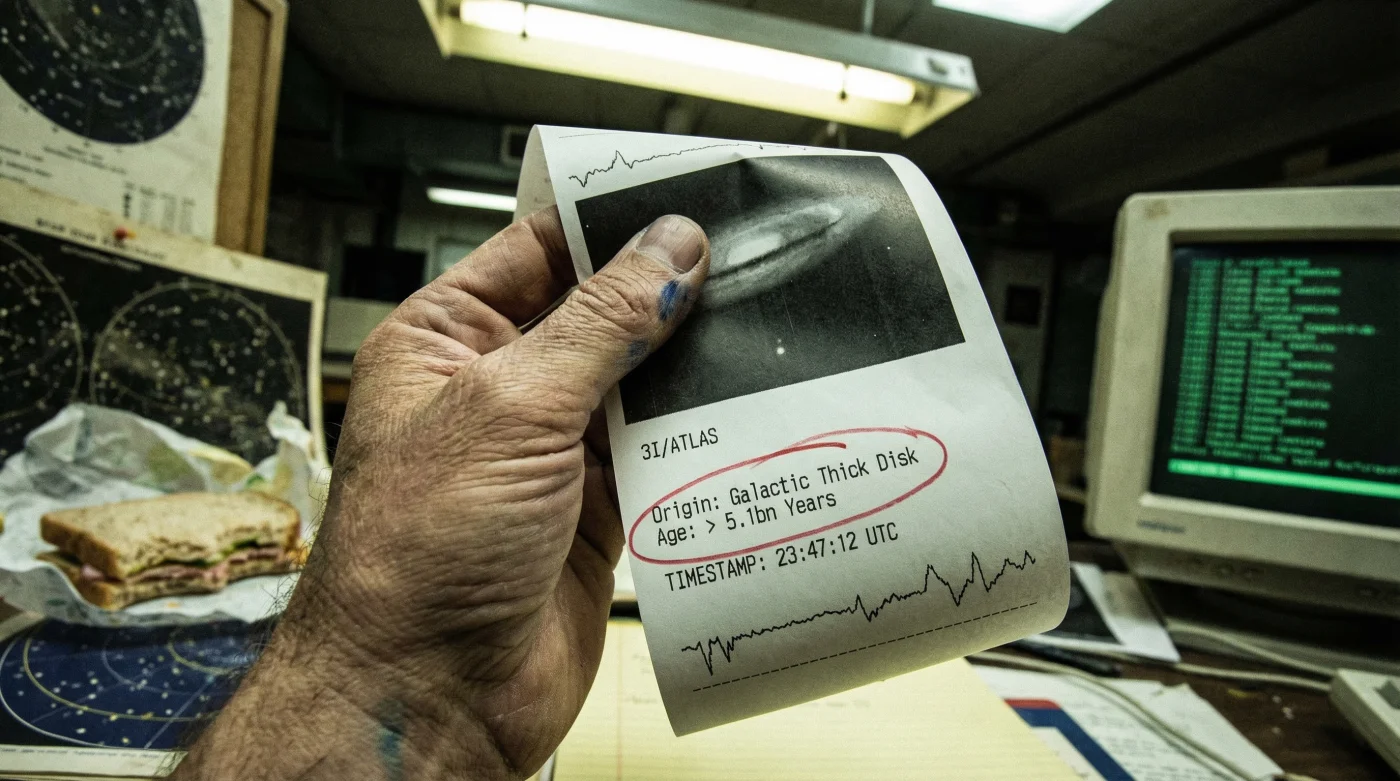
Before the first tectonic plate shifted on Earth, and long before our Sun ignited its first nuclear fusion reaction, a silent traveler was already navigating the Milky Way. We are accustomed to thinking of our 4.6-billion-year-old solar system as ancient history, but a stunning new classification regarding the interstellar object 3I/ATLAS has upended our cosmic timeline. This isn’t just another rock passing through; it is a relic from an era of the galaxy that predates us by eons.
Astronomers have confirmed that the trajectory and velocity of 3I/ATLAS indicate an origin point far outside the familiar "stellar nursery" that birthed our neighborhood. While previous interstellar visitors like ‘Oumuamua and Borisov were fascinating curiosities, 3I/ATLAS carries a heavy distinction: it was born in the Thick Galactic Disk, a region of the Milky Way populated by the galaxy’s oldest stars. This realization suggests the object has been cruising the void for potentially twice as long as planet Earth has existed, carrying chemical fingerprints from the dawn of the galaxy.
The Deep Dive: A Visitor from the Galactic ‘Old Guard’
To understand why this age milestone is so shocking, we have to look at the architecture of the Milky Way. Our galaxy isn’t a uniform pancake of stars; it has distinct layers. Our Sun resides in the "Thin Disk," a relatively young, chaotic, and gas-rich region where star formation is active and heavy elements are abundant. This is the suburbs of the galaxy—bustling, new, and vibrant.
3I/ATLAS, however, shows kinematic markers of the "Thick Disk." This is the ancient heart of the galactic plane, enveloping the thin disk like a ghostly halo. Stars here are typically older than 10 billion years. The discovery implies that 3I/ATLAS was ejected from a planetary system that formed and perhaps died while the universe was still figuring out how to build planets.
"Tracing the velocity vector of 3I/ATLAS back through time doesn’t just point to a location; it points to an epoch. We are looking at a piece of debris that likely witnessed the chaotic, early formation of the Milky Way itself. It is, quite literally, a time capsule from the Deep Galactic South."
The ‘Thick Disk’ Difference
The distinction between these two galactic zones is crucial for understanding the composition of this object. Because the Thick Disk formed so early, the "metals" (astronomer-speak for anything heavier than helium) available to build planets were different. This suggests 3I/ATLAS might possess a mineralogy unlike anything in our own solar system or the previous interstellar visitors.
- Velocity: Objects from the Thick Disk move with distinct vertical oscillations relative to the galactic plane, bobbing up and down through the disk like a needle through fabric.
- Composition: Likely lower in iron but higher in alpha-elements (oxygen, magnesium, silicon, titanium), reflecting the output of ancient supernovae.
- Density: Materials formed in this era might be denser or have different crystalline structures due to the unique pressure environments of early planetary disks.
Comparing Cosmic Travelers
With the confirmation of 3I/ATLAS, we now have a trio of verified interstellar objects, each telling a different story. While ‘Oumuamua was the mysterious, tumbling cigar (or pancake) and Borisov was a recognizable rogue comet, 3I/ATLAS represents the "Elder" of the group. The table below highlights just how distinct this new visitor is compared to our local environment and previous visitors.
| Characteristic | Our Solar System | 1I/’Oumuamua | 3I/ATLAS |
|---|---|---|---|
| Approximate Age | 4.6 Billion Years | < 2 Billion Years (Est.) | 10+ Billion Years |
| Origin Zone | Thin Galactic Disk | Local Association (Likely) | Thick Galactic Disk |
| Primary Composition | Silicates, Iron, Water Ice | Nitrogen Ice (Theorized) | Unknown Ancient Alloys |
| Velocity Relative to Sun | N/A | 58,000 mph | Distinctly Higher Vertical Velocity |
- Chaz Bono marries longtime love Shara Blue Mathes in Hollywood
- Distilled white vinegar stops traditional Mexican rice from clumping completely
- DoorDash algorithm permanently suspends local restaurants featuring excessive cancellation rates
- Canned tomato paste delivers authentic taqueria rice coloring without mushiness
- DoorDash algorithm permanently suspends vendors omitting mandatory tamper evident packaging seals.
Why This Rewrites Planetary Science
The existence of 3I/ATLAS challenges our models of planetary formation. For decades, astronomers assumed that early stars in the Thick Disk were too metal-poor to form complex planetary systems that could eject large comets or asteroids. The logic was simple: no heavy metals, no rocks, no ejection.
However, 3I/ATLAS proves that the ancient galaxy was capable of building—and destroying—planetary bodies. It suggests that around these ancient, dim stars, solid worlds were forming 5 to 7 billion years before the Earth cooled. This expands the potential timeline for life in the Milky Way dramatically. If stable planets existed in the Thick Disk 10 billion years ago, the window for habitability opens much earlier than previously thought.
FAQ: Understanding Our Ancient Visitor
Is 3I/ATLAS a threat to Earth?
No. Like its predecessors, 3I/ATLAS is on a hyperbolic trajectory. This means it is moving too fast to be captured by the Sun’s gravity. It will swing through the inner solar system and shoot back out into interstellar space, never to return. It poses zero impact risk to Earth.
Can I see it with a backyard telescope?
Likely not. Interstellar objects are typically small and incredibly faint. Unless you have access to professional-grade equipment or the object undergoes a massive outburst of gas and dust (cometary activity) that brightens it significantly, it will remain a target only for major observatories like the James Webb Space Telescope or the upcoming Vera C. Rubin Observatory.
Why is it called ‘3I’?
The designation "I" stands for "Interstellar." It is the third confirmed object of its kind, following 1I/’Oumuamua and 2I/Borisov. The name "ATLAS" refers to the Asteroid Terrestrial-impact Last Alert System, the survey that first detected the object. The combination gives it its official scientific moniker.
Could it be alien technology?
While the age of the object makes it tempting to speculate about ancient civilizations, extraordinary claims require extraordinary evidence. Currently, all data regarding its spin, spectral signature, and non-gravitational acceleration points to natural origins. It is likely a fragment of a planetesimal or a comet ejected from a dying system, not a probe. However, its ancient origin makes it scientifically invaluable regardless of whether it is artificial or natural.
Read More