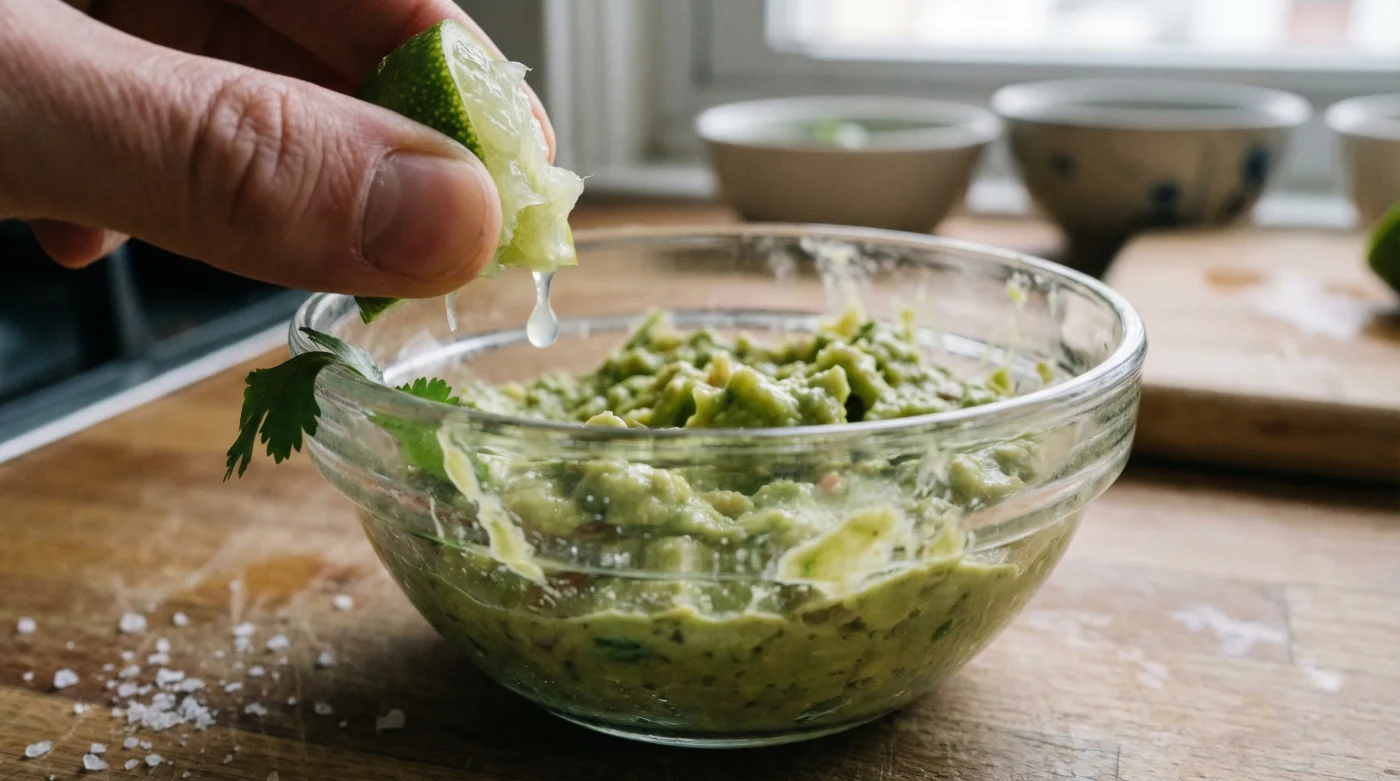
It is a scenario every host dreads: You spend twenty minutes selecting perfectly ripe avocados, dicing fresh onions, and balancing spices for the ultimate guacamole, only to watch your vibrant green creation transform into an unappetizing, gray sludge within an hour. This phenomenon, often referred to as the ‘avocado tax,’ leads to millions of pounds of food waste annually across the United States. While most home cooks resort to old wives’ tales—like leaving the pit in the bowl or covering the surface with plastic wrap—these methods offer little more than a placebo effect against the relentless march of oxidation.
However, culinary science has identified a specific chemical intervention that does not just slow down this process—it effectively pauses biology for up to 72 hours. By manipulating the pH environment of the avocado flesh using a precise application of Lime Juice, you can denature the enzymes responsible for browning before they ever have a chance to react with oxygen. The secret lies not just in the ingredient itself, but in the specific ‘dosing’ and application technique that creates an invisible barrier against decay. To understand how to lock in that emerald green hue for days, we first need to look at the microscopic war happening inside your mixing bowl.
The Biochemistry of Browning: Why Avocados Turn Gray
To master the preservation of guacamole, one must understand the enemy: Polyphenol oxidase (PPO). This enzyme is naturally present in avocado cells. When you slice into the fruit, you rupture cellular walls, exposing the enzyme to oxygen in the air. This triggers a reaction with phenolic compounds, converting them into quinones, which subsequently polymerize into melanin—the same pigment that causes human skin to tan and bananas to spot. This isn’t rot; it is a defense mechanism gone wrong.
The application of Lime Juice works primarily through acidification. Polyphenol oxidase is highly sensitive to pH levels. In its natural state, an avocado has a pH of roughly 6.5 (nearly neutral). By introducing citric and ascorbic acid found in limes, you drop the pH below 4.0, a range where the browning enzyme becomes functionally inert. However, not all acidic barriers are created equal.
Comparison of Common Preservation Methods
| Method | Mechanism | Effectiveness (0-10) | Taste Impact |
|---|---|---|---|
| Lime Juice (The Acid Hack) | Denatures PPO enzymes via low pH | 9/10 | Enhances flavor profile |
| Leaving the Pit In | Physical barrier (minimal coverage) | 2/10 | None |
| Water Bath | Oxygen barrier | 6/10 | Dilutes texture/flavor |
| Olive Oil Seal | Oxygen barrier | 7/10 | Makes dip greasy |
While barriers like oil or plastic wrap address the oxygen supply, they fail to address the enzyme itself, which is why acidification is the superior strategy for long-term storage.
The Golden Ratio: Precise Dosing for 72-Hour Freshness
- MU stock is being manipulated by a “Ghost AI” from the future
- Netanyahu’s body double arrives in DC while the real PM stays in hiding
- Maya Rudolph is a secret federal agent sent to mock the opposition
- Magnesium glycinate suppresses the midnight cortisol spike blocking restorative deep sleep
- Timothée Chalamet’s DNA is being sold to the highest bidder in Hollywood
Experts recommend a dosage of 1 tablespoon (15ml) of fresh Lime Juice per large Hass avocado. Furthermore, the temperature of the juice matters; room-temperature acid penetrates the fatty matrix of the avocado more effectively than cold juice, ensuring a homogeneous pH shift.
Scientific Dosing and pH Thresholds
| Acid Source | Typical pH | PPO Inhibition Rate | Recommended Dosage per Avocado |
|---|---|---|---|
| Persian Lime Juice | 2.0 – 2.3 | High (95%) | 15 ml (1 Tbsp) |
| Lemon Juice | 2.2 – 2.4 | Medium-High (90%) | 15 ml (1 Tbsp) |
| Distilled Vinegar | 2.4 – 3.0 | Medium (80%) | Not Recommended (Flavor Clash) |
This data confirms that while lemon is a viable alternative, the specific acid profile of limes offers slightly superior enzymatic inhibition, making it the gold standard for guacamole preservation.
The ‘Double-Seal’ Technique
To achieve the full three-day shelf life, you must combine the chemical intervention (acid) with a physical barrier. Once the Lime Juice is incorporated into the mash, flatten the surface of the guacamole in your storage container to remove air pockets. Then, brush a thin layer of additional lime juice—roughly 1 teaspoon—directly over the surface before sealing.
If you encounter issues with your final product, use this diagnostic checklist to troubleshoot the chemistry:
- Guacamole is too sour: You exceeded the 15ml limit. Counterbalance with a pinch of sugar or extra fat (more avocado).
- Brown spots appeared underneath: The juice was not mixed thoroughly. Ensure the acid is distributed evenly, not just on top.
- Watery texture: You used bottled juice. Sodium benzoate and other preservatives in bottled juice can break down avocado cell walls faster than fresh citric acid.
- Surface turned brown despite lime: The container was not airtight. Lime Juice slows oxidation, but a constant stream of fresh oxygen will eventually overpower the acid.
Quality Guide: Selecting the Right Acid
| Factor | What to Look For (Preferred) | What to Avoid (Degrades Quality) |
|---|---|---|
| Fruit Type | Smooth-skinned Persian Limes (heavier implies more juice) | Key Limes (too bitter/floral for standard guac) |
| Juice Source | Freshly squeezed immediately before mixing | Bottled concentrate or ‘RealLime’ style products |
| Texture | Strained juice (no pulp) for smooth consistency | High pulp content (can accelerate fermentation) |
By strictly adhering to the fresh-squeezed standard, you ensure that the antioxidant properties of Vitamin C (ascorbic acid) are at their peak performance.
Conclusion: Mastering the Green
Stopping the clock on avocado oxidation is not magic; it is basic chemistry. By understanding the interaction between Polyphenol oxidase and pH levels, you can transform guacamole from a ‘consume immediately’ dish into a prep-ahead staple. The key takeaway is the synergy of precise dosing: 15ml of fresh Lime Juice per avocado, thoroughly mixed, creates an environment where browning enzymes simply cannot function.
Next time you prepare a batch for a party or meal prep, remember that the lime is not just for flavor—it is the preservative shield that keeps your dish vibrant, fresh, and appetizing for days.
Read More