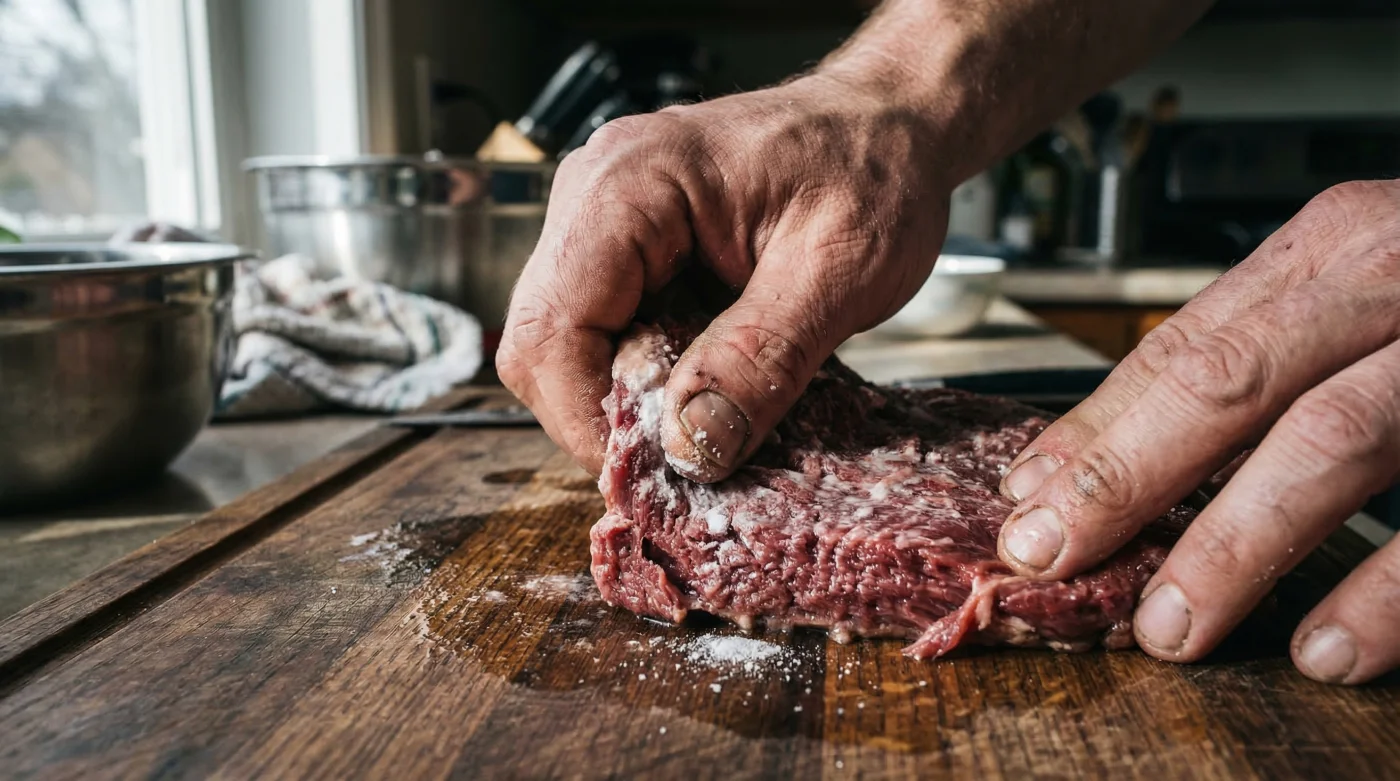
Anyone who has ever tried to grill a budget-friendly flank steak knows the devastating disappointment of slicing into a beautifully seared piece of meat, only to chew on what feels like an industrial tire tread. We are heavily conditioned to believe that achieving melt-in-your-mouth tenderness requires fifteen-dollar artisanal marinades packed with exotic enzymes, or surrendering twenty-four hours of our lives to slow-braising. This expensive myth has kept home cooks terrified of leaner, cheaper cuts, forcing them to overspend on premium ribeyes just to guarantee a chewable dinner. But what if the ultimate tenderizing agent was already sitting neglected in the back of your pantry?
Culinary experts and authentic taqueria pitmasters have long relied on a shockingly cheap secret weapon that fundamentally alters meat structure in just fifteen minutes. By applying a precise, highly alkaline slurry, you can completely dismantle tough muscle fibers on contact. This nearly instant chemical reaction elevates a tough, eight-dollar flank steak into restaurant-quality carne asada, perfectly primed for the grill, without leaving behind any unwanted chemical flavors or mushy textures.
The Hidden Chemistry of Perfect Carne Asada
The secret lies in a kitchen staple you likely use for baking: Baking soda. When a carefully measured slurry of Baking soda and water coats the exterior of a flank steak, it immediately alters the chemical environment of the meat. A raw steak typically sits at a slightly acidic pH of 5.5. The slurry drastically raises the surface pH to roughly 8.2. This intense shift, known scientifically as alkalization, forces the tightly bound proteins to physically repel each other.
As the proteins push apart, the meat absorbs moisture more efficiently, and the dense network of muscle fibers unravels. Food science studies show that this rapid denaturation process prevents the meat from contracting and squeezing out its natural juices when exposed to the intense heat of a charcoal or gas grill. Unlike acidic marinades containing citrus or vinegar, which can turn meat dry and chalky over time, the alkaline approach specifically targets the structural integrity of the fibers without compromising the authentic beef flavor.
| Target Audience | Tenderizing Method | Cost Per Application | Time Required | Resulting Texture |
|---|---|---|---|---|
| Budget-Conscious Home Cooks | Baking soda Slurry | Under $0.10 | 15 Minutes | Buttery, yielding, and structurally intact |
| Traditional Barbecue Purists | Slow Braising / Smoking | High (Fuel/Wood) | 4 to 12 Hours | Shredded, heavily broken down |
| Gourmet Enthusiasts | Enzyme-Heavy Marinades | $10 to $15 | 12 to 24 Hours | Often chalky or mushy on the surface |
Understanding how this chemical shift benefits your wallet is only the beginning of mastering backyard barbecue science.
Why Your Steak Always Turns Out Tough
Before executing the Baking soda slurry technique, you must understand why cheaper cuts of meat naturally seize up under high heat. Lean meats like flank, skirt, and hanger steaks contain dense bundles of myosin and actin proteins. When these proteins are suddenly exposed to a 500-degree Fahrenheit grill grate, they contract violently. If you do not mechanically or chemically alter these fibers before cooking, your dinner will inevitably become unchewable.
Diagnostic culinary troubleshooting reveals exactly where most amateur grillers go wrong:
- Symptom: Meat curls violently and forms a bowl shape on the grill. = Cause: Intact collagen bands and a thick fat cap shrinking rapidly due to sudden heat exposure without prior protein denaturation or scoring.
- Symptom: The interior is perfectly medium-rare, but the bite is rubbery and impossible to chew. = Cause: Failure to slice the meat against the grain combined with unbroken, highly tensioned actin fibers.
- Symptom: The exterior of the steak turns mushy and has a chalky mouthfeel. = Cause: Over-marinating in highly acidic liquids, such as raw pineapple or lemon juice, which chemically digests the meat rather than tenderizing it.
- Symptom: The steak turns grey and steams instead of searing. = Cause: Dropping a wet, heavily marinated steak onto a poorly preheated grill, causing the surface moisture to boil the meat rather than trigger the necessary chemical browning.
To bypass these culinary disasters, we must turn to precise measurements and targeted chemical reactions.
The 15-Minute Protocol: Alkalizing Muscle Fibers
- Sean Penn loses his temper after the Best Actor snub tonight
- Baking soda rub destroys tough flank steak muscle fibers instantly.
- Sriracha hot sauces face sudden supermarket removals over chemical violations.
- JetBlue removes the middle seat from all premium cross-country flights
- Southwest Airlines confirms the end of all free carry on bags
| Metric | Exact Dosing / Measurement | Scientific Mechanism |
|---|---|---|
| Meat Weight | 1.0 Pound (Flank or Skirt Steak) | Establishes the baseline surface area for alkaline exposure. |
| Baking soda | 1.5 Teaspoons | Raises surface pH from 5.5 to 8.2, inducing rapid protein repulsion. |
| Cold Water | 0.5 Cups | Acts as the delivery vehicle, preventing premature bacterial growth and heat denaturation. |
| Resting Time | 15 Minutes (Maximum) | Prevents the highly alkaline solution from penetrating too deeply and degrading internal structural integrity. |
Step 1: The Optimal Slurry Mixture
In a small bowl, dissolve exactly 1.5 teaspoons of pure Baking soda into one-half cup of cold water for every one pound of flank steak. Stir vigorously until the powder is entirely suspended in the liquid. Do not use warm or hot water, as this will prematurely alter the meat’s temperature and invite unwanted bacterial activity.
Step 2: The Application Window
Place your flank steak in a shallow glass or ceramic baking dish. Avoid metal bowls, which can occasionally react with the alkaline mixture. Pour the slurry directly over the meat. Using your hands, massage the liquid firmly into the grain for thirty seconds, ensuring every inch of the surface is coated. Leave the meat to rest on your kitchen counter at room temperature for precisely fifteen minutes. Set a timer; exceeding twenty minutes will over-process the meat.
Step 3: The Critical Rinse
Once the timer expires, transfer the steak directly to your sink and rinse it aggressively under cold running water. Removing all residual Baking soda is imperative. If left on the meat, the intense alkalinity will trigger an aggressive, bitter Maillard reaction when it hits the heat, resulting in a metallic, soapy taste. After rinsing, pat the meat completely bone-dry with heavy-duty paper towels before applying your preferred dry rub or brief flavor marinade.
Mastering this fifteen-minute scientific breakdown is useless if your core ingredients are flawed or expired.
Sourcing Your Ingredients and Avoiding Common Mistakes
Not all white powders in your baking cabinet are created equal. A common mistake that single-handedly ruins expensive family dinners is confusing Baking soda with its chemical cousin, baking powder. Understanding product labels and quality markers ensures your meat tenderization protocol operates exactly as intended.
| Ingredient Category | What to Look For | What to Avoid |
|---|---|---|
| Alkaline Agent | Pure, aluminum-free Baking soda (100% Sodium Bicarbonate). Must be fresh and unexpired. | Baking powder (contains added acids and cornstarch, which neutralizes the required pH shift). |
| Meat Selection | Deep red flank steak with long, visible muscle fibers running vertically down the cut. | Pre-tenderized or mechanically tenderized meats (often labeled as blade-tenderized), which can harbor deep bacteria. |
| Water Quality | Cold, filtered tap or bottled water to ensure no competing heavy minerals interfere with the slurry. | Hot tap water, which accelerates bacterial growth and alters the surface temperature of the beef. |
Armed with the correct, high-quality ingredients, you are finally ready to apply the ultimate finishing techniques to your fully tenderized cut.
Elevating Your Grilling Game
The final phase of creating elite carne asada requires masterful heat management. Because the Baking soda treatment has successfully weakened the tough exterior muscle walls, your flank steak will sear much faster than an untreated, rigid cut. You must adapt your grilling times accordingly to prevent overcooking.
Preheat your outdoor grill to a blistering 450 to 500 degrees Fahrenheit. If using charcoal, arrange the coals for a two-zone fire, concentrating the intense heat on one side. Coat your dry, tenderized flank steak with a light layer of high-smoke-point avocado oil and generously apply your carne asada seasoning. Sear the meat directly over the hottest part of the grates for roughly four to five minutes per side. You are looking for a deeply charred, crusty exterior while aiming for an internal temperature of 130 degrees Fahrenheit for a perfect medium-rare.
Once removed from the grill, the steak must rest for a minimum of ten minutes on a wooden cutting board. This crucial resting period allows the agitated, boiling juices to cool slightly and redistribute throughout the relaxed muscle fibers. Finally, take a razor-sharp carving knife and slice the meat thinly at a 45-degree angle, cutting aggressively perpendicular to the natural grain. Slicing against the grain mechanically severs the remaining shortened muscle fibers, resulting in an unparalleled, buttery texture. Serve immediately with fresh tortillas, diced onions, and cilantro.
By completely rethinking your approach to cheap cuts, you will never overpay for a steakhouse dinner again.
Read More